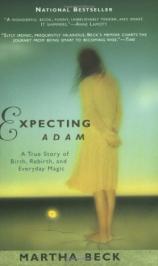
Expecting Adam
by Martha Beck
List Price: $13.95
Pages: 336
Format: Paperback
ISBN: 0425174484
Publisher: Berkley Publishing Group
"He says you'll never be hurt as much by being open as you have been by
remaining closed."
The messenger is a school janitor
with a master's in art history who claims to be channeling "from both
sides of the veil." "He" is Adam, a three-year-old who has never spoken
an intelligible word. And the message is intended for Martha Beck, Adam's
mother, who doesn't know whether to make a mad dash for the door to escape
a raving lunatic (after all, how many conversations like this one can
you have before you stop getting dinner party invitations and start pushing
a mop yourself?) or accept another in a series of life lessons from an
impeccable but mysterious source.
From the moment Martha and
her husband, John, accidentally conceived their second child, all hell
broke loose. They were a couple obsessed with success. After years of
matching IQs and test scores with less driven peers, they had two Harvard
degrees apiece and were gunning for more. They'd plotted out a future
in the most vaunted ivory tower of academe. But the dream had begun to
disintegrate. Then, when their unborn son, Adam, was diagnosed with Down
syndrome, doctors, advisers, and friends in the Harvard community warned
them that if they decided to keep the baby, they would lose all hope of
achieving their carefully crafted goals. Fortunately, that's exactly what
happened.
Expecting Adam is a
poignant, challenging, and achingly funny chronicle of the extraordinary
nine months of Martha's pregnancy. By the time Adam was born, Martha and
John were propelled into a world in which they were forced to redefine
everything of value to them, put all their faith in miracles, and trust
that they could fly without a net. And it worked.
Martha's riveting, beautifully
written memoir captures the abject terror and exhilarating freedom of
facing impending parentdom, being forced to question one's deepest beliefs,
and rewriting life's rules. It is an unforgettable celebration of the
everyday magic that connects human souls to each other
top of the page

1. At the beginning of Expecting Adam (p. 7), the author reveals that she wrote the book twice previously as a novel. Why do you think she began her work as fiction? Does this seem unusual or surprising? How did the switch to the nonfiction genre of memoir change her and her story? What were the risks involved?
2. How does the author employ aspects of Asian culture to enrich her story? Why do you think she looks beyond traditional Western experience to explain that of her own family? What is the significance of the Bunraku puppeteers in her story (see pp. 12, 16-17, 23, 26, and 41 for example), and why does this metaphor work so well to explain her extraordinary experiences?
3. The author writes that, through Adam, she and her husband John become 'infants in a world where magic is commonplace, Harvard professors are the slow learners, and retarded babies are the master teachers? (p. 7). Does she feel relief, terror, or both in the process of having her world turned upside down? Why? Why does our system of education seem to reward the closing of minds rather than their opening? Why do you think Martha and John find the culture of Harvard, arguably the apogee of the learned world, to be such a frightening and lonely place? Do you think they are the only ones who feel like impostors there? What does it say about this institution that Martha and John feel they have to tell lies, conceal themselves, and endure terrible loneliness in order to succeed there?
4. The author's life is now, she writes, full of magic and miracles. Why were Martha and John unable to experience the truly miraculous within the religions they practiced before Adam was born? How did the differences in their religious beliefs affect their personalities and their early marriage (pp. 169-170)? How does Adam lead them from their isolated positions, through the 'demilitarized zone' between them, to a genuine spiritual communion?
5. What does the author mean when she writes that 'mother' is a verb (p. 59)? Why does Martha have to allow herself to be mothered by Sibyl and Deirdre before she can understand the meaning of the noun? Why is it so difficult for Martha to accept their kindness at first?
6. What does the anecdote about Adam's handing the rose in the bud vase to his mother reveal about his essential nature (pp. 69-70)? How is the dream Martha has in University Health Services nearly four years earlier (pp. 64-66) connected to Adam's rose? What does Martha mean when she writes that Adam 'loved me despite my many disabilities' (p. 70)? Why do you think she chose to write about this experience near the beginning of the book, rather than placing it chronologically within the story?
7. Why do you think the author emphasizes that she does not intend to judge other parents for any of the decisions they make about the conception and birth of their children? How would a strongly 'pro-life' stance in the book have altered her work? How do her experiences and her 'new way of seeing' (p. 72) create such an open heart when considering the choices other people make?
8. How do Dr. Grendel's attitudes (pp. 215-220) reflect those of the scientific community in general? How can ignorance paradoxically coexist with extensive knowledge, even in our country's most prestigious medical practices? What, in your opinion, should love have to do with medicine? Do you think scientific researchers are on the right track concerning their efforts to eradicate chromosomal irregularities and genetic disease?
9. The author includes a quotation (p. 268) from Rumi, the Persian mystic, in her book: God's joy moves from unmarked box to unmarked box, From cell to cell. As rainwater, down into flowerbed. As roses, up from the ground. Now it looks like a plate of rice and fish, Now a cliff covered with vines, Now a horse being saddled. It hides within these, Till one day it cracks them open. What does this passage mean to the author? To you? In your opinion, are there angels at work in the world? Have you had experiences that, like those of Martha Beck, point to an extraordinary presence of goodness and grace among us? How do you explain them?
10. The author writes that, immediately after giving birth to Adam, 'I no longer felt like the focus of all that magic. I felt . . . normal. I felt exactly the way I wanted my son to be. It was a tremendous let-down' (p. 304). Are her emotions at this time what you would have expected? Why, or why not? How do these moments change forever the way the author values what is 'normal'? Has the story changed your feelings, as well?
11. The descriptions of Martha's and John's families, and anecdotes involving family members, are some of the funniest and most heartbreaking parts of the book. How does Adam's life gradually transform the worldviews of his grandparents, aunts, and uncles? How do their initial attitudes reflect those of society in general? Do you believe a similar transformation in attitudes toward those with chromosomal irregularities is possible in the culture at large?
top of the page