Reading Group Guide
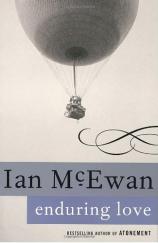
Enduring Love
by Ian McEwan

List Price: $12.95
Pages: 262
Format: Paperback
ISBN: 0385494149
Publisher: Anchor

Click here to buy this book from Amazon.com.
Click here to buy this book from Amazon.ca.


About This Book


On a windy spring day in the Chilterns, the calm, organized life of science writer Joe Rose is shattered when he witnesses a tragic accident: a hot-air balloon with a boy trapped in its basket is being tossed by the wind, and in the attempt to save the child, a man is killed. A stranger named Jed Parry joins Rose in helping to bring the balloon to safety. But unknown to Rose, something passes between Parry and himself on that day--something that gives birth to an obsession in Parry so powerful that it will test the limits of Rose's beloved rationalism, threaten the love of his wife, Clarissa, and drive him to the brink of murder and madness. Brilliant and compassionate, this is a novel of love, faith, and suspense, and of how life can change in an instant.

top of the page


rgg_discuss.gif (1294 bytes)


1. Which is the enduring love the title refers to?

2. Look carefully at the first chapter and talk about the way in which it holds the promise of the whole novel.

3. The narrator says, "I'm lingering in the prior moment because it was a time when other outcomes were still possible" (page 2). Discuss this as a theme throughout the novel.

4. How does science infuse this story? Discuss the different theories described and explained and their importance to this novel.

5. The author writes of "...morality's ancient, irresolvable dilemma: us, or me" (page 15) in relation to the balloon accident. Does this apply to other situations in the novel as well?

6. Joe describes how Clarissa views the trend in science toward neo-Darwinism, evolutionary psychology, and genetics as "rationalism gone berserk," and adds that she thought "everything was being stripped down...and in the process some larger meaning was lost" (page 75). Discuss this as a theme in the novel.

7. Did you think at the beginning that Joe and Clarissa's relationship would reach the crisis point it did? Did you think that Joe and Clarissa's love would endure? At different points, what made you think so?

8. In chapter nine, the author switches from first-person to third-person point of view, where the reader is in Clarissa's head as imagined by Joe. Talk about this unusual choice. What does it add to your understanding of Joe? Of Clarissa?

9. Did you doubt Joe, as Clarissa and others did? Did the author want you to?

10. In responding to Jean Logan's theory of her husband's tryst, Joe says, "But you can't know this...it's so particular, so elaborate. It's just a hypothesis. You can't let yourself believe in it" (page 132). Discuss the irony of Joe's remembering, moments later, what he's read about de Clerambault's syndrome.

11. At the moment before Clarissa first tells him it's over between them, Joe thinks about love, about how it "generates its own reserves." About how "conflicts, like living organisms, had a natural lifespan" (page 155). Later he notes that "...sustained stress is corrosive of feeling. It's the great deadener" (page 231). In light of what happens in this novel, in what ways is Joe right or wrong about this?

12. In both Amsterdam and Enduring Love, characters at a police station have faulty memories of events. Talk about the role of unreliable perceptions in this novel.

13. "It's like in banks. You never say money. Or in funeral parlors, no one says dead" (page 205). Though this is not a comic novel, the author uses observational humor throughout. Talk about other examples of humor in the novel.

14. The novel ends with the children and the river. What is the author saying with this choice?

15. In the appendixes, we're reminded (with Jed's letter) that "it is not always easy to accept that one of our most valued experiences may merge into psychopathology" (page 259). Is this true in your experience?

16. Why did the author choose to let us know that Joe and Clarissa reconciled (and adopted a child) with a line in a case study in the appendix?

top of the page

Critical Praise

"A remarkable novel, haunting and original and written in prose that anyone who writes can only envy."
Washington Post


"Impeccably written--[McEwan] is the quietest and most lucid of stylists, with never a word wasted or fumbled."
New York Review of Books


"A timeless tale about the way fate and faith shape our relationships--part existential fable about the human desire to control fate, [Enduring Love] is also, most affectingly, a story about the strength and fragility of married love."
Glamour


"Eerie, slow-paced suspense worth its weight in caffeine for keeping you up all night."
Entertainment Weekly


"[A] beautifully realized--novel about our responses to violence. It asks us to choose between competing visions of events, and, in the process, forces us to examine the way we react to both art and life when something terrible happens."
Boston Globe


"McEwan's writing--is unflaggingly poised and, as usual, capable of excavating deep, painful trenches in the back corridors of the psyche and the heart."
Miami Herald


"Cleverly imagined, beautifully executed --Mr. McEwan has few peers."
The Wall Street Journal

 
Back to top.   


Privacy Policy | Contact Us | Advertising | About Us

© Copyright 2001-2008, ReadingGroupGuides.com. All rights reserved.