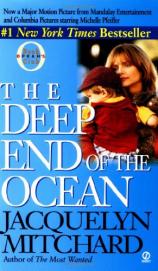
The Deep End of the Ocean
by Jacquelyn Mitchard
List Price: $7.99
Pages: 447
Format: Paperback
ISBN: 0451197747
Publisher: Signet
The Deep End of the Ocean is a story about every parent's worst nightmare: the loss of a child. It is a story that is all too familiar to many of us, made frighteningly routine by the young faces emblazoned on milk cartons or steeped in pathos by Hollywood scriptwriters. In Jacquelyn Mitchard's deft hands, however, the story of the Cappadora family is neither routine nor cliched. It is chillingly and beautifully real.
Photographer Beth Cappadora is far from the ideal mother and wife. She is harried, impatient, disorganized, and ambivalent about her husband and her kids‹faults that come back to haunt her after her middle child disappears in a crowded hotel lobby. The ensuing decade of unbelievable grief and pain, of Beth's attempt at recreating a life after her son disappears, is lovingly documented in this electrifying novel. Like photographs in a family album, scenes from Beth's life are offered in startling detail: the scoops of coffee she forces herself to measure out each day; snatches of conversation between a husband and wife doggedly trying to return to a normal life; the cynical observations of her oldest child as he struggles to be noticed and loved; the "purple elephants" that loom in every family's living room‹unspoken pain so huge one can only step around it, for to acknowledge it is too terrifying a prospect. And, like all good photographs, this one is not without many shades of gray. There are no easy heroes in this story, although heroism abounds. While the novel speeds along with the pace of a thriller, its drama reaches far beyond the story of Ben's disappearance. The mystery of what happened to Ben is only one of the mysteries that envelop this novel. In revealing what happens to the Cappadora family, Mitchard offers us no easy answers. Instead she raises difficult questions about the nature of grief and loss, about the value of families of all kinds, and about the gifts of love, redemption, and forgiveness.
It would be easy for a writer to grant a happy ending to the Cappadora family, who have been through so much and none of it their fault. And yet instead we are left with something much more real, the side of a tragedy you won't catch on the six o'clock news. The Deep End of the Ocean will make you catch your breath. It will make you thankful. It will make you think. It will make you feel.
top of the page

1. Beth and Pat deal with their grief over Ben in quite different ways: while Pat goes through the "normal stages," Beth is by turn stoic and hysterical; at times she feels as if her slightest move would cause an avalanche. What is this avalanche about? Do you think it is characteristic of men and women to deal with grief -- or the loss of a child -- differently?
2. Beth Cappadora in no way resembles an ideal mother, yet no one could question her love for her children. How does Beth express this love? Do you think she was a "sloppy" mother before Ben's disappearance? And after?
3. Beth points out that the divorce rate of grieving parents is eighty percent. Why is it so hard to sustain a marriage after losing a child? And why do you think Beth and Pat are able to stay together throughout their ordeal? Do you think their marriage will ultimately succeed?
4. Mitchard reveals Vincent to us in stages, allowing us to see him develop from a typical older brother to a troubled teenager. How effectively does she convey Vincent's complex feelings about the loss of Ben and about his parents? How does Ben's disappearance -- and Vincent's own role in the incident -- shape his personality as he grows older?
5. Both Vincent and Ben are known to the outside world by different names. What is the significance of these "aliases"? Why does Mitchard herself refer to Vincent as Reese in his named chapters? In your own mind, which names are the most appropriate for each boy?
6. In many instances Beth reacts angrily when her family expresses hope for Ben's return. Do you think it would have been easier on the family if they were to discover -- or have a real reason to believe -- that Ben had died? Why is the possibility of his being alive so painful to Beth? Do you fault her for being willing to believe that her son is dead?
7. Although it is difficult to imagine how any good could come out of the Cappadoras' tragedy and its aftermath, can you make an argument for what is often referred to as the "healing power of grief"? Has anyone in the family benefited from the experience of losing Ben? What kind of family would they have become had their lives not been torn apart?
8. Watching Sam (Ben) interact with her family, Beth thinks to herself that he is "not of this world." She realizes that George and Cecilia were loving, caring parents; perhaps in some ways better parents than she and Pat would have been. Do you think that Sam -- and the Cappadora family -- would have been better off if they had remained strangers? What parts of his personality as their birth child were preserved over the course of his years with George? How is he the Cappadoras' child, and how is he George's child?
9. The title, The Deep End of the Ocean, refers to Ben's first, timid reaction to a large body of water. Later in the novel, Beth reflects that Ben has indeed been to the ocean's deep end, and returned. What does the title mean to you? How have other members of the Cappadora family been to The Deep End of the Ocean?
10. Recurring throughout the novel is the image of a cedar chest -- as a coffin, as a storage for keepsakes, as a hiding place for Ben. What does the image of the chest evoke for you? Is it fearful or comforting? Claustrophobic or cozy? Why would a child be drawn to such an object?
11. Reunions play an important role throughout the story. What different kinds of reunions take place? Are these events generally pleasant or painful experiences for the characters involved?
12. After Ben's disappearance, Beth ceases to communicate with just about everybody, except Candy. Why do you think Beth turns to Candy instead of all the other people who love her and have tried to help her?
top of the page

"The Deep End of the Ocean burns itself into the memory line by line. It is by turns lyrical and startling, brilliant."
Kaye Gibbons
"A beautifully timed, wrenchingly told story of a family's worst nightmare... has the pace of a thriller with the emotional wallop of August and Endless Love."
The Boston Sunday Globe
"So well observed and perceptive it's hard to shy away from... masterfully paced... A story... of one family's slow tumble back into light."
Los Angeles Times
"Mitchard delivers a drama that has the tension of a thriller but moves more deeply into the emotional territory of family ties."
People
"A first-rate new storyteller."
Newsweek
"[A] rich, moving and altogether stunning first novel... Readers...will find this compelling and heartbreaking story -- sure to be compared with The Good Mother -- impossible to put down."
Publishers Weekly, starred boxed review
"Riveting.... Mitchard keeps her compassionate eye focused... [as she] examines love and loss, and what it means to be a family."
Glamour