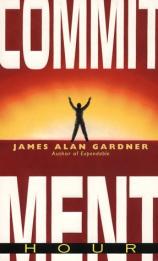
Commitment Hour
by James Alan Gardner
List Price: $5.99
Pages: none
Format: Paperback
ISBN: 0380798271
Publisher: HarperCollins
In the twenty-fifth century, Tober Cove is a wonderful place to be. With most of Earth's population long since departed for other planets, and with them the technology that makes such a journey possible, life here is simple and serene--especially for Fullin, a gifted musician whose talent commands many times the wages of a farmer or fisherman. But Fullin is twenty years old. And at that age, each person in Tober Cove must make the most important decision in life. Ominous winds of change swirl toward Fullin's idyllic existence, carrying dark secrets that will upend his beliefs, alter his view of reality and threaten his very life. But for the boy himself, there is no more room for indecision. The time has come to take an irrevocable stand and seal his fate forever. The hour of commitment is here.
From the author of Expendable, a major new voice in imaginative fiction, here is a spellbinding adventure which dares to pose critical questions about the human condition and answer them.
top of the page

1. Within the action of the first chapter, Fullin claims to have saved Cappie's life at least twice. Are his claims believable? What are the effects of having the story told by an unreliable or biased narrator? Where else does Fullin betray his biases and misapprehensions in describing actions throughout the novel?
2. Birds are a recurring image in the community of Tober Cove. The founders of the settlement clearly chose the bird iconography deliberately when they established their traditions. Can you speculate about the reasons they might have done so, and the symbolism they wanted the birds to represent?
3. Hakoore accuses Fullin of being a weasel ("you'd kill your own mother under the right circumstances."). What are some examples of Fullin's "weasely" behavior? Does Fullin's behavior change over the course of the novel?
4. Fullin sees no incongruity in accepting technology as a tool of the gods. For example, it does not lessen his faith to consider Master Crow as an aircraft. Is this a matter of enlightenment or doublethink?
5. The story takes place on Earth after the departure of most of humanity and the collapse of OldTech culture. Evidence of the lost or abandoned technology is all around Tober Cove. How has this affected the Tober people? For example, why did the Patriarch want to kill all scientists who entered the territory? Is Hakoore right when he talks about the destructive power of prosperity? (It's worthwhile considering Rashid as representative of both the good and bad sides of scientists. It's also worthwhile comparing COMMITMENT HOUR to other post-collapse novels, especially books like Canticle for Liebowitz by Walter M. Miller, where the collapse may be blamed directly on science.)
6. For someone whose whole upbringing was designed to eliminate gender bias, the male Fullin is fanatically concerned with pigeon-holing everybody by sex. Do you think Fullin is typical of Tober culture? Why has Cove society developed in this way?
7. All members of the community seem to believe in the death-wife/death-husband model of the afterlife. However, this model does not stand up to the test of reality; when Dorr touches Bonnakkut's body, nothing happens. Why do you think the Cove persists in believing this myth?
8. The coming-of-age ritual traditions in Tober Cove take place not at puberty but long after sexual maturity and the start of childbearing. Why? What are the merits of Committing after having had a child? What are the disadvantages? What differences might there be if Commitment took place at the age of 30 or 40 instead of age 20?
9. How is your reading of the story colored by the first-person narration? How would the story differ if it had been told from Cappie's viewpoint? Steck? Rashid, Hakoore, Leeta, or Zephram?
10. In discussions about the book, it has become apparent that the idea of switching sex throughout childhood strikes a responsive chord with many people. How do you feel about it? Would you have liked the chance to experience life as the opposite sex? What would it have changed? Would you want to meet an opposite-sex version of yourself?
top of the page