Reading Group Guide
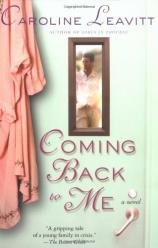
Coming Back to Me
by Caroline Leavitt

List Price: $13.95
Pages: 320
Format: Paperback
ISBN: 0312305540
Publisher: St. Martin's Griffin

Click here to buy this book from Amazon.com.
Click here to buy this book from Amazon.ca.


About This Book


The questions and discussion topics that follow are intended to enhance your group's reading of Caroline Leavitt's profoundly moving novel, Coming Back To Me. We hope you see these questions as inroads into a deeply-felt novel about love and loss, memory and redemption and the way families come apart-and together.

Gary, an orphan, and Molly, who feels herself orphaned, meet, fall in love, and marry, delighted to have formed a family unto themselves. But problems arise when the tightly knit, hardscrabble community they move into isn't welcoming or approving. The community softens a bit when Molly gets pregnant, but then, days after giving birth, a devastating medical emergency arises and Molly is comatose. Gary finds himself caring for young Otis alone and facing a mountain of medical bills and the loss of his job. All hopes for happiness-and for Molly-seem to be evaporating, until a desperate Gary calls the only person left who can help them-Molly's estranged sister Suzanne. Suzanne agrees to come only because she has no place left to go, but once she's settled in Molly's household, Suzanne gradually begins to appreciate the kind of life she used to ridicule, and to her amazement, she begins to fall in love with Gary. And then Molly awakens, and all three must now struggle to understand what has happened in the past, and what will happen now.

Told from the points of view of Gary, Molly and Suzanne, this is a novel that asks the question: how do you keep your loved ones safe? And provides the answer that if safety is not possible, community and family, and unexpected help from the most unexpected sources, sometimes is.

top of the page


rgg_discuss.gif (1294 bytes)


1. Coming Back To Me begins with a preface, which unlike the rest of the book, is written in the present tense. Why do you think Leavitt chose to do that? What effect does the present tense create? Why do you think Leavitt started the book in the middle of the story and then backtracked to an earlier, happier time? What effect does that have? How would the book have been different if it was told in a linear fashion?

2. Coming Back To Me deals a lot with the issue of community and the families we form, and how those families can ruin or protect us. Gary and Molly are drawn together because they both feel orphaned. When they move into New Jersey, they find a hardscrabble, tightly-knit community that perceives them as outsiders, which makes Gary and Molly so uncomfortable that they draw even closer together. What do you think Leavitt is saying about the notion of community? How and why does this notion change throughout the book?

3. On page 301, Gary thinks: "Events didn't always turn out the way you hoped they would. But the thing was that sometimes people came through. The most unexpected people in the most unexpected ways." Who were the unexpected people for Gary and how did they help? Why do you think this was this so surprising for Gary? Do you think his having been an orphan colored his thoughts on how things turn out in life?

4. Throughout the book, there runs the theme of people trying to keep safe. How do each of the major characters; Suzanne, Molly and Gary each handle this? How are each able to succeed-or fail? Why do you think Leavitt added a section revolving around the baby's safety? How does the baby's section differ from those of the other characters-and why?

5. Coming Back To Me focuses on the struggle between sisters. Why is it important that Suzanne and Molly start out being really close and loving? How does the conflict between the two sisters evolve? While Molly doesn't feel at fault, Leavitt indicates certain things that Molly does, which push Suzanne away. Could there have been another, better way for Molly to handle things with her sister?

6. Memory plays a large part in this novel. A cornerstone of the book is the two memories of the same event: Molly's version and Suzanne's version of the time when Suzanne ran away from home with her boyfriend Ivan and how and why it affected the family, especially the relationship between the sisters. Why do you think Leavitt gave us two versions of the same incident? How do both versions differ? Which version do you think is the correct one? What do you think this says about memory?

7. Memory-or the lack of it-crops up again, when Molly is in the hospital and has been given memory blockers and can't remember seeing her family at all. How does this event resonate with the theme of memory? What do you think Leavitt is trying to say about how and what and why we remember what we do? Are there ever things these characters-or people in general--need to forget?

8. Molly and Suzanne both had a missing-in-action mother, a woman who was there, but was more intent of finding a husband then attending to her daughter's needs. When Molly gives birth, to her horror, she also is a missing mother to her baby, whom she's not allowed to see. Why do you think Leavitt made Molly a missing-in-action mother, too? What is the significance of the way Molly finally bonds with baby Otis?

9. Coming Back To Me is told from the perspectives of three different people. Why do you think Leavitt did that? How would the book be different if it was told by just Gary? Or by just Suzanne?

10. Why do you think Leavitt ended the book on an ambiguous note? Why is the last section set in the fall and at Halloween where people are wearing costumes? Why do you think Molly uses the phrase "right now" twice? What do you think this says about destiny and fate and our ability to plan for the future-and why is this hopeful?

top of the page

Critical Praise

"In the vein of Jacquelyn Mitchard or Jane Hamilton. Realistic, well-plotted, eminently readable portrait of a family in crisis."
Kirkus Reviews


"Leavitt has a talent for creating believable characters whose problems touch the reader's heart."
Library Journal


"Caroline Leavitt is a marvelous writer."
Anne Lamott, author of Traveling Mercies: Some Thoughts On Faith


"Human nature can run from Caroline Leavitt, but cannot hide. She knows people, their fears, their blunders, and their reformation, and she tells them plain."
Jacquelyn Mitchard, author of The Deep End of the Ocean


"A rich and personal novel. What excellent writing, and what subtlety and intelligence inform this book. Readers who wait impatiently for the next Jane Hamilton or Sue Miller novel will find another favorite in Caroline Leavitt."
Katharine Weber, author of The Music Lesson

 
Back to top.   


Privacy Policy | Contact Us | Advertising | About Us

© Copyright 2001-2008, ReadingGroupGuides.com. All rights reserved.