City of God


About the Book
City of God




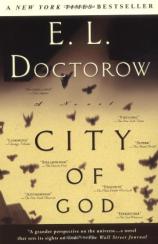
As diversely populated and wide-ranging as it seems, E. L. Doctorow's novel can nonetheless be viewed as a singular, intricately rendered portrait of one man's peripatetic imagination and streaming consciousness. Everything we read about in City of God—from the Episcopal priest in the throes of a crisis of faith and the bereaved rabbi endeavoring to redirect the destiny of the entire Jewish tradition, to a Holocaust survivor's harrowing ghetto narrative and the pair of lushly imagistic verse poems about the World Wars—presumably flows from a single, blinking computer cursor that is manipulated by a middle-aged New York novelist named Everett. With Everett as his protagonist and millennially harried Everyman, Doctorow takes readers on a sweeping survey of the twentieth century, channeling the voices of Albert Einstein, Ludwig Wittgenstein, and Frank Sinatra, as well as the voices of Everett's fellow fictional beings, who occupy the novel's principal narrative. Beginning with his novel's title and its Augustinian overtones, every aspect of Doctorow's survey is in the service of the novel's thematic preoccupation with the nature of belief, the mystery of human consciousness, and above all, "our wrecked romance with God."
As City of God begins, readers find Everett—a secular man without extensive training in astronomy or physics—riffing on the cosmos and dropping some poetry-tinged science. As he summarizes modern conceptions of the history of the universe, Everett struggles with the mind-dwarfing notions of two tenets that are central both to the novel itself as well as to the Judeo-Christian religious tradition writ large: the notion of a "singular original" Creator, and the belief in an ever-approaching and ultimately unknowable human destiny. If the Big Bang engendered fifteen billion years of spatial expansion, then to what end is this expansion progressing? And as to the space itself (our universe) that is expanding: what, exactly, is it filling up or replacing? And above all, Everett wonders, what kind of "fearsome" God could be involved in these concepts of "disastrous, hopeless infinitude," this "fluke happenstance," this apparently "accidental" genesis? Here, in Everett's universal musings, which appear frequently in the first forty or so pages of the book, Doctorow illuminates an unresolvable disconnect between Reason and Faith, or between scientific understandings about the origin of life and organized religion's increasingly untenable narratives about the same. This same crucial disconnect comes to play a primary part in the story of the Reverend Dr. Thomas Pemberton, to whom we are introduced as the first-person narrator of the new book Everett is sketching out.
In the early pages of the novel, an enormous brass cross is heisted from St. Timothy's Episcopal on the Lower East Side. Pemberton, D.D. (for "Divinity Detective"), sets off in search of it, yet he senses from the start that this is no ordinary theft, with no ordinary solution. "So now these people," Pem says, "have lifted our cross. It bothered me at first. But now I'm beginning to see it differently. That whoever stole the cross had to do it. And wouldn't that be blessed? Christ going where He is needed?" When the cross turns up on the roof of the fledgling Synagogue for Evolutionary Judaism on the Upper West Side, Pem realizes he is being led by fate. With Rabbi Sarah, Pem seeks to transcend the constraints of storytelling and to reclaim an elusive, pre-scriptural (pre-narrative) state of "unmediated awe." City of God's own story climaxes here, with Pem on the verge of Jewish conversion, giving what is in a sense his final sermon, telling God that consciousness, our stories, our language, all of them are "not enough." "If we are to remake [rewrite] ourselves, we must remake you, Lord."
Through Everett, E. L. Doctorow serves up an amalgam of literary genres dealing with a common theme. He introduces a series of tenuously related stories comprised of philosophical meanderings, sleuthing narratives, cultural histories, theological musings, science lessons on the life of ants, explications and deconstructions of pop lyrics, film treatments, poetry, and even a head-spinning monologue from the twentieth century's silver-throated Chairman of the Board. The dizzying array of styles, tones, and rhythms pile up on us like so much history. Doctorow has rendered what might be viewed as a prose simulation of contemporary Western consciousness: eclectic, scattered, unresolved, attention-deficit-disordered, overloaded with information, and tremendously burdened by the weight of so much devastating human history. Clearly, a linear, A-to-B narrative has no chance of reproducing the disjointed, poignant rhythms of the shell-shocked, end-of-the-century New York City which Doctorow imagines here. Like the Bible (the prototypical fusion of disparate stories on a common theme), like a city, like the whole of literature, and like contemporary life itself, Everett's stream of fragments in City of God resembles "a great historically amassed communal creation" derived from the Word and from the evolutions of culture that language makes possible.


City of God
- Publication Date: February 1, 2001
- Paperback: 288 pages
- Publisher: Plume
- ISBN-10: 0452282098
- ISBN-13: 9780452282094