IndieBound Independent Bookstores

Barnes & Noble

Loading
Reading Group Guide
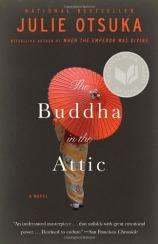
The Buddha in the Attic
by Julie Otsuka

List Price: $22.00
Pages: 144
Format: Hardcover
ISBN: 9780307700001
Publisher: Knopf

Click here to buy this book from Amazon.com.
Click here to buy this book from Amazon.ca.


About This Book

Julie Otsuka’s long awaited follow-up to When the Emperor Was Divine ("To watch Emperor catching on with teachers and students in vast numbers is to grasp what must have happened at the outset for novels like Lord of the Flies and To Kill a Mockingbird" --- The New York Times) is a tour de force of economy and precision, a novel that tells the story of a group of young women brought over from Japan to San Francisco as ‘picture brides’ nearly a century ago.

In eight incantatory sections, The Buddha in the Attic traces their extraordinary lives, from their arduous journey by boat, where they exchange photographs of their husbands, imagining uncertain futures in an unknown land; to their arrival in San Francisco and their tremulous first nights as new wives; to their backbreaking work picking fruit in the fields and scrubbing the floors of white women; to their struggles to master a new language and a new culture; to their experiences in childbirth, and then as mothers, raising children who will ultimately reject their heritage and their history; to the deracinating arrival of war.

In language that has the force and the fury of poetry, Julie Otsuka has written a singularly spellbinding novel about the American dream.

top of the page


rgg_discuss.gif (1294 bytes)

1. The Buddha in the Attic is narrated in the first person plural, i.e., told from the point of view of a group of women rather than an individual. Discuss the impact of this narrative decision on your reading experience. Why do you think the author made the choice to tell the story from this perspective?

2. Why is the novel called The Buddha in the Attic? To what does the title refer?

3. The novel opens with the women on the boat traveling from Japan to San Francisco. What does Otsuka tell us is"the first thing [they] did," and what does this suggest about the trajectories of their lives?

4. What are the women’s expectations about America? What are their fears? Why are they convinced that"it was better to marry a stranger in America than grow old with a farmer from the village"?

5. Discuss Otsuka’s use of italics in the novel. What are these shifts in typography meant to connote? How do they add to our knowledge of the women as individuals?

6. Otsuka tells us that the last words spoken by the women’s mothers still ring in their ears: "You will see: women are weak, but mothers are strong." What does this mean, and how does the novel bear this out?

7. In the final sentence of"First Night," Otsuka writes,"They took us swiftly, repeatedly, all throughout the night, and in the morning when we woke we were theirs." Discuss the women’s first nights with their new husbands. Are there particular images you found especially powerful? How did you feel reading this short chapter?

8. Why was the first word of English the women were taught"water" ?

9. In the section entitled"Whites," Otsuka describes several acts of kindness and compassion on the part of the women’s husbands. In what ways were the husbands useful to them or unexpectedly gentle with them in these early days? How does this reflect the complexity of their relationships?

10. What are the women’s lives like in these early months in America? How do their experiences and challenges differ from what they had been led to expect? How are they perceived by their husbands? By their employers? Discuss the disparity between the women’s understanding of their role in the American economy and what Otsuka suggests is the American perception of the Japanese women’s power.

11. Later in this section, the women ask themselves,"Is there any tribe more savage than the Americans?" What occasions this question? What does the author think? What do you think?

12. Discuss the passage on p. 37 that begins,"We forgot about Buddha. We forgot about God. . . . I fear my soul has died. . . . And often our husbands did not even notice we’d disappeared." What does Otsuka mean by"disappeared"? What is she suggesting about their spiritual lives, their inner selves? Do the women reappear in this sense in the course of the novel? When?

13. Throughout the novel, Otsuka uses the phrase"One of us…" Why? What is the effect of this shift in point of view? What does Otsuka achieve through this subtle adjustment?

14. Otsuka writes,"They gave us new names. They called us Helen and Lily. They called us Margaret. They called us Pearl." Discuss how this mirrors the names taken by the women’s children later in the novel.

15. Discuss the complexities and nuances of the relationship between the Japanese women and the white women. Was it strictly an employer/employee relationship, or something more?

16. What is J-town? Why do the women choose J-town over any attempt to return home?

17. The section called"Babies" is just six pages long but strikes with unique force. What was your reaction to the experiences of the women in childbirth? Take a close look at the last six sentences of the chapter, with a particular emphasis on the very last sentence. On what note does Otsuka end the chapter, and why? What does that last sentence reveal about Otsuka’s ideas about the future and about the past?

18. "One by one all the old words we had taught them began to disappear from their heads," Otsuka writes of the women’s children. Discuss the significance of names and naming in The Buddha in the Attic. What does it mean for these children to reject their mother’s language? What point is Otsuka making about cultural inheritance?

19. How do the the dreams of the children differ from the dreams of their mothers?

20. Why do the women feel closer to their husbands than ever before in the section entitled"Traitors"?

21. How is the structure of the penultimate section, called"Last Day," different from the structure of all the sections that precede it? Why do you think Otsuka chose to set it apart?

22. Who narrates the novel’s final section,"A Disappearance"? Why? What is the impact of this dramatic shift?

23. Discuss themes of guilt, shame, and forgiveness in The Buddha in the Attic.

top of the page

 
Facebook Fan Page  Follow us on Twitter


Add Your Guide to ReadingGroupGuides.com!

Bookreporter.com Bets On...: Books We're Betting You'll Love


Privacy Policy | Contact Us | Advertising | About Us

© Copyright 2001-2012, ReadingGroupGuides.com. All rights reserved.
The Book Report, Inc. • 250 West 57th Street • Suite 1228 • New York, NY • 10107
Ph: 212-246-3100 • Fax: 212-246-4640

Bookreporter.comReadingGroupGuides.comGraphicNovelReporter.comFaithfulReader.com
Teenreads.comKidsreads.comAuthorsOnTheWeb.com