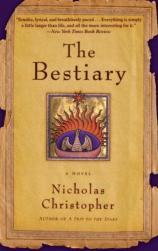
The Bestiary
by Nicholas Christopher
List Price: $14.00
Pages: 320
Format: Paperback
ISBN: 9780385337373
Publisher: Dial Press Trade Paperback
From “a writer of remarkable gifts,” “Borges with emotional weight, comes a tale that is at once a fantastical historical mystery, a haunting love story, and a glimpse into the uncanny --- the quest for a long-lost book detailing the animals left off Noah’s Ark.
Xeno Atlas grows up in the Bronx, his Sicilian grandmother’s strange stories of animal spirits his only escape from the legacy of his mother’s early death and his stern father’s long absences as a common seaman. Shunted off to an isolated boarding school, with his father’s activities abroad and the source of his newfound wealth grown increasingly mysterious, Xeno turns his early fascination with animals into a personal obsession: his search for the Caravan Bestiary. This medieval text, lost for eight hundred years, supposedly details the animals not granted passage on the Ark --- griffins, hippogriffs, manticores, and basilisks --- the vanished remnants of a lost world sometimes glimpsed in the shadowy recesses of our own.
Xeno’s quest takes him from the tenements of New York to the jungles of Vietnam to the ancient libraries of Europe --- but it is only by riddling out his own family secrets that he can hope to find what he is looking for. A story of panoramic scope and intellectual suspense, The Bestiary is ultimately a tale of heartbreak and redemption.
top of the page

1. Before you started reading The Bestiary, what did you know about the fable of Noah and the Ark? Did The Bestiary change your perception of this legend? What are some parallels between The Bestiary and the Noah’s Ark parable?
2. Xeno tells us that his name, derived from Latin, means “gift.” His father claims that in Greek, “xenos” means “stranger.” Are either of these meanings an accurate description of Xeno?
3. The book opens with this line from Xeno: “The first beast I laid eyes on was my father.” Discuss Xeno’s father. What was behind his remoteness?
4. What did you think of Xeno’s grandmother? Why did she have such a profound influence on him, even years after her death?
5. In Chapter One, Xeno believes he witnesses his grandmother become a fox. In Chapter Two, he encounters an actual fox in the woods, and recalls a monks’ proverb: “The fox can leave tracks in one direction while traveling in another,” (page 83). Are these two events connected? What does the monks’ saying mean? On what other occasions does Xeno see (or think he sees) a fox?
6. Water is a recurrent symbol in The Bestiary. Discuss some instances where water is prominent, and their significance. What are other symbols employed in the novel?
7. Xeno’s grandmother “talked about the animals she saw embodied in other people,” (page 14). What kinds of animals would you associate with the main characters?
8. Did it surprise you that Lena became a radical animal-rights activist? And Bruno, a celebrated academic? Is animal cruelty a metaphor for another theme in the book?
9. One might consider Xeno an orphan, as his mother was dead and his father was detached, both physically and emotionally. Who are the surrogate parents that Xeno adopts? How do these people help him?
10. Bears and panthers make multiple appearances throughout the novel, in both physical and figurative forms. What is the relevance of each? Why do you think the author chose these particular animals?
11. Why do you think Xeno longed for Lena throughout his life? Did you expect that he would be reunited with her?
12. What explains Xeno’s obsession with finding The Caravan Bestiary?
13. “Listening to Bruno, I was reminded of my grandmother’s most important gift to me: her belief that we must pursue the beasts of this life, rather than allowing them to pursue us,” (page 229). What are the “beasts” in this statement? How does Xeno confront them?
14. What did you think of the book’s ending?
top of the page

“Smart, entertaining ... a marvelous hybrid of intellectual quest and well-plotted adventure.... A literary thriller in which --- unusually --- neither “literary” nor “thriller” seems an afterthought.”
Kirkus Reviews
“The novel's greatest pleasures might lie in its esoterica, its fascinating trips down side paths of the fantastic.”
Columbus Dispatch
“A fascinating blend of the bibliophile quest novel merged with romance, intrigue and fantasy.”
Seattle Times
“Fascinating ... an old-fashioned quest.... Christopher is a compelling storyteller and writer.”
Boston Globe