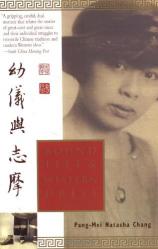
Bound Feet & Western Dress


About the Book
Bound Feet & Western Dress




The Story of Yu-i and Pang-Mei
Pang-Mei Natasha Chang was nine years old when she first met her great-aunt Chang Yu-i in 1974. Yu-i had just arrived in New York City, after living in China and then Hong Kong for most of her life. Fourteen years later, after Yu-i entrusted Pang-Mei with her life story, Pang-Mei sat close by in her great-aunt's studio apartment, listening to Yu-i's labored breath the night before she died.
Yu-i's mother, striking an aristocratic pose.
By that time, Pang-Mei had spent years listening and recording her great-aunt's story, gently urging this traditional woman to share her remarkable personal history. It was 1983 when Pang-Mei first came upon Yu-i's name in a textbook for course work in Chinese Studies at Harvard College. Until then she knew little of Yu-i's life, just a few bare facts the family rarely mentioned. To Pang-Mei's astonishment, she discovered that Yu-i had been married to a noted Chinese romantic poet, had received what is often referred to as "the first modern divorce in China," and was vice president of the Shanghai Women's Savings Bank. Growing up, Yu-i's family said of her that she was part man, because she was strong and willful. As an older woman, she was often quiet at family gatherings, appearing almost lost behind her thick-lensed glasses; there was little to suggest the deeply held passions and great strength of this retiring woman. Who was this woman to whom Pang-Mei felt such a deep and immediate attachment?
Yu-i's father, a respected doctor who ruled the household with a firm hand.
Pang-Mei began asking Yu-i questions and listening to her answers in earnest. And in the process of encouraging Yu-i to remember her story, gently urging forth details from her life, both women changed. Yu-i became more open, sharing her innermost feelings with her great-niece, and coming to a new understanding of her relationship with the husband who had abandoned her and their young son for the sake of his artistic pursuit. At the same time, Pang-Mei became less self-conscious about her Chinese heritage and learned to reconcile the opportunities presented to her with the responsiblilities and expectations attached to them--to study and do well, to marry a Chinese man, to care for family.
Eighteen-year-old Yu-i with her first son, the pride of the Hsü family.
By book's end, the echo of recognition that welled during Yu-i and Pang-Mei's first brief meeting resounds more deeply. They are bound together: two women from different eras who have struggled to come to terms with the traditional and modern values before them, with the choices and responsibilities they've been given, with the love and trust they feel for each other and their family.
Words as Passages to Memory and Meaning
Whether writing fiction or literary nonfiction, one of a writer's goals is to create a believable world for readers. To be believable, this world must contain details that snag a reader's attention. For it is through the physical details that the author delivers the universal emotional truth of a life, whether the setting is early-twentieth-century Shanghai, as in Yu-i's case, or Pang-Mei's late-twentieth-century- Connecticut.
A writer who wants to bring a scene to life begins by describing things. For instance, when remembering her mother, the writer might mention the scarlet lipstick she wore, the way she arranged the chairs just so around the kitchen table, or how she read a book while she folded laundry. Layer by layer, these emotionally accurate details lead to truth. Toni Morrison, in her essay "The Site of Memory" (from Inventing the Truth, William Zinsser, ed.), says, "I have suspected, more often than not...that I know more than my grandfather and my great-grandmother did, but I also know that I'm no wiser than they were....These people are my access to me; they are my entrance into my own interior life. Which is why the images that float around them--the remains, so to speak, at the archeological site--surface first, and they surface so vividly and so compellingly that I acknowledge them as my route to a reconstruction of a world, to an exploration of an interior life that was not written and to the revelation of a kind of truth."
Yu-i with her brothers and sisters, gathered in Shanghai in 1927 for their parents' funeral. Seated, from left, First and Fourth Sisters, and Yu-i. Standing, Third Sister and two sisters-in-law. Seated, from left, First, Second, Eighth, Fifth, and Third Brothers. Standing, Seventh, Fourth, and Sixth Brothers.
Pang-Mei knows this route well, and she uses it to bring us deep into Yu-i's story and her own, offering a web of details spun with Chinese words that are loaded with meaning. The list below, the things defined in Bound Feet & Western Dress--a dumpling, wisdom, a pen stroke, integrity--are embedded in Yu-i's life. They help us make connections that bring us closer to the truth at the heart of her story.


Bound Feet & Western Dress
- Publication Date: September 15, 1997
- Paperback: 215 pages
- Publisher: Anchor
- ISBN-10: 0385479646
- ISBN-13: 9780385479646