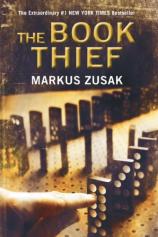
The Book Thief
by Markus Zusak
List Price: $11.99
Pages: 576
Format: Paperback
ISBN: 0375842209
Publisher: Alfred A. Knopf
Liesel Meminger is only nine years old when she is taken to live with the Hubermanns, a foster family, on Himmel Street in Molching, Germany, in the late 1930s. She arrives with few possessions, but among them is The Grave Digger’s Handbook, a book that she stole from her brother’s burial place. During the years that Liesel lives with the Hubermanns, Hitler becomes more powerful, life on Himmel Street becomes more fearful, and Liesel becomes a fullfledged book thief. She rescues books from Nazi book-burnings and steals from the library of the mayor. Liesel is illiterate when she steals her fi rst book, but Hans Hubermann uses her prized books to teach her to read. This is a story of courage, friendship, love, survival, death, and grief. This is Liesel’s life on Himmel Street, told from Death’s point of view.
top of the page

1. Discuss the symbolism of Death as the omniscient narrator of the novel.
What are Death’s feelings for each victim? Describe Death’s attempt to resist
Liesel. Death states, “I’m always finding humans at their best and worst.
I see their ugly and their beauty, and I wonder how the same thing can be
both.” (p. 491) What is ugly and beautiful about Liesel, Rosa and Hans
Hubermann, Max Vandenburg, Rudy Steiner, and Mrs. Hermann? Why is
Death haunted by humans?
2. What is ironic about Liesel’s obsession with stealing books? Discuss other
uses of irony in the novel.
3. The Grave Digger’s Handbook is the first book Liesel steals. Why did she
take the book? What is significant about the titles of the books she steals?
Discuss why she hides The Grave Digger’s Handbook under her mattress.
Describe Hans Hubermann’s reaction when he discovers the book. What
does the act of book thievery teach Liesel about life and death? Explain
Rudy’s reaction when he discovers that Liesel is a book thief. How does
stealing books from the mayor’s house lead to a friendship with the mayor’s
wife? Explain how Liesel’s own attempt to write a book saves her life.
4. Liesel believes that Hans Hubermann’s eyes show kindness, and from
the beginning she feels closer to him than to Rosa Hubermann. How does
Hans gain Liesel’s love and trust? Debate whether Liesel is a substitute for
Hans’s children, who have strayed from the family. Why is it so difficult for
Rosa to demonstrate the same warmth toward Liesel? Discuss how Liesel’s
relationship with Rosa changes by the end of the novel.
5. Abandonment is a central theme in the novel. The reader knows that Liesel
feels abandoned by her mother and by the death of her brother. How does
she equate love with abandonment? At what point does she understand why
she was abandoned by her mother? Who else abandons Liesel in the novel?
Debate whether she was abandoned by circumstance or by the heart.
6. Guilt is another recurring theme in the novel. Hans Hubermann’s life was
spared in France during World War I, and Erik Vandenburg’s life was
taken. Explain why Hans feels guilty about Erik’s death. Guilt is a powerful
emotion that may cause a person to become unhappy and despondent.
Discuss how Hans channels his guilt into helping others. Explain Max
Vandenburg’s thought, “Living was living. The price was guilt and shame.”
(p. 208) Why does he feel guilt and shame?
7. Compare and contrast the lives of Liesel and Max Vandenburg. How does
Max’s life give Liesel purpose? At what point do Liesel and Max become
friends? Max gives Liesel a story called “The Standover Man” for her
birthday. What is the signifi cance of this story?
8. Death says that Liesel was a girl “with a mountain to climb.” (p. 86)
What is her mountain? Who are her climbing partners? What is her greatest
obstacle? At what point does she reach the summit of her mountain?
Describe her descent. What does she discover at the foot of her mountain?
9. Hans Junior, a Nazi soldier, calls his dad a coward because he doesn’t
belong to the Nazi Party. He feels that you are either for Hitler or against
him. How does it take courage to oppose Hitler? There isn’t one coward
in the Hubermann household. Discuss how they demonstrate courage
throughout the novel.
10. Describe Liesel’s friendship with Rudy. How does their friendship change
and grow throughout the novel? Death says that Rudy doesn’t offer his
friendship “for free.” (p. 51) What does Rudy want from Liesel? Discuss
Death’s statement, “The only thing worse than a boy who hates you [is] a
boy who loves you.” (p. 52) Why is it diffi cult for Liesel to love Rudy?
Discuss why Liesel tells Mr. Steiner that she kissed Rudy’s dead body.
11. How does Zusak use the literary device of foreshadowing to pull the reader
into the story?
12. Liesel Meminger lived to be an old woman. Death says that he would
like to tell the book thief about beauty and brutality, but those are things
that she had lived. How does her life represent beauty in the wake of
brutality? Discuss how Zusak’s poetic writing style enhances the beauty
of Liesel’s story.
top of the page

"Brilliant and hugely ambitious… It’s the kind of book that can be life changing."
THE NEW YORK TIMES
"The Book Thief deserves a place on the same shelf with The Diary of a Young Girl by Anne Frank and Elie Wiesel’s Night. It seems poised to become a classic."
USA TODAY
"Beautiful and important."
KIRKUS REVIEWS, Starred
"An achievement."
PUBLISHERS WEEKLY, Starred