Reading Group Guide
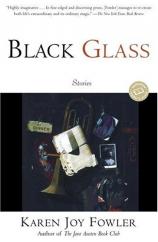
Black Glass
by Karen Joy Fowler

List Price: $12.95
Pages: 272
Format: Paperback
ISBN: 0345426533
Publisher: Ballantine

Click here to buy this book from Amazon.com.
Click here to buy this book from Amazon.ca.


About This Book


Carry Nation is on the loose again, smashing topless bars as she radicalizes women and preaches clean living to men. . . . Mrs. Gulliver's patience with her long-voyaging Lemuel is wearing thin: Money is short and the kids can't even remember what their dad looks like. . . . The ever-faithful Tonto is turning forty --- and not so much as a birthday phone call from that masked man. . . .

In these and thirteen other fantastical short fictions, Karen Joy Fowler turns accepted norms inside out and fairy tales upside down, as she playfully pushes us to reconsider life's fragile realities.

top of the page


rgg_discuss.gif (1294 bytes)


1. Sundry genres commingle in Fowler's short fictions; identify them. What is the function of each one? How does her approach call into question traditional notions of fiction? Do you regard the blending of genres as distinctly contemporary or time-honored?

2. One motif of the collected short stories is the seemingly ineluctable misreadings and discord that persist between the sexes. How does Fowler's handling of this theme differ from story to story? What questions or issues surface repeatedly in addressing the topic? Why does this topic lie so close to the heart of most fiction?

3. Lady Mary Wortley Motagu suggested that satire should "like a polished razor keen, wound with a touch that's scarcely felt or seen." Which stories in Black Glass read as satires? What about the subject is illuminated or obscured through the satirizing? Does the satire function simply as entertainment or as moral or ethical provocation?

4. What is lost or gained when Fowler abandons realism?

5. The narrator of "The Brew" says that "sometimes we can find a smaller world where we can live, inside the bigger world where we cannot." Which characters in Black Glass attempt to create smaller worlds for themselves? What compels the attempt? How do these fictions serve as small worlds for reader as well as author?

6. Throughout Black Glass we hear from women often marginalized in popular narratives of history and literature, for example, the spouses of Einstein and Gulliver. What compels such an approach? How do these voices challenge our understanding of events depicted? What does Fowler accomplish by giving voice to the once silent?

7. Stories such as "The Elizabeth Complex," "The View from Venus: A Case Study," and "Game Night at the Fox and Goose" invite us to reconsider views of women proffered and perpetuated by myth and media. What do Fowler's reimaginings of traditional tales accomplish? How, collectively, do her short stories alter our perspective on women in fiction? How does literature compare to other media in shaping our perceptions of gender?

8. At the close of the title story, Harris's wife describes her work on Carry Nation not as literature. She says, "We're trying to have an impact on the American psyche. Literature may not be the best way to do that anymore." Do you agree? Use Black Glass as evidence for your case.

9. American pop culture figures in a number of Fowler's stories. How does she use the seemingly trivial to suggest something of import? To what extent is her fiction distinctly American? Which stories transcend time and place? How?

10. Tonto opens "The Faithful Companion at Forty" by weighing two different theories on history: one acknowledges the individual as responsible for defining and directing change, the other cites the masses as bellwether. Most of Black Glass explores the connection between self and selves: the way we inhabit a world within as well as the one we share with others. Trace this theme throughout the collection. What conclusions can you draw?

11. In her essay "The Value of Laughter," Virginia Woolf suggests that "comedy represented the failings of human nature, and that tragedy pictured men as greater than they are. To paint them truly one must, it seems, strike a mean between the two, and the result is something too serious to be comic, too imperfect to be tragic, and this we may call humour." Which of Fowler's stories meet this definition of humor? How? What do they accomplish in the process?

12. What is the significance of the collection's title? How does it relate to more than the title story?

13. The narrator of "The View from Venus: A Case Study," invites her students to question their perception of reality. She asks: "How do others perceive you? How do you perceive others' perceptions of this you. We are now at two removes from the objective reality...and yet for the purposes of relationships this is absolutely the closest to reality anyone can come." How do the stories of Black Glass wrestle with this riddle of perception? What limitations of understanding and expression are acknowledged? Which works depict the perils of excessive subjectivity faced when turning life into narrative?

14. "Go Back" seems somewhat anomalous among the stories of Black Glass. Why? What, missing or present, separates it from the rest of the tales? What, nonetheless, shows its spirit as consonant with the collection?

15. The protagonist of "Go Back" receives this advice from he mother: "Sometimes going back is better....It only looks like you're losing when really it's the only way to win." How does this appreciation of a past explored characterize Black Glass? Which individual stories support or refute the notion? How?

16. How does the consideration of parenthood and marriage in "The Travails" differ from that in "Lieserl"?

17. In "The Travails," Mary insists that her husband admit that he is haunted by the family he seldom sees: "You can never go far enough to escape. We fill your Thoughts in spite of yourself. You mold your Memories about us, as if you had been here all along." This story, like others the collection, explores both the ongoing temptation to flee and the impossibility of true flight. What prevents Fowler's characters from escaping their lives? What is the significance of the obstacles?

18. We can also look at the above excerpt as a meditation on the extent to which our memories shape our character and direct the course of our life. What light shines through Black Glass onto this matter?

19. In "Lieserl," the narrator informs us that "none of this is as simple as it sounds, but one must start somewhere even though such placement inevitably entails the telling of a lie." To what extent do Fowler's stories convey the complexity of the situations they depict? How? Which stories turn to symbolism, parable, or fantasy to express or intimate complexity? Which resonate most? Why?

20. The narrator of "Lieserl" also observes that "man fumbles about the world, perceiving nothing, understanding nothing. In a whole universe, man has been shut into a small room." How does Black Glass open the door to this small room? What is revealed?

top of the page

Critical Praise

" Karen Joy Fowler has found her way from the details of what we take to be our history, our past, to the legend that is our true present. --W. S. Merwin Highly recommended . . . This stunning collection of stories by the author of Sarah Canary so carefully interweaves the ordinary with the extraordinary that what should seem incredible is fully believable. "
--Library Journal (starred review)


"Playing fast and loose with the facts is the fiction writer's prerogative, and in her second collection of short stories, Fowler exercises it with panache. "
--Toronto Globe and Mail


"Karen Joy Fowler is one of those rare American literary beasts: a true, homegrown magic realist. With Fowler, magic realism isn't an affectation. She comes by it quite naturally, and her writing shows it. "
--Des Moines Register


"Ferociously imaginative and provocative . . . Accomplished, risk-taking, exciting new work from one of our most interesting writers. "
--Kirkus Reviews (starred review)


"Elegant and witty prose . . . [Fowler] unfolds eccentric plots that keep the pages turning. "
--Publishers Weekly
 
Back to top.   


Privacy Policy | Contact Us | Advertising | About Us

© Copyright 2001-2008, ReadingGroupGuides.com. All rights reserved.