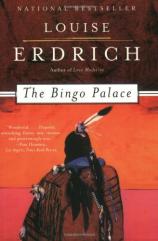
The Bingo Palace


About the Book
The Bingo Palace



We never ask for all this heat and silence in the first place, it's true. This package deal. It's like a million-dollar worthless letter in the mail. You're chosen from nothingness, but you don't know for what. You open the confusing ad and you think, Shall I send it in or should I just let the possiblities ripen? You are set there in a basket, and one day you hear the knock and open the door and reach down and there is your life. --Lipsha Morrissey in The Bingo Palace
When Lulu Lamartine sends her grandson, the hapless, underachieving Lipsha Morrissey, a copy of a wanted notice for his father, Gerry Nanapush, he takes it as a summons to return home to the reservation. Morrissey, gifted with healing powers, has "shorted out his touch" by living in cities and making "himself stupid with his dope-pipe." Part of what pulls him back is the need to confront a part of his history from which he has never quite emerged: the fact that his mother tied him in a sack and threw him in a slough, where he would have drowned but for a chance rescue. Lipsha's search for himself becomes complicated almost the instant he arrives, when he falls in love with Shawnee Ray Toose, an ambitious woman who is "semi-engaged" to his half-uncle, Lyman Lamartine. Lyman is the reservation's most successful businessman, "a big, bland Velveeta" in Lipsha's view, but the "biggest cheese" around, who dreams about building a bingo palace on traditional land that is still owned by Fleur Pillager. The novel weaves together the fate of a culture-- one trying to preserve its traditions, but needing to survive financially--with the story of Lipsha's personal quest for identity. It is through the rivalry with Lyman (who is also his guide and mentor) that Lipsha comes to understand the complexities of love, identity, success, and failure-- universals that we all must come to terms with, but that are shaded in particular ways for those who are descendants of Native American culture in the United States. As Lipsha, who has read the Greek classics, notes, "If you read about a thing like Lyman and me happening in those days, one or both of us would surely have to die. But us Indians, we're so used to inner plot twists that we just laugh."


The Bingo Palace
- Publication Date: February 15, 1995
- Paperback: 288 pages
- Publisher: Harper Perennial
- ISBN-10: 006092585X
- ISBN-13: 9780060925857