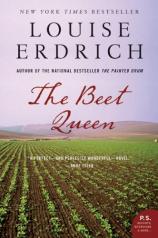
The Beet Queen


About the Book
The Beet Queen



"Everything that happened to him in his life," she said, "all the things we said and did. Where did it go?"
I didn't have an answer, so I just drove. Once I had caused a miracle by smashing my face on ice, but now I was an ordinary person. In the few miles we had left I could not help drawing out Celestine's strange ideas in my mind. In my line of work I've seen thousands of brains that belonged to sheep, pork, steers. They were all gray lumps like ours. Where did everything go? What was really inside? The flat fields unfolded, the shallow ditches ran beside the road. felt the live thoughts hum inside me, and I pictured tiny bees, insects made of blue electricity, in a colony so fragile that it would scatter at the slightest touch. I imagined a blow, like a mallet to the sheep, or a stroke, and I saw the whole swarm vibrating out.
Who could stop them? Who could catch them in their hands?
—Mary Adare in The Beet Queen
On a cold spring morning in 1932, fourteen-year old Karl Adare and his eleven-year-old sister, Mary, arrive by freight train in Argus, North Dakota. Abandoned by their mother, they have come to look for their mother's sister, Fritzie, who runs the House of Meats with her husband. The two Adares lose each other. Karl is frightened by a dog and runs back to the boxcar and Mary runs the other way, toward town. So it begins the forty-long story of a community and its people, held together by blood, circumstance, habit, will, and passion. Changes sweep across their lives--in the figures of birth, death, and descent into madness, and in the shape of a growing sugar beet industry. The novel follows the lives of Mary, who stays in Argus and takes over the butcher shop, and Karl, who seems determined to avenge his being cast aside, compulsively returning to and fleeing from all emotional ties. Narrated by various characters, the novel charts Mary's powerful dream life. She is a girl who causes miracles, but she is annoyed by her self-centered and unstable cousin, Sita Kozka. Mary's part-Chippewa childhood friend Celestine James and their lonely neighbor, Wallace Pfef, narrate different sections of the novel. The birth of Wallacette Darlene Adare, Celestine's daughter by Karl, brings together the lives of the characters in surprising ways. Dot sees herself as the "logical outcome" of a "thread beginning with my grandmother Adelaide and travelling through my father and arriving at me. The thread is flight."


The Beet Queen
- Publication Date: August 22, 2006
- Paperback: 368 pages
- Publisher: Harper Perennial
- ISBN-10: 0060835273
- ISBN-13: 9780060835279