Reading Group Guide
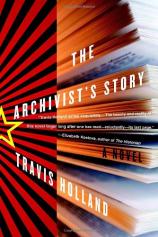
The Archivist's Story
by Travis Holland

List Price: $13.00
Pages: 256
Format: Paperback
ISBN: 9780385339964
Publisher: Dial Press Trade Paperback

Click here to buy this book from Amazon.com.
Click here to buy this book from Amazon.ca.


About This Book


Moscow, 1939. In the recesses of the infamous Lubyanka prison, a young archivist is sent to authenticate an unsigned story confiscated from one of the many political prisoners there. The writer is Isaac Babel. The great author of Red Cavalry is spending his last days forbidden to write, his final manuscripts consigned to the archivist, Pavel Dubrov, who will ultimately be charged with destroying them. The emotional jolt of meeting Babel face-to-face leads to a reckless decision: he will save the last stories of the author he reveres, whatever the cost.

From the margins of history, Travis Holland has woven a tale of the greatest power. Pavel’s private act of courage in the face of a vast bureaucracy of evil invigorates a life that had lost its meaning, even as it guarantees his almost certain undoing. A story of suspense, courage, and unexpected avenues of grace, The Archivist’s Story is ultimately an enduring tribute to the written word.

top of the page


rgg_discuss.gif (1294 bytes)


1. Discuss Travis Holland’s storytelling style. How were you affected by his use of the present tense to describe lives that are overshadowed by the past?

2. What did the initial encounter between Pavel and Babel reveal about both men, and about the way they perceive literature? Are there authors whom you revere as much as Pavel reveres Babel?

3. What does it mean to live free from censorship? How did Stalin’s literary purges shape the social climate of the Soviet Union? Is any degree of government-sponsored censorship appropriate?

4. Pavel recommends Chekhov’s story “Gooseberries” to his mother in Chapter Seven. What does her response to the story–particularly her concern that Ivan Ivanovich’s brother will eventually realize the bitterness of the berries–indicate about her view of the world? How does her illness shape Pavel’s outlook for the future?

5. How was your reading of The Archivist’s Story influenced by the knowledge that the story of Isaac Babel’s imprisonment and confiscated manuscripts is real? In what ways can fiction sometimes recall history more vividly than nonfiction does?

6. How familiar were you with the Russian literary works referred to throughout the novel? What traits do you associate with Russian writers, and how do those traits differ from your impressions of American writers? What is it like to read this novel, which captures life behind the Iron Curtain in the 1930s, in the aftermath of perestroika and the fall of the U.S.S.R.?

7. What ultimately inspires Pavel to risk his life to save a portion of Babel’s works? What does his courage illustrate about the value and political nature of literature? What does a nation’s fiction say about its history and culture?

8. Discuss Pavel’s memories of his wife, Elena, and his poignant quest to claim her ashes. Would you have believed the official version of the accident’s cause? How did the nature of her death complicate his ability to grieve for her?

9. What common ground do Pavel and Natalya share? Do they feed each other’s hungers, or are their emotional cravings impossible to satisfy?

10. What has kept Pavel resolute in his friendship with Semyon? Which one of them is more courageous? Which one is the better realist?

11. What is the significance of the archive at Lubyanka Prison? How would you define the role and purpose of archives–literary, presidential, or otherwise? Who should have access to them? Why do they matter?

12. Pavel cannot shake the memory of the slander he committed against his former colleague Mikhail. What compelled Pavel to go along with his student? Would you have been equally persuaded in similar circumstances?

13. In the novel’s closing chapters, Pavel has little left to lose and is resolute in his plan. As he retrieves his hidden items from the basement wall and imagines the ominous car coming for him, what is he leaving behind? What will be gained by his fate?

14. In what ways did Travis Holland resurrect Babel just as Pavel hoped to do? Is it the nature of authors to contribute to one another’s immortality?

top of the page

Critical Praise

“Travis Holland writes exquisitely. The Archivist’s Story is that very rare book, a historical novel that makes us forget ‘historical’ and remember only ‘novel’, even as we take in hard historical fact— the archivist Pavel living in the midst of Stalin’s purges, could be any of us, and Holland conveys his world in indelible images. The beauty and reality of this novel linger long after one has read—reluctantly—the last page.”
Elizabeth Kostova, author of The Historian


“A quietly miraculous book—uncannily persuasive in its rendering of a distant time and place, and deeply moving in its evocation of lives caught in the jaws of history. It's common to welcome a debut novel as "promising.” This book is a promise perfectly and profoundly kept, its author one to read now and into the future.”
Peter Ho Davies, author of The Welsh Girl


“A historical novel of subtle power and tremendous grace.”
Kirkus Reviews, starred review


“There is a quiet authenticity about Holland’s writing that draws you in, and soon you will find yourself sitting on the edge of your seat, silently cheering for his characters. Readers will want to hear more from the author of this heartbreaking and haunting work.”
Library Journal, starred review

 
Back to top.   


Privacy Policy | Contact Us | Advertising | About Us

© Copyright 2001-2009, ReadingGroupGuides.com. All rights reserved.
The Book Report, Inc. • 250 West 57th Street • Suite 1228 • New York, NY • 10107
Ph: 212-246-3100 • Fax: 212-246-4640

Bookreporter.comReadingGroupGuides.comGraphicNovelReporter.comFaithfulReader.com
Teenreads.comKidsreads.comAuthorsOnTheWeb.comAuthorYellowPages.com