IndieBound Independent Bookstores BRC Facebook Fan Page
Reading Group Guide
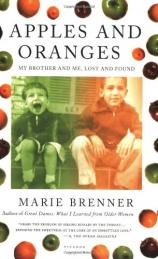
Apples & Oranges
My Brother and Me, Lost and Found
by Marie Brenner

List Price: $15.00
Pages: 288
Format: Paperback
ISBN: 9780312428808
Publisher: Picador

Click here to buy this book from Amazon.com.
Click here to buy this book from Amazon.ca.


About This Book


Rivals since their earliest youth, Marie Brenner and her brother, Carl, rarely found common ground. Like many brothers and sisters, they maintained a lifelong connection that was both aggravating and essential, navigating around the fact that they had settled in distinctly different corners of America. She had become a bestselling author and renowned journalist, at home among the left-leaning Manhattan intelligentsia he despised. He divided his time between their family’s genteel neighborhood in San Antonio, Texas, and his apple orchards in Washington State. She reveled in the history of their Jewish ancestry; he started attending a church. She was addicted to questions, probing for answers. He lived entrenched in suspicion and generalization. Then, after they had spent decades in opposition, a crisis forced them to unite. Charting their course as they waded through years of simmering angst, Apples & Oranges is ultimately the story of an uncanny reconciliation and a bittersweet confrontation between the uncertain future and the ghosts of the past.

top of the page


rgg_discuss.gif (1294 bytes)


1. Marie Brenner’s memories encompass a variety of settings, particularly central Texas, New York, and her brother’s Washington orchards. What identities and cultures are captured in each of these settings? Where does she feel most at home? Which locale would you prefer? To what degree does birthplace shape our sense of self?

2. What is the effect of the memoir’s timeline, weaving the near present with the distant past? In what way does this structure mirror the way memories enter our lives?

3. What accounts for the tremendous personality differences between Marie and Carl, despite their having had the same upbringing? What may have contributed to Carl’s conservatism in the face of a family history that often embraced progressive ideas? In terms of temperament, did Marie and Carl share any similarities?

4. How did the past repeat itself in Brenner family history? How is Marie affected by her research into family lore, particularly her findings about Anita? Who are the most colorful figures in your family’s past? How are we shaped by the knowledge of these legacies?

5. In what ways does religion as a cultural institution figure into the Brenner identity? As Marie captures the experience of Jewish immigrants who arrived in the United States through Galveston, what costs and benefits are ascribed to assimilation, or life as a secular Jew? How does Ilene’s approach to Christianity compare to Carl’s?

6. Marie describes her sorrowful encounter with her ancestors’ correspondence at the Harry Ransom Center, as well as her childhood home, filled with typewriters on which many carbon-copied letters were produced. What does it mean for her to come from a verbal family that left miles of documentation in its wake? Is the truth captured in such documents? Is the quest for answers a defense mechanism, as Marie proposes?

7. Discuss the experience of reading about Carl’s beloved orchards and the landscape of rural Washington. What does his enthusiasm for agriculture—and his rejection of the family’s apparel trade—say about him? In what ways does the perfectionistic process of nurturing, harvesting, and exporting world-class produce serve as a metaphor for his understanding of life?

8. Speaking before a crowded church, Ilene recalls that “we were going to weave a new family, and no longer be part of the tapestry of brainy squabblers that had ended their time together in silence and separation.” What degrees of reconciliation are achieved in Carl’s lifetime? What are the greatest hurdles to reconciliation?

9. How did Thelma and Milton, at the helm of the Brenner household, shape their children’s lives? What did Marie learn from Thelma about being a woman, and what did Carl learn from Milton about becoming a man?

10. What does having a big brother signify to Marie? How does Carl seem to view the role of his little sister? What binds them together, despite their extreme differences? How does her perception of her brother differ from the way others see him?

11. How does Marie compare to the other women in Carl’s life? What qualities does he appear to be drawn to? How do women respond to him?

12. With a reporter’s precision, Marie describes the tumultuous emotions with which her brother confronted his illness as he tried both Chinese and western medicine, culminating in a loss of confidence in the possibility for healing. What controls our reaction to fate? What personality traits are reflected in the very different responses Carl and Marie showed to his prognosis?

13. The closing scenes capture a memory of peace and laughter between Carl and Marie as well as the beauty of the acreage he once tended. How will Casey’s generation remember Carl’s and Marie’s? What will this sibling legacy be?

14. Marie’s preface begins with an advertising line from a movie trailer: “Every life has moments that change us forever and make us who we are.” She observes that, despite the hyperbole, it’s a true statement. What were the most pivotal moments she encountered in her life? Which experiences have made you who you are?

15. How did you respond to the psychoanalytic theories described in the book regarding siblings? How would you describe your relationship with your siblings? Do these relationships affect (or reflect) the other interactions in your life—in love, at work, or within friendships?

top of the page

Critical Praise

“Original, wrenching, and wonderfully realized. Marie Brenner has written a compellingly honest memoir of a sibling relationship that is at once fraught and instantly recognizable. She has started a conversation about the ignored hot-button topic of brothers and sisters that will reverberate with readers of all ages.”
Tina Brown, author of The Diana Chronicles


Apples & Oranges is genius. It’s the true story of a grown-up brother and sister trying to get along, but always devolving, bickering; always returning to the backseat of the car. Marie Brenner tells her true story with painful rawness and the cold, sure honesty of an X-ray machine. She also tells it with the pen of a poet. It’s the most beautifully written book I’ve read in years.”
Lesley Stahl


“The most moving emotion in literature is honesty, and in a memoir, the hardest to achieve. I wept at the end of Apples and Oranges, and not least for Marie Brenner’s courage in biting into a forbidden fruit that hangs from every family tree. It’s the fruit of knowledge about our flawed humanity in relation to those whom we most love, hate, need, fear to lose—and resemble. One of our best investigative reporters has here filed the story she was born to write.”
Judith Thurman, author of Cleopatra’s Nose: 39 Varieties of Desire

 
Back to top.   


Privacy Policy | Contact Us | Advertising | About Us

© Copyright 2001-2009, ReadingGroupGuides.com. All rights reserved.
The Book Report, Inc. • 250 West 57th Street • Suite 1228 • New York, NY • 10107
Ph: 212-246-3100 • Fax: 212-246-4640

Bookreporter.comReadingGroupGuides.comGraphicNovelReporter.comFaithfulReader.com
Teenreads.comKidsreads.comAuthorsOnTheWeb.comAuthorYellowPages.com