IndieBound Independent Bookstores BRC Facebook Fan Page
Coming Soon
Reading Group Guide
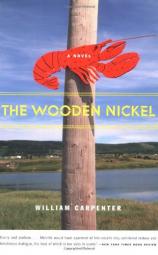
The Wooden Nickel
A Novel
by William Carpenter

List Price: $13.95
Pages: 368
Format: Paperback
ISBN: 0316089745
Publisher: Back Bay Books

Click here to buy this book from Amazon.com.
Click here to buy this book from Amazon.ca.


About This Book


The Wooden Nickel is a boat. Its owner, Lucky Lunt, is an endangered species: a Maine lobsterman who works the same waters as his father and grandfather. Lucky's world is changing faster than he can fathom - his heart is failing him, too - and soon he is embroiled in a turf war that forces him to abandon what he should hold most dear: family, health, solvency, and even the rules of the sea. It only makes matters worse that Lucky's partner in crime is the sexy, not-quite-ex-wife of the local lobster wholesaler. Brilliantly capturing all the pathos and hilarity of Lucky's epic battle for survival, this remarkable novel announces the arrival of a startlingly fresh, mature, and important voice in American fiction.

top of the page


rgg_discuss.gif (1294 bytes)


1. How would you characterize Lucky and Ronette's relationship? How is it different from Lucky's relationship with Sarah? Do you think one is healthier or stronger than the other?

2. Seeing a cocktail party on an expensive sailboat, Lucky says, "Every one of them things is some son of a bitch screwing the working man" (page 121). Lucky has a very negative view of tourists and the summer people who come to Orphan Point, though much of his livelihood depends on them. Do you think his resentment is justified? What might account for his reaction to these outsiders?

3. Lucky and Sarah's son, Kyle, and their daughter, Kristen, pursue divergent paths in life, yet Lucky doesn't seem entirely comfortable with either of them. Discuss Lucky's relationship with each of his children. In the final chapters Lucky tries to run down Kyle's boat, while he buys Kristen the car of her dreams. Why does he end up treating his two children so differently?

4. Lucky sees his decision to work for Moto as a betrayal. Why is this such a wrenching choice? What motivates him to go forward despite his reservations? Can you sympathize with his decision, or do you think he should have acted otherwise?

5. After learning about Ronette, Sarah tells Lucky, "Lucas, don't you see? Nothing is yours anymore. Not me, not this house, nothing. You don't even own yourself" (page 146). What does she mean by this?

6. What are the factors, besides simple desire, that propel Lucky into his affair with Ronette?

7. Discuss Sarah's reactions to Lucky's infidelity and to Ronette's pregnancy. Do you think her responses are appropriate? Do you think she might have acted differently in the first instance if Lucky had shown more remorse about the affair?

8. In a sense, Lucky is the author of his own demise — much of what befalls him results from his own actions. Do you think there is an inevitability to the difficulties Lucky experiences, or does he bring them all upon himself?

9. Consider Ronette's perspective: Why would she choose Lucky as an escape route from her marriage? Unlike other blind forces operating in the novel, Ronette seems to have a plan. What do we know of her strategies and success in getting what she wants?

10. By the end of the novel Lucky has lost his wife, his boat, and his occupation and has traded his waterfront home for a house trailer. Given all this, is there any way we could say he is better off?

11. Identify other relationships —apart from his entanglements with people —that Lucky is involved in. How important are they to him and to the novel?

12. Lucky spends a lot of energy criticizing and condemning the world as he sees it. But what positive values does he seem to hold?

13. How do you interpret the novel's ending? What do you think happens to Lucky and Ronette after the last scene? Do you agree with the author's decision to leave the ending ambiguous?

14. The novel is seen through Lucky's eyes and told in his voice. How might the story be different if told from the perspective of one of the other characters?

top of the page

Critical Praise

"A funny, funny book. . . . Lucky Lunt leaps to life and you buy his story - hook, line, and sinker."
Tampa Tribune


"The novel is a hoot with a heart, a raucous portrayal of working-class life in extremis. . . . Mr. Carpenter keeps a nice balance between the consistent focus on Lucky's abrasive sensibility and the novel's busy plot. . . . Lucky Lunt is an irresistibly vivid character. . . . You might not want to invite him to your next book club meeting. But a few bracing, expletive-filled hours aboard the Wooden Nickel with Lucky just might do your own heart a modest world of good."
—Bruce Allen, Washington Times


"Move over, Richard Russo, there's an impressive new chronicler of the lives of hard-edged working men on the scene. . . . This is a fully engaging story that creates a powerful portrait of a man struggling to make sense of a world that seems rigged against him."
Publishers Weekly


"Powerful. . . . The Wooden Nickel will be the punchiest, raunchiest Maine coast lobstering novel you'll encounter in a long while."
—Michael Kenney, Boston Globe


Privacy Policy | Contact Us | Advertising | About Us

© Copyright 2001-2010, ReadingGroupGuides.com. All rights reserved.
The Book Report, Inc. • 250 West 57th Street • Suite 1228 • New York, NY • 10107
Ph: 212-246-3100 • Fax: 212-246-4640

Bookreporter.comReadingGroupGuides.comGraphicNovelReporter.comFaithfulReader.com
Teenreads.comKidsreads.comAuthorsOnTheWeb.comAuthorYellowPages.com