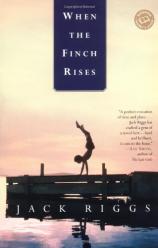
When the Finch Rises
A Novel
by Jack Riggs
List Price: $13.95
Pages: 272
Format: Paperback
ISBN: 0345468198
Publisher: Ballantine Books
When the Finch Rises is the debut novel of an author whose work will be read as classic literature for a long time to come. It is a story full of truths and revelations, transcending its fictional bounds to become something so real and so finely wrought that it will simply astonish. Jack Riggs has created an emotional testament to the myriad shades of the human condition.
It is the late 1960s in the small North Carolina mill town of Ellenton. Twelve-year-old Raybert Williams and his best friend Palmer Conroy live in cramped homes in a working-class neighborhood, but they use the vast outdoors as their personal playground. Yet hardships are never far away. Raybert's father disappears for days at a time, only to come home broken and battered. Raybert's mother is a loving woman who battles her own demons while struggling to keep it all together. Palmer's family life offers no better refuge for the adventure-seeking boys.
But Raybert and Palmer have each other. And in that glorious friendship, they are significantly blessed. They dream together of space flight and moonwalks. They construct a bike jump to rival Evel Knievel's–and they'll run it once they work up the courage. Knievel tempted fate and won, taking a leap over twenty buses on faith alone, soaring high and landing safely, even after many crashes and broken bones. Palmer and Raybert have their own plan that, once executed, will take them all the way to the ocean, landing them intact and together on the other side of freedom.
Through the scrim of adolescence and poverty, Jack Riggs offers a glimpse of universal human foibles and singular moments of transcendence. Fiercely honest and beautifully narrated, When the Finch Rises flashes like the sharp rim of the eclipsed moon on the night when Raybert and Palmer's fate is finally revealed.
top of the page

1. What is the significance of the title When the Finch Rises?
2. Do you think the setting of the novel is symbolic? Could this story have taken place somewhere else?
3. Commenting on how Evelyn's illness drives him crazy, Ray says of their home and their lives, "Ain't much choice here, is there?" What effect does choice have on each character in the novel? Do you think fate plays a role as well?
4. How do you think the photograph of Rodney Small's lynching affects Raybert and Palmer? Would it be better if they had never seen the photograph?
5. Ray "remained in love with Momma through it all. He just never knew what he was supposed to do when she became ill." What are the limits of love in the novel? How do the characters express their love?
6. Some very specific historical and social events are mentioned in the novel. How do they advance the novel's plot? What do they reveal about the characters?
7. When Palmer and Raybert visit the place where Rodney Small was lynched, they witness something no one else seems to experience at that time, the return of the finches to Finch Creek. After they experience the amazing flight of the finches, Palmer states, "I think this whole show might be Rodney Small thanking us for just coming out here and looking around. Maybe he's saying don't worry about me anymore." What does this experience have to do with their feelings about the lynching? How does this reflect the theme of redemption and forgiveness in the novel?
8. Why does Ray plant a new lawn for Evelyn? As Evelyn watches Ray work on the new lawn, she waits "silently for him to fail." Why do you think he fails throughout the novel? Is Ray a character that you sympathize with? Why or why not?
9. Inez Palmer's lover Edgar calls Raybert and Palmer "faggots" when he discovers them hiding in Palmer's closet. What role does sexual ambiguity and identity play in the novel? How would you describe Raybert and Palmer's friendship?
10. Raybert stays with Aunt Iris and Uncle Clewell for over a month. Do you think this visit adds to or detracts from the novel's plot? Why?
11. Why is Palmer so upset at Raybert when he shoots and kills the finch with his new BB gun? After Raybert kills the finch, he apologizes to Palmer, who comments, "It's in your blood. You can't do nothing about it. Just don't do it again or you might not be able to stop." What does he mean? What role does physical violence play in the novel?
12. Do you think Palmer's birthmark is symbolic? Of what?
13. What do you think of Raybert's mother? Is she a likeable character? Why or why not?
14. What is the symbolic significance of Raybert's finally making the bicycle jump at the end of the novel? Do you think the story has a happy ending? Why or why not?
top of the page

"A perfect evocation of time and place . . . Jack Riggs has crafted a gem of a novel here–hard and brilliant, it cuts to the bone."
Lee Smith, author of The Last Girls
"Refreshingly different . . . Clear-eyed and fair . . . [Riggs] pulls everything together with honesty and grace, the fate of each character seeming both unexpected and inevitable."
The Charlotte Observer
"Riggs conjures up the mysteries of a mill town summer, vividly depicting the lights and shadows of ordinary events and horrors. . . . [A] deeply satisfying portrait of a troubled family."
The Atlanta Journal-Constitution
"[Readers will] be taken with narrator Raybert's vivid and poignant recollection of and reflection on his childhood, and appreciative of the choices Riggs made in bringing it to life."
Richmond Times-Dispatch