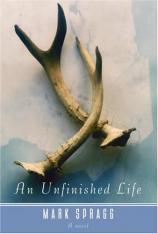
An Unfinished Life


Review
An Unfinished Life




Every life is unfinished; there is never enough time to meet all of our goals, fulfill all of our potential, satisfy all of our yearnings. Each death is its own half-forgotten story, its incomplete symphony, its fragmentary first novel sitting on the shelf, yellowed papers curling up to the ceiling. To personalize things for a moment, it doesn't matter whether I die next Friday or three hundred years from now in the best hospital on Mars. My life will still be unfinished. There are a hundred reasons why. Four quick examples: I will never take the field for the Texas Rangers at Arlington Stadium; I will never get to sing in public; I will never discover a cure for any disease; and I will never manage to write as well as Mark Spragg.
It is not unfinished lives that Spragg is writing about here. It is not a what-if novel; the dead do not hang around like Marley's ghost, trying to do what was left undone in life. Instead, AN UNFINISHED LIFE is about the long-term effects of tragedy; how tragedy radiates through the years, sending out resonance frequencies that vibrate throughout the lost years, showing up now and again, repeating their patterns over and over. It is the long-ago death of Griff Gilkyson that concerns us here. We know nothing of him, practically, except that he was born, died young, and left a void in the hearts of his father, Einar Gilkyson, his wife Jean, and the daughter he never met. Ten years later, Jean and her daughter (also named Griff) return to Einar's remote Wyoming ranch, shaking off a Midwestern exile spent in trailer parks and women's shelters.
Spragg tells the story from a variety of shifting viewpoints --- something that you're expressly told not to do at writer's conferences, but something that you can do if you write as well as this author. It helps to have, as Spragg does, a knack for dry, spare dialogue and sharply delineated characters ---- whether those characters are vulnerable ten-year old girls, or lonesome ranchers, or abusive boyfriends. That's the obvious point to make; what is less obvious is that, unlike the other characters, the main character here --- the state of Wyoming itself --- doesn't get its own chapter, nor does it need one. In a way, AN UNFINISHED LIFE is about how the characters relate to the empty spaces and dusty roads of rural Wyoming as much as how they relate to one another.
Spragg's Wyoming is a place of wide vistas and long rides in pickup trucks that can be as confining and claustrophobic as your closet at home, depending on your options and opportunities. It is still a half-wild place. The big attraction in Ishawooa, Wyoming is the zoo, filled with local animals "with names and sad stories," from distressed sandhill cranes to captive rattlesnakes. The Wyoming landscape, it seems, is so stark and forbidding that even the native animals have problems adapting to it.
Spragg's writing, like the Wyoming landscape, is spare and unadorned, but it is also uncommonly beautiful in the right light, especially counterpointed with his use of direct, Laconic dialogue. Spragg can, and does here, make a driver's license interesting reading: "Jean Marie Gilkyson," it reads. "Donor. What hasn't she given away? Her pride, her body. She holds the laminated card at arm's length. Dreams, too, it goes without saying."
AN UNFINISHED LIFE takes place in an unfinished world, or maybe the finish just wears off the closer you get to the Rocky Mountains. It is a book about loss, of course, and suffering --- more than that, it is about how suffering is our inheritance and our right, "a burden, even sacred, for both man and beast." Though it is deeply steeped in Wyoming, Spragg's second novel speaks directly to us, with the transcendent clarity of carefully crafted prose, where we are and who we are amidst the pain of our everyday struggles and defeats.
My only gripe with the title itself --- AN UNFINISHED LIFE, which is deeply unsatisfactory, for it is a tautology.
This is not a book for the timid, or anyone who would rather be reading THE DA VINCI CODE on their layover at the Cincinnati airport. AN UNFINISHED LIFE stands above the grief and pain of its ordinary characters and even its extraordinary landscape, for it is about those things that are higher than loss and death --- loyalty, and endurance, and, gratefully, love.
Reviewed by Curtis Edmonds, who recentlycompleted his first novel, CHASING DIMAGGIO(http://www.txreviews.com/chasingdimaggio/). on January 24, 2011


An Unfinished Life
- Publication Date: August 31, 2004
- Genres: Fiction
- Hardcover: 272 pages
- Publisher: Knopf
- ISBN-10: 1400042011
- ISBN-13: 9781400042012