IndieBound Independent Bookstores BRC Facebook Fan Page
Coming Soon
Reading Group Guide
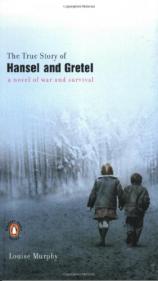
The True Story of Hansel and Gretel
by Louise Murphy

List Price: $13.00
Pages: 320
Format: Paperback
ISBN: 0142003077
Publisher: Penguin Books

Click here to buy this book from Amazon.com.
Click here to buy this book from Amazon.ca.


About This Book


"The story has been told over and over by liars and it must be retold."

In the winter of 1943, on the outskirts of a dark forest, two Jewish children flee the Nazis with their father and stepmother. In a moment of desperation, the children are given the aliases Hansel and Gretel and sent alone into the woods to hide. Gretel leads her younger brother in search of food and protection, while Hansel leaves a trail of breadcrumbs behind so that their father might find them again. So begins The True Story of Hansel and Gretel, which takes us along on their journey into a forest more ancient than man. In a landscape populated by exotic beasts, refugees, and revolutionaries, the two children embark upon a new life as Christian orphans, protected by a woman who is called Magda the witch and whose tiny hut is heated by an enormous baker's oven.

In this extraordinary novel by Louise Murphy, a fairy tale is reimagined and a war story retold. It is the story of individuals striving to survive and a village trying to outlast a war. Magda the witch lives on the edge of Piaski, in a region of Eastern Poland that has been overrun first by Russians and now by Germans. Her family is an assortment of outsiders: her brother Piotr, a fallen priest, her great-niece Nelka, a beauty in love with an enigmatic woodsman, her dead grandmother, a Gypsy and an abortionist. The villagers are terrorized by a small but vicious Nazi presence and weary at the end of a war that has brought them many conquerors and few saviors. Murphy unflinchingly presents the war as a landscape of horrors, the village humiliated under the yoke of ruthless SS officers and by the necessities of survival under unbearable circumstances.

We also follow the trials of Hansel and Gretel's father, who endures a brutal winter of revolutionary action and personal transformation, all the while preoccupied with the fear that his children may not survive and the hope that he will find them again. This unique novel gives voice to figures that have before now been underrepresented in the writing of World War II: the voices of Jews who hid in the forests, of men and women who participated in resistance movements, and of Polish civilians. These characters struggle with their relationship with God, with their disgust for a humanity in crisis, and with the desire to define a new and more just world.

Yet Murphy manages to maintain the fairy-tale foundation of her story, returning again and again to the elements of an old story to infuse meaning into a newer one. The Bialowieza Forest, the oldest in Europe, is a place of mysterious and untouched beauty, and its lessons for the children and for humanity permeate the book. Murphy juxtaposes horror with lyricism, reality with magic. The primal nature of war is met by the primal power of story—and the belief that love can rescue humans from their worst capabilities. Hansel and Gretel are on a quest to reclaim their identities, and the witch and the forest—the world of the fairy tale—show them the way.

In prose both luminous and enlightening, Murphy explores the power of memory, the necessity of love in times of great trauma, and the redemption that can come about through the refusal to erase one's own past. This is the tale of two brave children who never give up, of women who refuse to be defined by convention, and of the bitter cost of survival. Over the course of the winter, Hansel and Gretel will come of age. Their mother dead, their father and stepmother in hiding, by necessity forced to alter their own identities, they become survivors.

top of the page


rgg_discuss.gif (1294 bytes)


1. Murphy begins and ends her true fairy tale with the words of the wise witch Magda, who is the children's savior. She's an outsider from the village of Piaski, with Gypsy heritage, but she's also a relative to many characters: an aunt, a sister, and a surrogate mother to the children. How is she a traditional witch? What abilities mark her as such? How does she display her unconventional morals when considering the affairs of others? Why does Murphy make her a kind of narrator?

2. The primeval forest of Bialowieza is itself a character in this novel. It's a place that is harsh and wild but that offers protection to the children, to Magda, and to the Partisans as they work to oust the Germans. How does the forest enhance the fairy-tale sensibility? Does the forest have a personality; and if so, how would you describe it?

3. The forest is filled with wild beasts: the wild ponies, the elusive bison, the mad boar. Think back to some of the encounters characters have with these animals. How do wild animals function as symbols in the story? How do they connect characters? Do they serve as indicators of change at certain crucial moments in the plot?

4. Nelka and Telek are the romantic center of the novel. Each is forced to undertake harrowing actions in order to protect their families and the villagers. Telek in particular is forced to inflict harm in order to prevent an even greater wrong. What do these sacrifices bring them? How do you think they are able to endure these horrors and still imagine a future for themselves as lovers?

5. The stepmother is not a traditional fairy-tale stepmother; she is portrayed very positively, as an independent woman and a brave guardian of Hansel and Gretel's father. She does, however, make some excruciating decisions for the Mechanik and his children, decisions that have major consequences for them all. Consider different points in the story when she is forced to make painful choices; do you agree with those choices? Could she have acted differently? Do you think her fate—she is, after all, the stepmother—is a necessity of the fairy-tale genre?

6. At the start of novel, the children are given new names by the stepmother; they will struggle after a while to remember their original ones. Other characters receive new names too: the father becomes the Mechanik, the stepmother the White Wolf. The father notes that "His name had disappeared with the war"; what does this loss of names symbolize? Why do so many of the Partisans go by aliases? Why do you think Murphy chose not to reveal everyone's "real" names?

7. Memory is a key theme, especially for Gretel. At the start of the novel, she is already complaining that time in the ghetto has marred her memories of life before the war. By the end, those memories become key to her emotional well-being. What does it mean for her to lose and/or retain memories of a home before the trauma? How does memory serve the children during their quest to stay alive and find their father? Do you think Murphy implies there is a symbolic or real relationship between people and memory?

8. In many ways, this novel details a fairy-tale world, one with magical animals, the true love of Nelka and Telek, and a woman known as a witch. A traumatized Gretel spends part of the novel in the realm of madness, and for her it ultimately becomes important that she leave behind her immersion in fantasy and face reality. Hansel, too, has to give up playing war and lead his sister in a very real struggle for survival. Do you think that Murphy is suggesting that too much belief in fantasy can be an obstacle to maturity or to finding resolution? Or do you think that she shows how belief—in fairy tales, magic, and beauty—can help us overcome trials? Will Gretel continue to be an unusual child, or do you imagine her as more ordinary—more normal—as we leave her at the end of the book?

9. Both religion and magic infuse this story. There are scenes of Father Piotr's agony over his fallen priesthood, Hansel's folk cure for Gretel when she has the grippe, and Gretel holding a personal Shabbas. Often traditional church-centered worship and a more female-oriented magic or paganism have been in conflict in Europe and America; here it seems that a more immediate experience of evil erodes that conflict, at least for some of the central characters. How does this story allow church and magic to coexist? What does this say about the nature of spirituality for some of the characters?

10. On the other hand, the Partisans are distinctly antireligious; they dream of a godless communism to supplant the bloody passions of a world they view as too irrational. The father became an assimilated, nonreligious Jew, and throughout the book he struggles with his own inability to believe in God. At the same time he is trying with all his might to believe, against all logic, that his children will survive. How did the ending resolve this conflict in him, or did it? And what is Murphy suggesting about the place of religion in an ethical society, whether it be postwar revolutionary communist, or family-based? What place do you think religion will—or should—have for the main characters in their new lives?

11. The village of Piaski is populated by many types of people: there are ordinary Polish citizens, collaborators, and secret revolutionaries, alongside Nazis and their imported workers. Though there are, as one character notes, "so many reasons to hate the war," many of the villagers seem to be trying to simply endure the world of devastation that is closing in on their small town in the hopes that the war will end before they have to make greater sacrifices. Who in the town did you sympathize with? Try to recall villagers you would characterize as collaborators. Were their actions understandable to you? What about Hansel's childish admiration for the Nazis? What might you have done in a similar situation?

12. The end of the novel brings satisfaction for some, but doesn't avoid the real consequences of the war on the lives of these characters; all of them face futures that are radically altered from anything they have known before. Which characters do you think achieved redemption? Who got what they deserved? What do you think the future will be like for Hansel and Gretel? For the people of Piaski?

top of the page

Critical Praise

"This harrowing portrayal of the daily ordeal of Poles caught up in the German occupation-Gentiles as well as Jews-makes this a page-turner as well as a moving testament to the human will to do good and survive despite all odds. Highly recommended."
Library Journal


"[S]earing narrative transforms the old archetypes.... [A] gripping narrative"
Booklist


"A provocative transformation of the classic fairy tale into a haunting survival story set in Poland during WWII, Murphy's second novel (after The Sea Within) is darkly enchanting. No reader who picks up this inspiring novel will put it down until the final pages, in which redemption is not a fairy tale ending but a heartening message of hope."
Publishers Weekly


Privacy Policy | Contact Us | Advertising | About Us

© Copyright 2001-2010, ReadingGroupGuides.com. All rights reserved.
The Book Report, Inc. • 250 West 57th Street • Suite 1228 • New York, NY • 10107
Ph: 212-246-3100 • Fax: 212-246-4640

Bookreporter.comReadingGroupGuides.comGraphicNovelReporter.comFaithfulReader.com
Teenreads.comKidsreads.comAuthorsOnTheWeb.comAuthorYellowPages.com