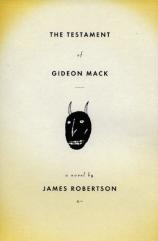
The Testament of Gideon Mack
by James Robertson
List Price: $24.95
Pages: 400
Format: Hardcover
ISBN: 067003844X
Publisher: Penguin Group
When Gideon Mack falls into a ravine while rescuing a fellow minister’s dog, he begins a journey that will take him, figuratively and literally, out of this world. Swallowed up in the roaring rapids of the legendary Black Jaws, he is assumed dead by one and all, and when he is spit out three days later, somehow alive, the outrageous story he tells of how he survived is met with disbelief and derision. Gideon claims it was the Devil who saved him, that the Devil healed his broken leg, engaged him in personal and philosophical discussion, and stole his shoes.
Gideon Mack is a man riddled with paradox: a minister who does not believe in God but comes face-to-face with the Devil, a pillar of the community who is widely admired while living a lie but denounced as insane when he tells the truth, a man who has repressed his passions all his life but has an affair with his best friend’s wife. In James Robertson’s skillful hands, these paradoxes not only make Gideon a fascinatingly complex and continually surprising character but suggest the larger issues that underlie his story. The Testament of Gideon Mack takes a multifaceted look at how religious belief manifests in our particular historical and cultural moment. From Gideon’s own coldly angry father, for whom the Bible is the only book worth reading, and the self-righteously puffed-up Peter Macmurray to the contemptuously agnostic Miss Craigie and Gideon’s own brand of practical hypocrisy, the religious views expressed in the novel cover a wide spectrum. The Devil himself feels sorry for God, given the fickle nature of human faith and the horrors committed in his name. The novel also poses questions about the reliability of human perception and indeed about the nature of belief itself. People, the novel seems to suggest, believe what they want to believe. Gideon claims to find a standing stone on a path he has run for years. One day it is suddenly and inexplicably there. Or is it? No one else sees it, and when Gideon photographs it—using old film—it doesn’t show up. But he touches it, embraces it, pounds his fist against it, and it is entirely real to him. But then so is the Devil. Readers must decide for themselves—Robertson is careful not to tip his hand—whether or not Gideon is lying or delusional or, if he is being truthful and accurate about his experience of the supernatural, what that implies about the nature of reality and the relationship of belief to perception.
But The Testament of Gideon Mack is much more than an epistemological investigation or a critique of religious belief. It is a fast-moving, beautifully written, often funny and always engaging story of one man’s inner life and outer experience as he comes to know the truth of himself. Robertson artfully frames the narrative Gideon spent his final days writing with the skeptical voice of a publisher weighing the potential sales of a scandalous memoir against the likelihood of lawsuits. But what is at stake in the story itself—for “those who have eyes to see,” as Gideon writes—far surpasses mundane considerations of profit and loss.
top of the page

1. Nancy Croy says, “When I think of all the novels I’ve read, I do wonder if it’s been a sensible use of my time. Why would I fill my head with all those made-up stories if it wasn’t to try and understand my own story? Every month my book group discusses a novel and its characters as if they were real people making real choices. Life is a story” (p. 220). Is Nancy right in thinking we read novels chiefly to understand our own stories? Why do we tend to talk about fictional characters as if they were real people? In what ways is life itself a story?
2. In his introduction, the publisher Patrick Walker writes that Gideon Mack’s story, “though some may dismiss it as a tissue of lies or the fantasy of a damaged mind, is a genuine document with its own relevance for our times” (pp. 3–4). What is its relevance for our times?
3. How does the narrative frame of the novel affect the way we read it?
4. Most of the people in the town believe that Gideon went mad during the three days he was lost in the Black Jaws and that his story about meeting the Devil is either a delusion or a lie. Why do they feel this way? Why is it impossible for anyone other than Gideon to believe that he actually met the Devil? What concrete evidence seems to support his story? Why do those who assert that God exists and the Devil is real consider anyone who claims to have seen either one to be insane?
5. After many years of dishonesty in his religious life—playing the role of a minister while disbelieving in God—why does Gideon feel so compelled to tell the truth about his meeting with the Devil? How does the Devil affect Gideon’s ideas about salvation, redemption, and the afterlife?
6. The Devil tells Gideon that he feels sorry for God, that when things are going well people forget about him. “They unchain the swings, turn the churches into casinos and mock anybody who still believes in him. He’s a very easy target. And who does he get left with? Fanatics and maniacs of every faith and every persuasion, who want to kill the heretics and blow themselves to pieces in his name” (p. 295). Discuss this argument about how religious belief manifests in our time. Do you find it convincing?
7. In what senses is Gideon Mack’s story a “testament”?
8. Gideon’s father, James Mack, asserts that “stupidity is rife in this world, and its wellspring is the United States of America” (p. 117). Why does he despise the United States so intensely? Is he right in suggesting that the pursuit of happiness leads to misery? Does it do so for characters in the novel?
9. What is the symbolic or mythic significance of Gideon’s “subterranean journey” through the Black Jaws? In what ways does it change Gideon? Are these changes positive or negative?
10. Gideon’s wife asks him, “Can you be dishonest in one part of your life but not another?” (p. 155). In what ways does Gideon’s dishonesty about his faith affect the rest of his life? What ironies are involved in the fact that it is Gideon’s honesty about his meeting with the Devil that makes everyone think he’s gone insane?
11. Gideon learns early on, from his strict religious upbringing and his parents’ example, that passions should be muzzled. How does this emotional repression affect the rest of his life?
12. Gideon says he knew that the stone “was a sign” but that he’d had “no idea what it meant” (p. 341). What does the stone signify? How does it change Gideon’s life?
13. What makes Catherine Craigie such an admirably eccentric character? Why is she so likable in spite of her abrasive manner?
14. What does The Testament of Gideon Mack as a whole suggest about the role of religion in our lives? What different views of religion do Gideon, Gideon’s father, Peter MacMurray, Lorna Sprott, John Moffat, Catherine Craigie, and the Devil express? Does the novel seem to endorse one of these views over the others?
top of the page

"Robertson [is] one of the foremost Scottish (and British) writers. "The Testament of Gideon Mack" easily cements this position."
Irvine Welsh, The Guardian (London)
"An extraordinary book. . .hugely enjoyable. Robertson writes with a gravity that lends solid weight to his supernatural propositions. . .a deeply refreshing book, and its touch of devilry makes it even more of a joy."
The Herald (UK)
"xxxxxxxxxxxxx"
XXXX
"xxxxxxxxxxxxx"
XXXX