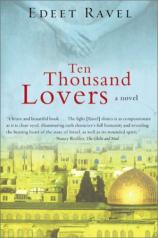
Ten Thousand Lovers
A Novel
by Edeet Ravel
List Price: $12.95
Pages: 304
Format: Paperback
ISBN: 0060565624
Publisher: Perennial
A long time ago, when I was twenty, I was involved with a man who was an interrogator.
So begins the story of Lily and Ami.
Lily, an Israeli-born Canadian, recalls her life in the 1970s as a student at Hebrew University's overseas student program in Jerusalem. While hitchhiking to Tel Aviv she meets Ami, a former actor. Handsome, intelligent, and exciting, he shares a dark side with his beautiful, disintegrating country. Although Lily is horrified to learn of his job as an army interrogator, she cannot stop the passion that grows between them. And soon she is witness to the heartbreaking struggle within Ami, and the struggle that tears apart the country she loves.
Juxtaposing her past with her present and the secrets hidden within the Hebrew language, Lily shares her timely and universal story of passion, suffering, and the transcending power of love.
top of the page

1. What is the significance of the book's title?
2. Ravel's chapters alternate between the story of Lily's past love, the story of her current life, and the history of the Hebrew language. Did you like this format?
3. "The word 'Israeli' means everyone who is a citizen of Israel, including Arabs ... But when people say 'Israeli' they aren't usually thinking of Arabs living in Israel. Arabs are in the word, but not in the word. They are there, but not there." Can you think of other words that have the same kind of mystery attached to them?
4. "People aren't good or bad. They just do good and bad things. Your only hope is to know which is which." Do you agree with Ami?
5. Lily has a recurring dream about Ami and his blue number plate. What do you think this dream reflects about her relationship with Ami?
6. "What's a border, I ask you? We're living in a world of mirrors ... We have no idea who's in, who's out." Do you think Ibrahim's statement applies to our world today? Why or why not?
7. Do you understand why Ami works as an interrogator even though he hates the system? Or do you think he contributes to the problem?
8. Bracha says, "It's easier to see things on stage than on the news. You can imagine you have some control." Have you ever felt more connected to a political or cultural issue because it was presented to you in an entertainment format? If so, discuss.
9. What is the significance of Tufiq's keffiyeh around Ami's neck?
10. Discuss the last chapter, specifically the meaning of the last sentence.
top of the page