IndieBound Independent Bookstores BRC Facebook Fan Page
Coming Soon
Reading Group Guide
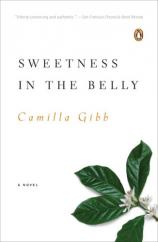
Sweetness in the Belly
by Camilla Gibb

List Price: $14.00
Pages: 368
Format: Hardcover
ISBN: 0143038729
Publisher: Penguin (Non-Classics) (March 27, 2007)

Click here to buy this book from Amazon.com.
Click here to buy this book from Amazon.ca.


About This Book


Lilly, the main character of Camilla Gibb’s stunning new novel, has anything but a stable childhood. The daughter of English/Irish hippies, she was “born in Yugoslavia, breast-fed in the Ukraine, weaned in Corsica, freed from nappies in Sicily and walking by the time [they] got to the Algarve…” The family’s nomadic adventure ends in Tangier when Lilly’s parents are killed in a drug deal gone awry. Orphaned at eight, Lilly is left in the care of a Sufi sheikh, who shows her the way of Islam through the Qur’an. When political turmoil erupts, Lilly, now sixteen, is sent to the ancient walled city of Harar, Ethiopia, where she stays in a dirt-floored compound with an impoverished widow named Nouria and her four children.

In Harar, Lilly earns her keep by helping with the household chores and teaching local children the Qur’an. Ignoring the cries of “farenji” (foreigner), she slowly begins to put down roots, learning the language and immersing herself in a culture rich in customs and rituals and lush with glittering bright headscarves, the chorus of muezzins and the scent of incense and coffee. She is drawn to an idealistic half-Sudanese doctor named Aziz, and the two begin to meet every Saturday at a social gathering. As they stay behind to talk, Lilly finds her faith tested for the first time in her life: “The desire to remain in his company overwhelmed common sense; I would pick up my good Muslim self on the way home.” Just as their love begins to blossom, they are wrenched apart when the aging emperor Haile Selassie is deposed by the brutal Dergue regime. Lilly seeks exile in London, while Aziz stays to pursue his revolutionary passions.

In London, Lilly’s life as a white Muslim is no less complicated. A hospital staff nurse, she befriends a refugee from Ethiopia named Amina, whose daughter she helped to deliver in a back alley. The two women set up a community association to re-unite refugees with lost family members. Their work, however, isn’t entirely altruistic. Both women are looking for someone: Amina, her husband, Yusuf, and Lilly, Aziz, who remains firmly, painfully, implanted in her heart.

The first-person narrative alternates seamlessly between England (1981-91) and Ethiopia (1970-74), weaving a rich tapestry of one woman’s quest to maintain faith and love through revolution, upheaval and the alienation of life in exile.

Sweetness in the Belly was universally praised for the tremendous empathy that Gibb brings to an ambitious story. Kirkus Reviews writes that the novel "reflect(s) the pain, cultural relocation and uncertainty of tribal, political and religious refugees the world over. Gibb's territory is urgently modern and controversial but she enters it softly, with grace, integrity and a lovely compassionate story. [It is a] poem to belief and to the displaced–humane, resonant, original, impressive." According to the Literary Review of Canada, Sweetness in the Belly is “…a novel that is culturally sensitive, consummately researched and deeply compassionate…richly imagined, full of sensuous detail and arresting imagery…Gibb has smuggled Western readers into the centre of lives they might never otherwise come into contact with, let alone understand.”

top of the page


rgg_discuss.gif (1294 bytes)


1. Discuss Lilly’s role as an outsider and her struggle for acceptance both as a farenji in Harar and as a white Muslim in London. Who else in the novel could be considered an outsider?

2. What do the words “family” and “home” mean to Lilly? How does her view of herself as an orphan evolve over the course of the novel?

3. “Faith has accompanied me over time and geography and upheaval,” says Lilly. For her, love and Islam “have always been one.” Did Sweetness in the Belly in any way alter or broaden your understanding of Islam? Consider, for instance, the notion of jihad or holy war.

4. Sweetness in the Belly alternates between Harar, Ethiopia, in the 70s, and London, England, in the 80s and early 90s. What qualities does this crosscutting of time and place impart to the narrative?

5. In the chapter entitled “Exile,” Lilly observes that “the smell of coffee draws women together, an olfactory call throughout a neighbourhood luring women from their homes to gather…” Later in the chapter, the act of twisting a mortar over coffee beans and cardamom triggers in her a surge of nightmarish images from the Red Terror. Of the many lush sensory details in the novel – both fair and foul – which affected you the most?

6. While living in Ethiopia, Camilla Gibb witnessed a female circumcision. A doctoral student in social anthropology at the time, she says she had to “understand it in the context of the community in which it was taking place, and not judge.” When Nouria’s daughters are circumcised in Sweetness in the Belly, how does Lilly react as the only Western-born character in the scene? How did you react as a reader?

7. Based on your reading of Sweetness in the Belly, what feelings and psychological states are associated with the experience of exile? How do Amina and Yusuf, for example, cope with their respective traumas?

8. In Harar, Aziz is called a “black savage, African slave, barbarian, pagan.” In London, Lilly is called a “white fu’in Paki.” Discuss the notion of “otherness” in the novel. How do artificial divisions manifest themselves based on ethnicity, class, race, religion and gender?

9. Discuss the ways in which the female characters ensure their survival and empower themselves despite the gender divisions within their communities.

10. What does Lilly mean when she says that Aziz “unveiled” her? How does she reconcile her love for him with her love of Islam?

top of the page

Critical Praise

“Gibb’s Africa is finely crafted, as is her delicate rendering of the complexities of Ethiopian society. . . . The book rings true.”
Time Magazine


“This complex tale about exile, romance and human rights combines the authority of Gibb’s scholarship on social anthropology with the lushness of her fictional vision.”
Elle Canada


"Ambitious . . . vivid and rich in detail, politically relevant and eminently readable."
The Globe and Mail


"A marvellous, highly absorbing read bound to strike up conversations at award time."
Ottawa Citizen


Privacy Policy | Contact Us | Advertising | About Us

© Copyright 2001-2010, ReadingGroupGuides.com. All rights reserved.
The Book Report, Inc. • 250 West 57th Street • Suite 1228 • New York, NY • 10107
Ph: 212-246-3100 • Fax: 212-246-4640

Bookreporter.comReadingGroupGuides.comGraphicNovelReporter.comFaithfulReader.com
Teenreads.comKidsreads.comAuthorsOnTheWeb.comAuthorYellowPages.com