Reading Group Guide
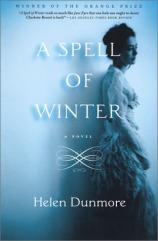
A Spell of Winter
A Novel
by Helen Dunmore

List Price: $13.00
Pages: 320
Format: Hardcover/Paperback
ISBN: 0802138764
Publisher: Grove Press

Click here to buy this book from Amazon.com.
Click here to buy this book from Amazon.ca.


About This Book


Disturbing love and underlying horror govern the hermetic world of this Gothic novel set in early twentieth-century England. Catherine and Rob Allen, siblings two years apart, grow up in a world of shameful secrets. Their mother abandons them when they are young, and their father dies after being institutionalized. The children live with their grandfather in a crumbling country estate accompanied by their dependable maid, Kate, and a malicious tutor, Miss Gallagher. Together they forge a passionate refuge for themselves while the world outside moves to the brink of war.

Against this backdrop, cruelty and eroticism lurk beneath every surface. Kate and Rob finally leave for Canada and then the war comes, taking most of the neighboring men with it, so that Cathy is left with her ailing grandfather on the farm. It's only when the war ends, and she is alone that she is ready to break away and be redeemed by love.

Helen Dunmore's most celebrated work, which captured Britain's prestigious Orange Prize, is a compelling tale of innocence corrupted by secrecy, and the grace of second chances.

top of the page


rgg_discuss.gif (1294 bytes)


1. A Spell of Winter is considered a literary Gothic novel. When it began in the late-eighteenth century, Gothicism emphasized experiences connected with subterranean dungeons, secret passageways, bloody hands, ghosts, graveyards, etc. What motifs does the author use to create this atmosphere? Which eerie features are grounded in reality? Which ones are mysterious?

2. The author begins the novel with a flashback of Kate delivering a scary story by the fire to Rob and Cathy (pp. 1-5). What is Cathy's reaction? Discuss the concept of a narrative being pleasurably terrifying. Why do you think people enjoy being scared by stories?

3. Comparing herself to the beautiful Livvy, a dowdier Cathy thinks: "I was too like my mother. My face made people think of the things men and women did together in the dark" (p. 66). What does she mean? What kind of face forces people into shame? Contrast this with the shame that Miss Gallagher attempts to stir up in people.

4. Throughout the text, the reader encounters graphic descriptions of smells-numerous flowers, perspiring bodies, dry rot, lemons, the fresh sweat of a horse, and so on. What literary purpose do these all these olfactory references serve? When telling Cathy a story about their father, Rob says: "I remember...because when I came in you were sitting by the fire and room smelled of rosemary" (p. 111). Clearly, smells assist (and can trigger) memory. What else boosts memory in this story and why is it so important?

5. Both servants fiercely guard the mysteries of the family heritage from Rob and Cathy. This inverts common behavior, resulting in outsiders who are better informed about the family than the family itself. What effect does this have on Cathy? Rob?

6. Having abandoned her family, the mother remains a topic mostly avoided by the men at the estate. But Cathy has difficulty forgetting (and forgiving). After Cathy's abortion, she recalls a poem about a women's stillbirth: "A mother, a mother was born" (p. 196). What does this mean to Cathy? How does the abortion affect Cathy's bond with her mother? Contrast this with Cathy's feelings toward her father.

7. When closely observing the paintings of Richard Tandy, Cathy notices that "the sky was so pale, it dazzled, and behind the wood there was a heap of hills, purple as damsons" (p. 86). Intrigued by the style, she suggests it represents a different "reality" and a different "language." Why did Mr. Bullivant want Cathy to see these works? In what kind of reality does Cathy exist?

8. The author makes great use of closed spaces: the "snow-house" where the first incestuous union occurs (p. 99); the little "cottage" where the abortion takes place (p. 185); the tiny "clearing" where Miss Gallagher dies (p. 203). What relation do these physical landscapes have to the country estate? How do they correspond to the emotional landscape of the characters? Can you think of other enclosed spaces to which the author might be alluding?

9. "Blood seeped rustily out of me.... I thought I would never stop bleeding" (189). These are the words of Cathy after her abortion. Blood is mentioned numerous times in the text. Give more examples. Why did the author choose blood as a definitive symbol?

10. The novel takes place at the turn-of-the-century, when modernization is beginning to sweep across Europe. Confronted with new comforts like indoor heating at Ash Court, Cathy thinks: "I wondered if I would miss our alternations of roasting and shivering, which were as natural to us as the squeeze and swell of our hearts" (p. 80). How does this call into question the very idea of what is "natural"? Consider how modernization has changed, and sanitized, our subjection to bodily functions. Do you think this displacement makes it difficult for characters in a modern setting to have the same Gothic sensibilities as those of characters in A Spell of Winter?

11. Chapter 18 begins with Kate packing to leave, simply saying: "It's never been my home" (p.223). Do you agree with this? Ownership of the estate, in strictly metaphorical terms, figures prominently throughout the text. How does Cathy feel about the home? What about Grandfather? Rob? Miss Gallagher? How do the characters' feelings toward the house influence their eventual outcomes?

12. Mr. Bullivant offers Cathy glimpses of a larger world, and Kate urges her to leave the estate, but she cannot bring herself to act in response. She even states that she's "not sure about anything" except staying at the house (p. 253). Why is Cathy so attached to a house with bad memories? What does this suggest about her psychological complexity?

13. When Rob breaks his leg, Cathy firmly confronts her grandfather: "I saw what he saw: my set, sullen face, my big hands. I was capable and I knew I was. I could inflict my will on him" (p. 164). Much is made of Cathy's physical attributes in this passage. Does her stature affect her personality? Discuss the role her physicality plays later in life, when only she and her grandfather are left on the farm. What's the significance of Grandfather shouting they should "CHERISH...one another"? (p. 265)

14. Scenes of madness are prominent plot devices in this novel. From the helpless father to the domineering governess, or even the exuberant Mr. Bullivant, the reader encounters off-kilter behavior. Give examples of when Cathy's sanity could be called into question. Which characters are the most stable? Which character is accused of madness without the reader experiencing it firsthand?

15. When Rob returns from Canada, Cathy no longer lusts after him—"I no longer wanted what he wanted" (p. 276)-and in France, before meeting her mother, she experiences genuine happiness-"It makes me want to laugh. And as if he senses it, he gives me a smile...(p. 300). Discuss what prominent changes had to occur before Cathy could establish this outlook.

16. Everyone, including Cathy, compares herself to her mother. By the story's end, do you think this comparison is warranted? Why or why not?

17. There are a number of mothers and mother figures in A Spell of Winter. Cathy has three "mothers"—Kate, who is affectionate, dependable, but in the end more centered on her own life than on the lives of the children; Miss Gallagher, who is a fairytale "bad mother," possessive, dangerous and yet pathetic; and finally Cathy's real mother, Cynthia, who is absent and mysterious and does no mothering at all as far as we can see, and yet is both idealized and mourned by her daughter. What do you think the author is suggesting about our notions of mothering and motherhood? What steps seem to be necessary in order to launch a successful mother and child relationship?

top of the page

Critical Praise

"A Spell of Winter reads so much like Jane Eyre that one feels one ought to shout: Charlotte Brontė is back!"
Los Angeles Times Book Review


"Unsettling love and stifled horror create and then destroy the claustrophobic world of this lush, literary Gothic set in turn-of-the-century England. . . . In true Gothic fashion, terror, violence and eroticism collect beneath every dark surface. . . . A finely crafted, if disturbing, literary page-turner."
Publishers Weekly (starred review)


"[Dunmore] beautifully captures paranoia, how it feels to wonder if people smell guilt on your skin and—most powerfully—how you can rationalize an act until you convince yourself it never even happened. . . . [A] Gothic wonder of a novel."
Salon


"Not many novels grab the reader’s lapels with the opening sentence, but Helen Dunmore’s A Spell of Winter is surely one. . . . We plunge headlong into Dunmore’s dark and creepy tale, an update of such Gothic literary classics as Wuthering Heights and Jane Eyre. . . . Dunmore’s gifts are considerable."
Houston Chronicle


"An intensely gripping book. Tense, dark and beautifully crafted, the book that won its author the Orange Prize is one that will be hard to forget . . . written so seductively that some passages sing out from the page, like music for the eyes."
The Sunday Times


"British Orange Prize winning Dunmore mixes the spirits of T. Hardy, E. Brontė, and D. H. Lawrence to offer up a country tale of loss, madness, and deep secrecy—all with a vividness that’s luscious and unflagging. . . . Dunmore is skilled at keeping her telling always restrained and thus real. . . . Romantic turmoil, but every square inch done with a sharp exactness of eye, word, and detail that give it the pleasures of a Merchant and Ivory on the page."
Kirkus Reviews


"The story is wreathed in mysteries with a possibility of violence, yet this is not just a bleak tale of incest or a murder mystery. Rather, it is a lyrical exploration of the meaning of love and the possibilities of life. Dunmore writes poetry as well as prose, and through poetic writing she has crafted a sensual narrative. This modern Gothic, which won the first Orange Prize in Britain in 1995, is recommended for must public and academic collections."
Library Journal


"[A] dark, poetic and deftly crafted Gothic novel . . . Dunmore, also a poet, uses metaphor to paint painfully vivid images and manages to convey depths of emotion and meaning in remarkably short sentences. . . .  Dunmore crafts her prose into beautiful imagery. . . . Although the story’s setting is reminiscent of a Gothic classic, the novel has a current flair in Catherine’s self-awareness and observations, and in the psychological complexity of each character. . . . Distinctly modern."
Associated Press


"[Dunmore’s] voice is distinctive—wild yet controlled—and its incantatory music does suggest ‘a spell.’ . . . This is an erotic pastoral, the rhythms of the land contending with those of the body itself. . . . In the hands of an author less assured, this might be romantic melodrama or mere period piece; in Dunmore’s authoritative tell A Spell of Winter haunts."
The Washington Post Book World


"Dunmore’s dark, poetic and deftly crafted Gothic novel unfolds . . . in a style that aches like homesickness."
The Kingston Freeman (New York)


"Helen Dunmore clearly claims the Brontėan landscape, emotional as well as physical, as her territory. . . . Dunmore is wonderful at establishing a sense of place; you smell what she smell, se what she sees."
Book Reporter


 "Helen Dunmore’s spellbinding, lyrical prose is close to poetry. She writes like an angel and the compelling turn-of-the-century story she so skillfully unfolds in A Spell of Winter makes the emotions churn and tingle. . . . This is a marvelous novel about forbidden passions and the terrible consequences of thwarted love. It is also about the almost mystical bond between mothers and daughters, and I defy any woman to read the final paragraphs without tears streaming down her face. . . . Dunmore is one of our finest writers."
The Daily Mail


"A Spell of Winter, suitable for Anne Tyler or Hilary Mantel readers, is highly accessible, immensely sad, quite beautiful, and deserves to be read by all lovers of good novels. [Dunmore] is an author to take note of and to watch for in the future."
The Bookseller


"A hugely involving story which often stops you in your tracks with the beauty of its writing."
The Observer (London)


"An electrifying and original talent, a writer whose style is characterized by a lyrical, dreamy intensity."
The Guardian


"Her prose is poetic in its emotional range and intensity."
The Times Literary Supplement


"A Spell of Winter is a book which reads as if it was burning a hole through the writer’s desk. . . . Unforgettable, packed with lambent images and mysterious like the best poetry, or dreams."
Venue

 
Back to top.   


Privacy Policy | Contact Us | Advertising | About Us

© Copyright 2001-2008, ReadingGroupGuides.com. All rights reserved.