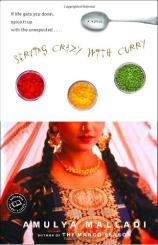
Serving Crazy With Curry


Review
Serving Crazy With Curry




Amulya Malladi’s third novel is SERVING CRAZY WITH CURRY, a dark comedy in which suicide is the center of the story. The reader is allowed inside the thoughts of Devi Veturi as she ponders killing herself, plans it, attempts it, and then tries to recover from it while living with her crazy family in the middle of California’s famous Silicon Valley. It almost resembles a Bollywood-style movie and is just as entertaining.
The book opens with Devi contemplating reasons to die. She writes a list of pros and cons of whether to die or not, as if she were deciding on something as mundane as buying a house. It’s important, but she treats the idea as a business plan, which can be of equal importance. And she has just been laid off (again), which doesn’t help with her depression. Despite how she feels, her list tells her that she must save herself and abandon her previous plans, but she has already made up her mind and is now devising ways to do it. She has finally made her decision --- or thinks she has --- but she’s up all night worrying about this business of suicide.
She then decides to call her father, as it is now morning and because talking to him would help stall her decision to kill herself. She hears her family in the background as her father answers the phone. There are tears in her eyes, but she tells him that she is fine and doesn’t let on about her latest job, or how she is really feeling. She wants her father to make things better but knows that everything that has happened to her is her own fault and that she is responsible for her own actions. She will deal with her life as only she knows how.
What saves her is a "mistake" she made the previous year, by giving her mother a set of keys to her apartment. From then on, her mother, Saroj, would make appearances at the apartment, with one excuse or another. On the morning when Devi attempts to kill herself, her mother has the sixth sense to come over to see her eldest daughter. Devi’s other mistake was refusing to talk to her mother when she had called earlier that morning. When Saroj finds out from Girish, her son-in-law, that Devi had just lost her job, she rushes to the apartment to see how Devi is doing. Saroj finds her daughter in the bathtub, blood everywhere.
The family, already living in a dysfunctional state, goes into cardiac arrest when they find out about Devi. Her parents bring her home to recuperate, and although they are not quite sure if she’s making any progress with her emotional state, they do know one thing: she refuses to speak. Instead, she voices her emotions through cooking, which is more than her family can take. Yes, they have discovered that Devi has a gift for cooking, which was never apparent before. But on the other hand, she WAS communicating through her food to express feelings, whether it was of happiness or anger. On one occasion, she creates such a hot and spicy meal that it was almost impossible for anyone to eat it. Everyone, however, knew how she felt. The food said it all.
Devi starts a journal while she is recuperating and expresses her feelings through her recipes. Each recipe reflects what she is feeling at the moment, explained through the ingredients and how she prepares the dish. It is a very clever way of getting inside her head, and the reader begins to understand what Devi truly is going through. The center of her depression, however, is not fully realized until much later in the book when it is finally revealed exactly why Devi wanted to end her life.
A wonderful book and probably Malladi’s best so far, SERVING CRAZY WITH CURRY is a very inventive way of using recipes to help tell a story. Malladi creates a family of characters that one can imagine on the big screen: the jealous younger sister, the doting father, the nagging mother, the grandmother, and the good son-in-law. While some books are noted for either a great story line or a great set of characters, this book can boast both. This reviewer would love to see a sequel, to see where Devi and her family go from here.
Reviewed by Marie Hashima Lofton on January 23, 2011


Serving Crazy With Curry
- Publication Date: October 26, 2004
- Genres: Fiction
- Paperback: 251 pages
- Publisher: Ballantine Books
- ISBN-10: 0345466128
- ISBN-13: 9780345466129