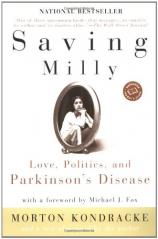
Saving Milly
by Morton Kondracke
List Price: $14.00
Pages: 320
Format: Paperback
ISBN: 034545197X
Publisher: Ballantine
A powerfully moving chronicle of a remarkable couple's battle with the devastating physical and emotional effects of Parkinson's disease. It is also the unforgettable story of Morton's own transformation from careerist to caregiver and disease activist- a process that has deepened his religious faith.
top of the page

1. How do you personally reconcile the existence of evil in the world with the idea of an all-powerful, all-knowing, and loving God? Why do you think bad things happen to good people?
2. How would you react if you were diagnosed with a chronic, incurable illness, or if this happened to a person you love? Would your reaction be more like Mort's or Milly's?
3. The journalist Michael Kinsley, announcing in Time magazine that he has Parkinson's, defended the idea of "denial"-- keeping the disease secret for as long as possible and trying to get on with one's life. He disparaged "aggressive victimhood" or "confrontation"--in other words, going public and demanding action. What would your choice be?
4. Why do you suppose that women are so much more likely to "stick it out" with a chronically ill spouse than men are?
5. Should government--federal, state, or local--provide assistance (whether in money or nursing services) to spouses caring for a chronically ill mate?
6. Does it strike you as unethical for a journalist to lobby the White House or Congress for what he or she believes is a good cause?
7. How did you react to the fact that wide disparities--by hundreds, sometimes even thousands of dollars per victim-- exist in federal research funding for various diseases? How do you think federal dollars should be allocated?
8. Should allocations of disease research money be "political"? Can it be otherwise as long as Congress appropriates the money for medical research?
9. Would you favor creating a dependable, dedicated money source for medical research, such as a 1 percent or 2 percent tax on health insurance premiums or a tax increase on such illness-producing products as tobacco, alcohol, or high-fat foods?
10. Do you believe that human embryos "leftover" at fertility clinics and destined to be discarded should be used to extract stem cells for medical research? If so, should the federal government fund this research?
11. Should the government outlaw the cloning of human embryos for both reproductive and research purposes, as President Bush advocates?
12. Should terminally ill people have the right to end their own lives? If so, under what circumstances? In hospices, where they can be kept comfortable as they refuse food and water? Or by assisted suicide, in which a doctor actually administers lethal drugs?
top of the page

"One of those uncommon books that manages to ennoble its author and its reader alike."
The Wall Street Journal
"A TRULY COMPELLING READ . . . AN INTENSELY PERSONAL MEMOIR . . . There is only one Milly. And from what I learned in her husband's splendid book, she is a treasure."
National Review
"HONEST AND WISE . . . A love story that, without mushiness, plumbs the meaning of marriage . . . A tender tell-all that grabs one by the throat from the first paragraph to the last."
The Oregonian
"ONE OF THOSE BOOKS YOU OWE IT TO YOURSELF TO READ. . . . It is a moving testimonial to a brave woman. . . . It's a beautiful book. Do yourself a favor and read it."
Wisconsin State Journal
"WARM, LOVING, TENDER . . . IMPOSSIBLE TO PUT DOWN."
LARRY KING, USA Today
"POWERFUL, UNVARNISHED, HEARTRENDING."
Chicago Tribune