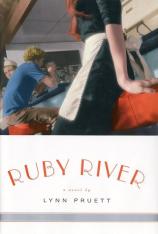
Ruby River
A Novel
by Lynn Pruett
List Price: $24.00
Pages: 288
Format: Hardcover
ISBN: 0871138557
Publisher: Atlantic Monthly Press
Warm and sensuous, Lynn Pruett's whirlwind of a novel drops us into a small town during a blistering Alabama summer where Hattie Bohannon has just opened a truck stop. A magnet for transients of questionable background and inclination, and run by Hattie's nubile daughters, the truck stop is an uneasy presence in tradition-bound, gossipy Maridoches. Crackling with the energy and spark of strong, colorful characters whose lives are continually colliding, Ruby River is a poignant, uplifting story by a writer of extraordinary generosity of spirit and earthy wit. Hattie is quietly mourning her recently dead husband and trying to determine the contours of herself alone, but too often her strong-willed daughterswhose burgeoning sexuality is attracting attention from the truck-stop patronskeep her at loose ends. In a season of unrelenting heat, desire gestates and hovers over Maridoches, threatening the moral equilibrium of the small church-town. Then Hattie's oldest daughter, Jessamine, is falsely accused of prostitution, and the reverend conveniently declares war against the immorality of the Bohannons and their establishment. What ensues is a clash of wills and values that will leave no one unaffected.
Lynn Pruett deftly weaves the struggles of Hattie, her daughters, and members of the community into a tapestry of individuals desperately trying to deny the conflicting urges of flesh and spirit, progress and tradition. In the manner of beloved contemporary writers such as Fannie Flagg and Rebecca Wells, Lynn Pruett's glorious talerich with the feel and flavor of the Southcaptures the struggle for the very soul of a community suddenly forced to look at itself in a new light.
top of the page

1. Truth and lies have a slippery relationship in Ruby River. One can lead to the other or transform itself into the other. Hattie's and Jessamine's lies about Heather lead to one demonstrable truth: Heather's membership in the family as daughter and sister. Jessamine's telling the truth about her love for Richard leads to her being lied about, and called a prostitute. When else in the novel are truth and lies confusing or deceptive?
2. "From watching this family I've learned that love is a lot like the Ruby Riversometimes it runs straight and true but sometimes it shoots out in a new direction, and when it does, you best just ride it." Do you think this comment by Darla would make an apt epigraph to the novel?
3. The river and other water references provide rich symbolism in the novel. Consider Reverend Peterson's uncomfortable fishing trip as he sits swaddled in the orange life jacket, having foregone the customary river baptism. The ladies' committee fervently requests that he give sermons about water (praying for rain, the Red Sea, bullrushes, the Great Flood) instead of the adultery and prostitution sermons that fire their husbands' lust. The river is a trysting place for Jessamine and Paul (as the waterfall has been earlier for Hattie and Paul). When prayer fails Martin Peterson, he decides on radical action: confront his beast, embrace temptation, and then rededicate his life at a river baptism. The tangle of lives in Gert, Hattie and Martin is resolved in a murky way by the near-drownings in Ruby River. What happens to Hattie's reputation and to Martin's messianic voice?
4. The narrative method of the novel is somewhat cubist as it multiplies the points of view of various characters. Would the novel be as effective if it were told from one point of view, say, that of Hattie or of Martin Peterson? What is gained from hearing so many voices? Are they all credible witnesses? Do you enjoy putting the pieces together, as in Rashomon, or do you prefer a strong third-person narrative?
5. As resourceful as she is, Hattie still relies on men in her life: on Oakley for posthumous advice, on Troy Clyde for muscle and straight talk, on Paul Dodd for retrieving Oakley's ashes. ("Then she'll have to decide if the past or the future matters the most.") Is her trust in these men validated? Does she find other sources of strength by the end of the book? What are they?
6. Behind the darkened windows of his midnight-blue Cadillac, Reverend Peterson watches his cool, elegant wife Stelle as she works her religious magic. (We are reminded of Dickens' Estella in Great Expectations, another woman beautiful and alluring, yet cold and distant as a star.) Meanwhile Martin fantasizes about prostitutes, real and alleged, about Gert's sizable body, even about the one-breasted Ann Reynolds. Is it ultimately lust that knits this congregation together?
7. Pruett's small town of Maridoches, Alabama, bristles with a whole world of characters. For instance, within the Bohannon family the daughters are sharply distinguished. Darla, "always out of the loop," still feels close to her father and tries to find him. How? Heather, the only brown-eyed one in a family of blue eyes, is too young to remember her father. Why? Jessamine is the wild card who more than once compromises Hattie's efforts to run a tight shop. What about Connie? Discuss the twists in the girls' relationships with one and other as well as with their mother. This is a family of women, diverse, unconventional for this town, often disputing, yet a strong family nonetheless. What is Pruett saying about the value of family that transcends conservative and liberal attitudes?
8. Hattie says, "I wish those churchwomen had jobs. Then they'd quit poking their noses where they don't belong." Is Hattie saying that gainful employment can keep women from mischievous "moral" meddling? Could her comment be extended to sexual adventuring? And if so, why should that work for women and not for men?
9. Male dominance is thrown into question in various ways in Ruby River. The Council of Elders is composed of men, yet it is Stelle who handles the of the church. Jewell acknowledges to Darla that "there's not much opportunity in this country for a young woman, other than the ancient choices." What are those ancient choices? Is she exaggerating?
10. Hattie, like many mothers, learns as much from her daughters as she teaches. After the prom, her "first reaction to the fiasco had been anger at her daughter. Why couldn't Connie go to the prom and return without scandal? As the pieces of the story came out and she understood Connie's fear and courage, she felt ashamed of herself." What other instances can you recall of Hattie's learning from her daughters? When is her maternal loyalty most severely tested? How does she resolve her anger at or disappointment in her daughters at different times?
11. Ruby River contains numerous examples of desire and its subversion through addiction. What about Gert's size, her role as cook? How does she deny desire or give in to other physical pleasures? Is she a hypocrite for loving food and cigarettes as much as God? How do other characters cope with addiction and withdrawal?
12. Cooking offers a bountiful selection of metaphors in this book set in a truck-stop café: cooks vie for power ("Worcestershire?" " More pepper?"), and the quest for fresh tomatoes involves cloak-and-dagger irrigation. Cooking is invoked for courting, and a recycled recipe reveals treachery. Consider the cooking philosophies of Gert, Hattie, Paul, and Jessamine, among others. Can you form opinions of these characters through their cooking? How does cooking play important symbolic roles in our own lives even in an era of takeout and microwave?
13. From the outset of the novel Hattie is set up as an outsider, a woman not only better-looking, single, and more competent, but one with an outlook on life different than that of her neighbors. What are the consequences of her independence? When does her pride lead to peril? What is complicated about her being an individual rather than part of a couple? At one point she thinks, "I am my children. I am my job." Do you think she is sacrificing her identity as a person for valid reasons? Paul says, "You're their mother, but you have a life." But does Hattie "have a life" as she adheres to loyalty for her dead husband?
14. Stelle Peterson, the reverend's wife, becomes a creature of higher calling, higher even than her husband's. She no longer shares the appetites of her neighbors (in fact, she can hardly contemplate preparing a meal for Martin). Instead she provides mysticism for the church and pours herself into furious painting. Are Reverend Peterson's inability to connect with Stelle and his bitter war against the truck stop coincidental? Is Martin a cynical calculator, or is he, like his flock, flawed and unable to control all that he wishes? Do you sympathize with Martin?
15. How do we react to the church in Ruby River? Recall the church office, a stage set for revival, with its fabric waterfall undulating down the wall, an audiotape simulating a flowing river, Stelle speaking of God's forgiveness, draped in sunset colors streaming through a stained-glass windowhow can a girl resist such pageantry? "Can I come tonight to the revival?" asks Jessamine. What are we to make of this manipulation, this masterly PR that yet serves a hunger for Jessamine and others? Do you see any good coming out of the Church of the Holy Resurrection in this novel? Are there resurrections that are sly, ironic and offbeat?
16. Even in the male bastion of the church there are hints of change. Gert arms Ash Lee with a Polaroid to hook hypocrites. Stelle nudges her minister husband with new observations and questions. "Adam ate the apple, too. You cannot blame it all on her." And "Whose paradise, Martin? God's? Adam's? How did Eve feel being an afterthought?" Is it only the women who begin to ask about their roles? Or do the men in the book begin to learn new things, too? (For some it takes catastrophe to crack their assumptions.)
17. Politics and religion become blurred in Ruby River. Public morality is linked to private greed, as in the churchmen's business motivations, establishing a steak house, for instance, in place of the truck stop. Is the microcosm of this small town applicable to larger communities? Should people aspire to strict separation of church and secular offices? Are there ever advantages to church and state working together, or is the cost/risk always too high? Think about examples in current events.
18. Dreams that disintegrate are symbolized by Connie's beautiful prom dress, fancy hairdo, and vision of herself as lovely, all left in tatters by the brute Kyle, calling her "truck stop girl" and treating her worse. "The church ladies' march had tarred all of us." Not all dreams in the book are merely crushed. Some characters' dreams take a new course, such as Hattie's and her enshrining of Oakley. Can you think of other dreams that transform or take on new life in the book?
19. Hattie's needs are at odds. "She wanted a man who would police the world so her daughter could go to the prom without being attacked by a teenage boy. She wanted him to protect the truth, not merely the law. . . . What she wanted from him was unfair. To make her world right, safe, honest. To hold and protect her, to lift her when she was tired, to laugh at her jokes, to share her children's woes, to offer solace and intelligence, guidance and help. Good Lord, she thought. What a price to pay for good sex." (p. 192) Who's paying the price here? What can men and women realistically expect of one and other?
20. Daddy Oakley remains a will o' the wisp and a dilemma for the family. Central images are his Jetstar 88, his lost and found ashes, and his barn boards. There is the issue of whom to invite to the memorial bonfire. Jewell? Jessamine and Paul? "It seemed Daddy would always be with us, waiting for a proper acknowledgment, stuck in a purgatory of our minds and memories." Do you think the ghost is ever truly laid to rest for the family? Is there evidence?
21. Perhaps not since Chaucer's Canterbury Tales have we seen such bald and funnyoutrageous, sinning hypocrites mouthing pieties as they plot their own prosperity. Think of Toller Lee who, hearing of Jessamine's sin-washing baptism, says, "That's all well and good . . . but it interferes with our other holy purpose of establishing a Christian steak house on the site of former sin." Or of Gert, who finds her mission in a wickedly funny alliance with Ash Lee. What are other examples in the book? What in public life in our time? What is your opinion about exposing the hypocritical, and how much latitude should be given to track it downshould phones be tapped or trash gone through? Do you think Paparazzi and tabloid methods are ever justified?
22. Hattie and Reverend Peterson both struggle to fulfill a public role (mother/business owner, minister) that conflicts with their personal needs. Does either succeed in having personal needs met? What is sacrificed in this struggle? Why is it so necessary in our society to define people by their sexual activity"or lack of it", as Hattie says?
top of the page

"Ruby River is gorgeously written and its changing points of view are enlivened by the authors nonjudgmental empathy with her diverse characters and leavened by her humor, embedded within a serious tale about character and morality." Martin Northway, St. Louis Post-Dispatch
"Lynn Pruett's novel is funny, smart, sexy, and full of heart. She understands small towns and small-town people, but she never condescends to her lively and engaging characters."
Lee Smith, author of Fair and Tender Ladies and Saving Grace
"Lynn Pruett's writing can break your heart and make you laugh within the same carefully structured sentence. This novel pulls off that nearly impossible feat of being both wonderfully poetic and wildly entertaining. Most of all, Ruby River is brimming with real lifeall of its joys and sorrows and the moments of revelation in between, told with a graceful clarity that will leave readers desperate for more."
Silas House, author of Clay's Quilt and The Cool of the Day
"Lynn Pruett is a wonderful storyteller. Limitations of money, education, and mobility confront her characters, but their toughness, humor, and sexuality give them choices, complexity, and fire that make us care deeply about them. She renders tough economic and political realities while keeping the heart fully engaged. Lynn Pruett is a hell of a writer and Ruby River is a beautiful novel."
Tim Parrish, author of Red Stick Men
"A Southern story told by a Southern writer who must have spent some very hot days in some small Southern towns. Lynn Pruett knows her territory."
Rodney Barfield, Roanoke Times
"A sensuous, humorous, heart-breaking and uplifting look at life in a small Alabama town. . . . [Ruby River] evokes the physical and spiritual heat of the South, with passions rising amidst gossip and religious hypocrisy."
Dawn Mosher, The New Haven Advocate
"In her debut novel, Pruett writes evocatively, even poetically, of the South, fully drawing characters whose varied points of view are presented in chapters bearing their names. Her amusing descriptions offer lovely surprises and good reading. . . . Highly recommended for all fiction collections."
Library Journal
"Snappy, smart writing, and memorable characters distinguish Pruetts debut."
Kristine Huntley, Booklist