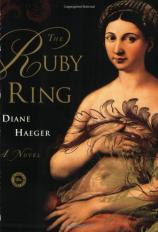
The Ruby Ring
A Novel
by Diane Haeger
List Price: $12.95
Pages: 384
Format: Paperback
ISBN: 1400051738
Publisher: Three Rivers Press
Rome, 1520. The Eternal City is in mourning. Raphael Sanzio, beloved painter and national hero, has died suddenly at the height of his fame. His body lies in state at the splendid marble Pantheon. At the nearby convent of Sant’Apollonia, a young woman comes to the Mother Superior, seeking refuge. She is Margherita Luti, a baker’s daughter from a humble neighborhood on the Tiber, now an outcast from Roman society, persecuted by powerful enemies within the Vatican. Margherita was Raphael’s beloved and appeared as the Madonna in many of his paintings. Theirs was a love for the ages. But now that Raphael is gone, the convent is her only hope of finding an honest and peaceful life.
The Mother Superior agrees to admit Margherita to their order. But first, she must give up the ruby ring she wears on her left hand, the ring she had worn in Raphael’s scandalous nude “engagement portrait.” The ring has a storied past, and it must be returned to the Church or Margherita will be cast out into the streets. Behind the quiet walls of the convent, Margherita makes her decision . . . and remembers her life with Raphael—and the love and torment—embodied in that one precious jewel.
In The Ruby Ring, Diane Haeger brings to life a love affair so passionate that it remains undimmed by time. Set in the sumptuous world of the Italian Renaissance, it’s the story of the clergymen, artists, rakes, and noblemen who made Raphael and Margherita’s world the most dynamic and decadent era in European history.
top of the page

1. Like Margherita, Raphael idealizes his dead mother, “whose loss had forever changed his life.” How is his obsession with the Madonna image linked to this tragedy? Does his sense of abandonment abate once he is involved with Margherita?
2. As the story opens, Raphael has lost the “heated passion toward creation” that once fueled his painting. His artistic block is already well known to his increasingly impatient patrons. Why, then, does he attempt to keep it a secret from his assistants? Is he motivated by pride, or by kindness?
3. Francesco Luti urges his daughter to take the plunge and accept Raphael’s extraordinary invitation to model for him. “Look beyond your nose,” he argues. “There is a whole wide world out there, and none of us has ever had the chance to see any of it.” How does his advice echo the advice pressed upon Raphael by his own father? What are both fathers trying to protect their children from, and what counterargument do both Margherita and Raphael offer in response?
4. Margherita’s stubborn refusal to succumb to Raphael’s advances stems from a deep cynicism about the entrenched social hierarchy in Rome: “A man who breaks bread with dukes, kings, and the Holy Father himself does not make a wife of the woman who bakes that bread!” she insists. Does she ever fully transcend this sense of social inferiority beside Raphael?
5. Raphael is surprisingly compassionate toward his enemies. Even when Sebastiano Luciani hires thugs to break Raphael’s hand, Raphael rationalizes, “He is desperate, and desperation can all too easily cloud the mind of wisdom.” Is Raphael too soft for his own good?
6. It is common Vatican knowledge that Cardinal Bibbiena cares deeply about the happiness of his niece, Maria. Yet when she begs to be allowed to call off her agonizing and embarrassing engagement to the unfeeling Raphael, the cardinal refuses her this relief. Why?
7. What does Antonio stand to gain by telling Agostino Chigi that Margherita is the cause of Raphael’s deteriorating work pace? Does he achieve it?
8. With his dedication to his commissions flagging, his distaste for the hypocrisies of the Vatican growing, plenty of wealth amassed, an interested clientele in France, and Margherita with whom to build a new life—why doesn’t Raphael simply throw in the towel and set himself free from the constant pressure that plagues him in Rome?
9. At the beginning of the novel, Margherita makes it very clear that she is too savvy to be bamboozled by the likes of Raphael. Why, then, does she allow herself to be charmed by the sleazy Sebastiano Luciani, even going so far as to dismiss Raphael’s warnings about him: “Raphael must be wrong about him . . . Sebastiano simply could not be guilty of those . . . awful things.” Why does she sit with him, unchaperoned, at the pope’s party?
10. When it becomes clear that the kidnapping plan has backfired and Raphael has not resumed his prolific work pace, Agostino Chigi suggests to Pope Leo that it’s time to confess the plot to Raphael. Is Chigi motivated by compassion here, or by the same self-interest that motivates Leo and Bibbiena? Why does the pope agree to do it?
11. Only when Raphael lies dying and Margherita is in dire straits do we discover that her relations with her family have deteriorated to the point where “They did not want her back now . . . she could never go home to the bakery or the life she once had lived there.” Why do you think the author skips over the potentially juicy story of the Luti family’s disintegration?
12. Margherita’s motivation for destroying Raphael’s new will—which leaves everything to her—and replacing it with the old one, which bequeaths Raphael’s estate to Giulio Romano, is left a mystery. Can you decipher a meaning behind Margherita’s selfpunishing decision?
13. How does Donato gently reveal to Margherita both Antonio’s duplicity and Raphael’s genius? Why does he betray his brother's secret?
14. Why does Raphael blame the supposed celibacy of the clergy for some of his troubles?
15. Why do you think the author includes the subplot involving Maria Bibbiena and her chief guard? Does the guard’s attention and tenderness humanize Maria in your view? What point is the author making about unexpressed attraction?
16. What parting advice does Leonardo da Vinci offer Raphael about how to handle his relationship with Margherita? Is it wise?
17. Does Raphael’s pervasive self-doubt and the episodes of selfpity that verge on wallowing—bemoaning his life “with no family, no love, no reason even to exist, but only to paint and work to the point of exhaustion and blindness! To create only for the desire of others, on and on . . . day after day, then return home completely alone!”, for example—make him a more accessible character? Why or why not?
top of the page