IndieBound Independent Bookstores BRC Facebook Fan Page
Coming Soon
Reading Group Guide
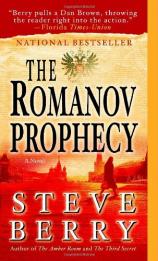
The Romanov Prophecy
by Steve Berry

List Price: $6.99
Pages: 416
Format: Paperback
ISBN: 0345460065
Publisher: Fawcett Books

Click here to buy this book from Amazon.com.
Click here to buy this book from Amazon.ca.


About This Book


On July 11, 1613, sixteen-year-old Mikhail Romanov was crowned Tsar of All Russia. So began the Romanov dynasty, which continued unbroken until July 16, 1918, when Nicholas II and his family were executed. Interestingly, Mikhail, the first Romanov, was found at the Ipatiev Monastery in Siberia where he'd taken refuge with his mother, and the last Romanov, Nicholas II, was murdered in the Ipatiev house located in the Siberian town of Yekaterinburg. A strange, circular journey that took the Romanov family from the heights of absolute power to the depths of total destruction.

During the 305 years of Romanov rule, an assortment of men and women held the throne. They ranged from the incompetent, like Peter III (1762) and Paul I (1796-1801), to the dynamic, like Peter the Great (1682-1695) and Catherine the Great (1762-1796). Tragedy seemed the family's constant companion. Ivan VI (1740-1741) spent his life in solitary confinement. Peter II (1727-1730) was beaten to death. Paul I (1796-1801) was strangled. Alexander II (1855-1881) bombed. Nicholas II (1894-1917) shot. But there was likewise unparalleled accomplishment as Russia was led from an isolated, agricultural state dependent solely on serfdom for its existence to an industrial, world power.

The dynasty fell on March 15,1917 when Nicholas II, facing a internal revolution that he could not stop and an external world war he could not win, signed his abdication. On March 22, 1917 Nicholas joined his wife, Alexandra, son, Alexei, and four daughters (Maria, Olga, Tatiana, and Anastasia) and together they were confined in the Alexander Palace at Tsarskoye Selo. The Provisional Government attempted to obtain asylum for the family in England. But King George V, Nicholas II's cousin, fearing a backlash from the English people, refused the request. The Provisional Government, fearing for the Tsar's safety, then moved the family west to Tobolsk, in Siberia. The family stayed there eight months, during which time the Provisional Government was overthrown by Lenin and the Bolsheviks in a bloodless coup that came to known as the October Revolution.

The family was then moved farther west, deeper into Siberia, to Yekaterinburg. There, they were surrounded by Red Bolsheviks and guarded by radical anti-Tsarists. The local Ural Soviet and the Central Moscow Committee, led by Lenin, finally made the decision to eliminate the entire family. On July 16, 1918 they were awakened in the middle of the night, taken to a basement room, and shot. Their bodies were eventually buried in a muddy roadway, beneath railroad ties, where they remained until 1979.

That was when a retired geologist, Alexander Avdonin, and a Russian filmmaker, Geli Ryabov, deduced where the burial site was located. But it was not until 1991 that the bones were exhumed. It took another three years to positively identify the remains through DNA analysis, and something shocking was learned. Only nine skeletons were in the grave. There should have been eleven. Two of Nicholas II's children were not there. Russian experts who examined the bones concluded, from photographic superimposition, that daughter, Maria, and son, Alexei, were missing. An American expert analyzed dental and bone specimens and independently determined the missing to be son, Alexei, and daughter, Anastasia. The debate over who was right raged for years and has, to this day, never been resolved. The only point that all agree upon is that the remains of two imperial children have never been found.

Even in death, the Romanovs generated controversy. While pathologists debated over their findings, the cities of Yekaterinburg and St. Petersburg fought bitterly over where their final burial would occur. Tsars for centuries had been laid to rest in the cathedral at St. Petersburg, but Yekaterinburg argued that the family had died in Siberia and should be buried there as well. While these debates ensued, the bones of Nicholas II and his family languished on laboratory shelves, awaiting a decision. Finally, a Russian commission chose St. Petersburg and on July 16, 1998, the imperial family was entombed, with royal pomp and circumstance, alongside their ancestors. They were buried togther. Which is fitting, since all observers agree that in life they were a close, loving family.

And in death, so shall they remain.

top of the page


rgg_discuss.gif (1294 bytes)


1. In Berry's first novel of suspense, The Amber Room, he used as his backdrop a piece of history that is very real but largely unknown to the American audience. In this novel, he uses as his backdrop a much better known piece of history-namely, the execution of Russia's last royal family. Before reading this novel, how much did you know about the Romanovs and their tragic end? Did you find Berry's research enlightening, were you aware of these historical events? How did your prior knowledge-or lack thereof-affect your interest in this backdrop and storyline? In general, would you rather read a novel concerned with 1) a historical incident you know well, 2) a historical incident about which you know something but not too much, or 3) a historical incident with which you are completely unfamiliar?

2. The Prologue in The Romanov Prophecy introduces you to the Romanovs, and their concern for succession, and also to Rasputin, whose words become crucial to the story later on. Did you enjoy the Prologue? Did it intrigue you and compel you to read on? How did it add to the overall atmosphere of the book?

3. In The Romanov Prophecy bullets fly in the first paragraph of Chapter 1, and we find Miles Lord on the run from then on. Do you prefer when a novel of this type builds suspense slowly and steadily, or when it begins with a bang? Did the first chapter's frantic opening help you sympathize with Lord's disorientation and subsequent struggle for survival? Or did the quick pace exhaust or confuse you as a reader? How did you feel about the pace throughout the rest of the novel?

4. Miles Lord is an African-American, and we learn early on how his complexion sets him apart from others in Russia. Why do you think Berry chose to create a black narrator in Russia? How does Lord's race affect his quest? How does it enhance the book's tension? And how does Berry use it to tell us more about Russia?

5. Early on in the book, the reader learns that Taylor Hayes is not as trustworthy as Lord thinks he is. Throughout the rest of the novel, this provides a great deal of dramatic irony, as Lord continues to trust Hayes implicitly while the reader recognizes he is making a nearly fatal mistake. How does Berry use this device (dramatic irony) to raise tension and to play with readers' expectations? Did you buy into Lord's continuing trust of his boss? And did you think that this source of tension sustained itself over the course of the entire book?

6. Accidentally (or not at all accidentally, if you believe Rasputin's words), Lord comes to partner up with Akilina Petrovna, a circus performer who is proudly Russian, though she has undoubtedly experienced all the worst Russia has had to offer over the years. As their quest comes more and more to follow the path prophesied so many years before by Rasputin, Akilina is much quicker than Lord to accept the predestined or mythical nature of it all. Lord more steadfastly maintains skepticism through much of the novel. Did you feel that Akilina was too quick to accept the prophecy? Did you feel that Lord was too slow? Berry seems to place much of the reasoning behind this difference between them on the national characters of Russia and the United States. What does this tell us about Russians, and about Americans? Do you agree with Berry's analysis?

7. Throughout the novel, Berry basically employs only three points of view-Lord's, Hayes', and Akilina's. Are these three points of view enough with which to tell the story fully? In your opinion, are any of the three unnecessary? Whose point of view was the most interesting to you? Whose was the least interesting? How did the relatively small number of points of view enhance the novel? In your opinion, did it in any way detract from the novel?

8. When Lord and Akilina finally know for sure that Michael Thorn is the Romanov descendent they've been seeking, Lord asks him, "Why haven't you come forward?" Thorn responds: "I was always told not to reveal myself unless the raven and the eagle appeared and the words were uttered. Anything less was a trap laid down by our enemies." Did you find this tough to accept, as Lord does? Clearly it makes sense to Thorn, who is of the mindset that he is part of something much larger than himself. But, in your opinion, is he too respectful of the mysticism surrounding the succession? Should he have stepped forward as soon as the search for a successor began?

9. A number of times throughout the novel, we return to the actual events of July 16, 1918, when the Romanov family was executed and their bodies disposed of. Did you find these sections more or less gripping than the rest of the novel? And how did you feel about the way Berry revealed them slowly, over the course of a few hundred pages, through the words of numerous characters?

10. Obviously, this novel in many ways builds to the revelation of what "really" happened in July 1918-in Berry's version, Alexie and Anastasia were saved heroically and secretly, and then transported to America. Did you find this a satisfying and fitting conclusion? Did you find it believable? And if you're not convinced by Berry's fictional theory, what do you think really happened?

top of the page

Critical Praise

"The Romanov Prophecy grabs a hold of the reader within the first few pages . . . a captivating work . . . I'm surprised that The Romanov Prophecy doesn't come with a blood pressure cuff shrink-wrapped to it. But don't let that stop you from reading this riveting work . . . more than an artistic triumph in the thriller genre; it is also the ultimate justification of those who had faith in Berry and, more importantly, Berry's faith in himself. Highly recommended."
Bookreporter.com


"The fate of Mother Russia ups the ante for Berry's formula: based on international intrigue, swashbuckling action, indestructible hero from the American South. . . . Not to be missed."
Kirkus Reviews


"In his accomplished second thriller, Berry turns to another great historical mystery --- the 1918 murder of Nicholas II and his family --- skillfully blending fact with a contemporary tale of conspiracy. . . . Exciting action, an engrossing puzzle, and atmospheric settings make this a great read. Highly recommended for all public libraries."
Library Journal


"Berry uses Russia --- past and present --- to excellent effect and makes sharp observations about the contemporary Russian scene . . . a solid tale, a cut above --- and then some --- many thrillers on the market."
Publishers Weekly


Privacy Policy | Contact Us | Advertising | About Us

© Copyright 2001-2010, ReadingGroupGuides.com. All rights reserved.
The Book Report, Inc. • 250 West 57th Street • Suite 1228 • New York, NY • 10107
Ph: 212-246-3100 • Fax: 212-246-4640

Bookreporter.comReadingGroupGuides.comGraphicNovelReporter.comFaithfulReader.com
Teenreads.comKidsreads.comAuthorsOnTheWeb.comAuthorYellowPages.com