Reading Group Guide
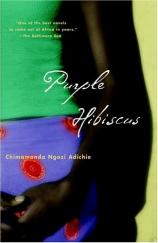
Purple Hibiscus
A Novel
by Chimamanda Ngozi Adichie

List Price: $13.00
Pages: 320
Format: Paperback
ISBN: 1400076943
Publisher: Anchor

Click here to buy this book from Amazon.com.
Click here to buy this book from Amazon.ca.


About This Book


Fifteen-year-old Kambili's world is circumscribed by the high walls and frangipani trees of her family compound. Her wealthy Catholic father, under whose shadow Kambili lives, while generous and politically active in the community, is repressive and fanatically religious at home.

When Nigeria begins to fall apart under a military coup, Kambili's father sends her and her brother away to stay with their aunt, a University professor, whose house is noisy and full of laughter. There, Kambili and her brother discover a life and love beyond the confines of their father's authority. The visit will lift the silence from their world and, in time, give rise to devotion and defiance that reveal themselves in profound and unexpected ways. This is a book about the promise of freedom; about the blurred lines between childhood and adulthood; between love and hatred, between the old gods and the new.

top of the page


rgg_discuss.gif (1294 bytes)


1. What is the emotional atmosphere in Kambili's home? What effect does this have on Kambili and Jaja? Why is their father so strict?

2. When Kambili visits Aunty Ifeoma, she is immediately struck by how much laughter fills the house. Why is it so surprising to her to hear people speak, laugh, and argue so freely? How does she manage to regain her own ability to speak, and, most importantly, to laugh?

3. When Kambili hears Amaka weeping after her grandfather's death, Kambili thinks: "She had not learned the art of silent crying. She had not needed to" [p. 185]. What does this passage suggest about the differences between Amaka and Kambili? In what other ways are Aunty Ifeoma's children—Amaka, Obiora, and Chima—different from Kambili and Jaja?

4. Amaka says, "Uncle Eugene is not a bad man, really. . . . People have problems, people make mistakes" [p. 251]. Is he in fact a "bad man"? Why does he violently abuse his wife and children? What good deeds does he perform? How can his generosity and political integrity coexist with his religious intolerance?

5. In what ways are Aunty Ifeoma and Eugene different from one another? How does each character approach life? How do they differ in their religious views? Why is Ifeoma so much happier even though she is poor and her brother is rich?

6. Eugene boasts that his Kambili and Jaja are "not like those loud children people are raising these days, with no home training and no fear of God"; to which Ade Coker replies: "Imagine what the Standard would be if we were all quiet" [p. 58]. Why is quiet obedience a questionable virtue in a country where the truth needs to be spoken? In what ways is the refusal to be quiet dangerous?

7. What kind of man is Papa-Nnukwu? What are his most appealing qualities? What do the things he prays for say about his character? Why has his son disowned him so completely?

8. What are the ironies involved in Eugene loving God the Father and Jesus the Son, but despising his own father and abusing his own son?

9. Why does Kambili's mother keep returning to her husband, even after he beats her so badly that he causes a miscarriage, and even after he nearly kills Kambili? How does she justify her husband's behavior? How should she be judged for poisoning her husband?

10. How does Father Amadi bring Kambili to life? Why is her relationship with him so important to her sense of herself?

11. Jaja questions why Jesus had to be sacrificed, "Why did He have to murder his own son so we would be saved? Why didn't He just go ahead and save us?" [p. 289] And yet, Jaja sacrifices himself to save his mother from prison. Why does he do this? Should this be understood as a Christian sacrifice or a simple act of compassion and bravery?

12. After Aunty Ifeoma moves her family to the United States, Amaka writes, "there has never been a power outage and hot water runs from a tap, but we don't laugh anymore . . . because we no longer have the time to laugh, because we don't even see one another" [p. 301]. What does this passage suggest about the essential difference between American culture and African culture?

13. What does the novel as a whole say about the nature of religion? About the relationship between belief and behavior?

14. What does Purple Hibiscus reveal about life in Nigeria? How are Nigerians similar to Americans? In what significant ways are they different? How do Americans regard Nigerians in the novel?

15. Why does Chimamanda Ngozi Adichie end the novel with an image of rain clouds? What are the implications of Kambili feeling that the clouds hung so low she "could reach out and squeeze the moisture from them"? What is the meaning of the novel's very simple final sentence: "The new rains will come down soon"?

top of the page

Critical Praise

"One of the best novels to come out of Africa in years."
The Baltimore Sun


"A breathtaking debut. . .[Adichie] is very much the 21st-century daughter of that other great Igbo novelist, Chinua Achebe."
The Washington Post Book World


"The author's straightforward prose captures the tragic riddle of a man who has made an unquestionably positive contribution to the lives of strangers while abandoning the needs of those who are closest to him."
The New York Times Book Review


"At once the portrait of a country and a family, of terrible choices and the tremulous pleasure of an odd, rare purple hibiscus blooming amid a conforming sea of red ones"
San Francisco Chronicle

 
Back to top.   


Privacy Policy | Contact Us | Advertising | About Us

© Copyright 2001-2009, ReadingGroupGuides.com. All rights reserved.
The Book Report, Inc. • 250 West 57th Street • Suite 1228 • New York, NY • 10107
Ph: 212-246-3100 • Fax: 212-246-4640

Bookreporter.comReadingGroupGuides.comGraphicNovelReporter.comFaithfulReader.com
Teenreads.comKidsreads.comAuthorsOnTheWeb.comAuthorYellowPages.com