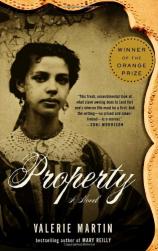
Property
A Novel
by Valerie Martin
List Price: $12.00
Pages: 208
Format: Paperback
ISBN: 0375713301
Publisher: Vintage Books
From the acclaimed author of Mary Reilly, a groundbreaking novel that reexamines the questions of power and resistance, violence and sex, which inform all her work.
Set in the surreal heat of the antebellum South during a slave rebellion, Property takes the form of a dramatic monologue, bringing to the page a voice rarely heard in American fiction: the voice of a woman slave holder. Manon Gaudet is pretty and petulant, self-absorbed and bored. She has come to a sugar plantation north of New Orleans as a bride, bringing with her a prized piece of property, the young slave Sarah, only to see Sarah become her husband’s mistress and bear his child. As the whispers of a slave rebellion grow louder and more threatening, Manon speaks to us of her past and her present, her longings and dreams an uncensored, pitch-perfect voice from the heart of moral darkness.
Property is riveting fiction, fast, richly plotted, shimmering with visual detail. It is also an invitation to re-examine the traditions of the Southern novel and the myth of the chivalrous South, and a haunting meditation on what Valerie Martin has called "the fantastic and constant perversity of the oppressor to feel victimized by the oppressed."
top of the page

1. In the course of this novel, Manon Gaudet moves from adoring her dead father to rejecting him so fiercely that she turns his picture face down and calls him a hypocrite. Discuss the psychological progression that leads Manon to this thoroughgoing change of heart.
2. Manon recalls that as a child her father told her that "Religion was for the negroes," adding that "it was their solace and consolation, as they are ours" (p.22). Discuss this remark.
3. In what sense is Sarah an alter ego or a double for Manon?
4. Manon hears voices at several points in the novel, and they’re always saying things she can’t quite understand. Where do you think these voices are coming from?
5. This novel opens with a woman watching her husband through a spyglass. Is this a metaphor for what follows?
6. There are several scenes involving nursing in this novel. Manon suggests that the practice of sending babies out to be nursed by slaves is "how the poison entered us all" (p.180). What is this poison?
7. "It was the lie at the center of everything, the great lie we all supported, tended and worshipped as if our lives depended upon it…" (p.179). Manon claims that it is this lie that has turned her heart to stone, and not, as her aunt maintains, the burden of her childlessness. What, in your view, constitutes this lie?
8. When Manon is in her husband’s control, one might say that she is something of a slave herself. But once her husband is dead, she is perfectly free. What can explain the persistence of her sense of injustice and victimization?
9. Why does the author refuse to let Sarah tell the story of her failed escape from bondage herself? What could be the purpose of having these events related third hand, by the slave-catcher to an acquaintance and thence to Manon’s Aunt Lelia?
10. When Manon refuses to sell Sarah and Walter to Mr. Roget, she says the bit of white plaster that falls from his cuff onto the carpet spurs her decision, that it "enraged" her and, unbeknownst to Mr. Roget, "sealed his fate" (p.170). Is it really the reason Manon refuses to part with Sarah and Walter? Why does Mr. Roget’s offer make her so angry?
11. How does Manon really feel about Walter by the end of the novel? What do you imagine will become of him?
top of the page

"I made the "mistake" of glancing at the opening page and was instantly hijacked into the text. This fresh, unsentimental look at what slaveowning does to (and for) one’s interior life must be a first. And the writing so prised and clean-limbedis a marvel"
Toni Morrison
"A wonderful novel, vivid, revealing."
Carol Shields
"In this stunningly powerful novel, Valerie Martin's gifts--a fearless originality and seemingly limitless perspective combined with a cool and elegant intelligenc--are all on splendid display."
Barbara Gowdy
"[Property] is vivid and gripping. I read it in one gulp."
Marilyn French