Reading Group Guide
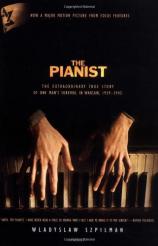
The Pianist
The Extraordinary True Story of One Man's Survival in Warsaw, 1939-1945
by Wladyslaw Szpilman

List Price: $13.00
Pages: 224
Format: Paperback
ISBN: 0312311354
Publisher: Picador

Click here to buy this book from Amazon.com.
Click here to buy this book from Amazon.ca.


About This Book


NOW A MAJOR MOTION PICTURE FROM FOCUS FEATURES

On September 23, 1939, the great Polish classical pianist Wladyslaw Szpilman played a Chopin nocturne live on the radio, but the shells blasting at a nearby window were so loud he could not hear his piano. Germany was invading Warsaw, and German occupation of this city meant that unanswerable murder and unspeakable cruelty would soon be daily, inescapable realities. But sometimes a person can escape the inescapable: The Pianist offers the amazing, often shocking true story of Szpilman's survival amid the rampant inhumanity of the Holocaust.

Although the nightmarish experiences of the Jewish ghetto claimed the lives of all of his immediate relatives and many of his friends, Szpilman himself--as depicted in this moving, profoundly important memoir--lived through the war by way of careful hiding, selfless bravery, and incredible fortune. Indeed, his ability at the keyboard actually proved indispensable to his survival--as did the surprising benevolence and compassion of a certain German officer who, near the end of the war, heard Szpilman play the same Chopin nocturne he had been performing when German artillery first exploded throughout Warsaw.

This well-written autobiography reveals the triumph of the soul, the flourishing of the artistic sensibility, even in the face of the most hellish circumstances. The Pianist, Roman Polanski's recent film based on this book, won the highest honor at the Cannes Film Festival and has been nominated for seven Academy Awards.

top of the page


rgg_discuss.gif (1294 bytes)


1. What do we learn about the narrator of The Pianist in the book's opening chapter? Who is he? Where does he live? What does he do for a living? Who are his loved ones? Also, discuss the narrator's tone or attitude, given his use of phrases like "the most wonderful of all gas chambers" and other such remarks.

2. "Two lives began to go on side by side," Szpilman writes near the conclusion of Chapter 4, discussing what it was like to be in Warsaw just after the Germans took the city. What were these two lives? What exactly did each life involve? And who were the people leading them? Comment on the dual character that Szpilman ascribes to his hometown, both in this chapter and throughout The Pianist.

3. "I laid my head on the piano and--for the first time in this war--I burst into tears." What specific event causes Szpilman to react in this way? Why does it affect him so? Explain.

4. Much of this memoir finds Szpilman pent-up, stuck in a cage, or held in some other sort of cell: an empty flat, a forgotten attic, etc. In Chapter 6, for example, he writes: "The reality of the ghetto was all the worse just because it had the appearance of freedom. You could walk out into the street and maintain the illusion of being in a perfectly normal city." What did reading The Pianist show or tell you about the psychology of confinement--about the mental, physical, spiritual, and emotional costs of imprisonment?

5. Chapter 8 of the book is entitled "An Anthill Under Threat." Explicate and explain this metaphor. Who or what is Szpilman describing with this image?

6. Look again at the brief conversation Szpilman's father has at the Umschlagplatz with a local dentist and a businessman. What crucial question do they discuss here--and how does each of them view this question? And who did you, as a reader, agree with on this score? Defend your own viewpoint with references from the book itself or with other historical and/or textural references.

7. Around Christmas of 1945, after months of more or less solitary confinement, after years of staying completely hidden, Szpilman briefly imagines himself as Robinson Crusoe. How does he specifically compare and contrast himself with Defoe's archetypal loner? What other literary figures, if any, would you cite as reflections of Wladyslaw Szpilman?

8. Discuss in some detail the role of music in The Pianist. How might music itself be understood as a character in this story? What does music do in this memoir? How does influence or otherwise alter the course of Szpilman's book--and, indeed, the course of his life?

9. Interestingly, The Pianist gives us two back-to-back impressions of the German Captain Wilm Hosenfeld. The first, of course, appears within Szpilman's narrative, where Hosenfeld (although we do not know his name at the time) effectively saves our hero's life. The second impression comes in the form of Hosenfeld's diaries. Draw on both impressions to create a full description (or at least a fleshed-out, 3-D summation) of this person. Discuss whatever links or connections you can establish between Hosenfeld's journal entries and his actions toward Szpilman.

10. In his Epilogue, Wolf Biermann points out that The Pianist "was first published in Poland in 1946 under the title of one of its chapters, Death of a City." Which title, in your view, is the more fitting or appropriate one? Explain.

11. Finally, compare and contrast the memoir version of The Pianist with the film version. In what ways did these two works strike you as similar? In what ways did they affect you differently? (Or, if you have not seen Polanski's film, compare and contrast Szpilman's memoir with other books, plays, or films that you have read or seen concerning the Holocaust.)

top of the page

Critical Praise

"Until The Pianist, I had never read a piece so moving that I felt I had to bring it to the screen."
Roman Polanski


"Remarkable . . . Of lasting historical and human value . . . Overlooked since its publication in 1946 and translated into English just now for the first time, [this is] an account of the Holocaust written in the immediate aftermath of the experience itself."
Los Angeles Times Book Review (Named a Best Book of the Year)


"Stunning . . . Filled with unforgettable incidents, images, and people."
The Wall Street Journal


"The Pianist is a great book."
The Boston Globe


"Historically indispensable."
The Washington Post Book World


"[The Pianist] joins the ranks of Holocaust memoirs notable as much for their literary value as for their historical significance . . . Szpilman is a remarkably lucid observer and chronicler."
Publishers Weekly (starred review)


"Staggering . . . Even by the standards set by Holocaust memoirs, this book is a stunner."
Seattle Weekly


"[Szpilman's] story of courage, fortitude, blind luck, and survival in the Jewish ghetto is extraordinary."
Columbus Dispatch


"Striking . . . Conveys with exceptional immediacy and cool reportage the author's desperate fight for survival. This is also a book about the power of music, which provides Szpilman the determination to go on and literally saves him several times."
Kirkus Reviews


"A richly detailed and absorbing work . . . Fascinating for its detail . . . Illuminating and astonishing."
Rain Taxi

 
Back to top.   


Privacy Policy | Contact Us | Advertising | About Us

© Copyright 2001-2009, ReadingGroupGuides.com. All rights reserved.
The Book Report, Inc. • 250 West 57th Street • Suite 1228 • New York, NY • 10107
Ph: 212-246-3100 • Fax: 212-246-4640

Bookreporter.comReadingGroupGuides.comGraphicNovelReporter.comFaithfulReader.com
Teenreads.comKidsreads.comAuthorsOnTheWeb.comAuthorYellowPages.com