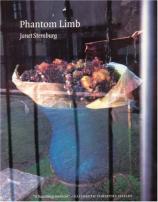
Phantom Limb
by Janet Sternburg
List Price: $20.00
Pages: 148
Format: Hardcover
ISBN: 0803242964
Publisher: University of Nebraska Press
"Do you know what I do when I leave my parents' apartment? You must never say another word about this, but I get into my car, roll up all the windows and I scream." So says the author's cousin, speaking with self-aware humor of the difficulties faced by a grown child at the end of her parents' lives.
Phantom Limb, a story of a family across generations, is a book for anyone going through the last years and loss of their parents -- or, indeed, any great loss that survives in memory.
The book takes its title from the situation of the author's mother who, having lost a leg, continued to feel pain as though the leg were still present. The author suggests we all have the condition of phantom limb: someone no longer with us remains a part of us. The question is: do we hold the memories, or try to rid ourselves of painful phantoms?
Phantom Limb is a book in which ordinary people live through critical tests of body and spirit. When she learned her daughter had cancer, Sternburg's mother said, "I am a lioness and you are my cub." Years later, successfully recovered, Sternburg sets out to help her mother's pain. Along the way, she uncovers new thinking about the relationship of mind to body, about the nature of memory and the of the brain. A poignant story of discovering the depth of love between grown child and parent, Phantom Limb provides a structure for life choices. In its resolution, the book offers a vision that links us all in the struggle to make peace with the physical and emotional phantoms of the past.
Phantom Limb charts a journey every adult must make.
top of the page

1. Do you think we all have the condition of phantom limb, someone or something no longer with us who remains a part of us?
2. Phantom Limb treats the inevitability of losing one's parents. Does our society prepare us adequately for this loss? Sternburg writes about the limitations and strengths of one's own parents. Do you feel that those limitations and strengths return in you?
3. Faced with the author's decision to put her mother in a nursing home, would you have done as she did? Why? Why not?
4. Sternburg begins the book with the need to expand her own heart. By the end, she has learned to forgive. Is this a journey you have taken, or want to take? To what extent could you identify with the events of her early life?
5. To what extent could you identify with the events of the author's early life? "My father is sitting behind me, my mother in the back, the three of us in a very different configuration from the way we sat on our weekly drive in our 1950s Buick with its mighty fins. Then I was in the middle dying for air." What can you glean from the relationship of the three?
6. How did you react to Janet's descriptions of her mother? How would you characterize Sternburg's relationship with her mother at the beginning? At the middle? At the end?
7. What do you think of the author's cousin, who rolls up her windows and screams? Is that familiar? What do you make of the passage: "All over America people are screaming trying not to be heard?" What do you make of this wish not to be heard? Is it fear of hurting parents? Of being an embarrassment? What might keeping quiet about one's emotions do to a person? In this story, the car serves as a safe place. What are other safe places to cope with excess emotion?
8. What does a crisis of this sort do to a marriage? In the book, there is support, and also strain. What can you detect from this book, and in others' experiences?
9. "I am a lioness and you are my cub." These words are the author's mother's response to learning that her daughter has cancer. How do you interpret this? Is she saying, "fight?" Is she herself a fighter? Were you surprised, as Sternburg was, by this reaction?
10. At the end, there's an image of Janet cradling the artificial leg in her arms. How do you interpret that image? She is left with her parents' possessions. What do you think she did with them all?
11. What is an inheritance? Is it money? For the author, furniture plays a symbolic role, as does her interpretation of objects like a ring and a wig. What is an inheritance to you? Your legacy?
12. Why do you think the author found out so much about her mother's medical condition? There are many different ways to respond to an illness, or any emergency. Consider the ways Janet did it. Do you think that trying to control events by knowledge helps one to cope?
13. "Is memory worth it if it brings pain?" This is the question asked in the book. How would you answer this question?
14. Are there phantom limbs in your own life? People no longer with you but who remain part of you?
15. . The author writes that she is "aware of how much ordinary pain there is in the world, and questions: "why so universal an experience is so little acknowledged." Do you agree with that observation? If so, why do you think we are so reluctant to acknowledge not feeling well? What are the consequences? Do you agree with the author when she writes that: "We need new words for illness."
16. Sternburg asks a number of philosophical questions in the book --- What does it mean to be good? Can one fix things? What is the nature of memory? What does she mean when she says "memory is diasporic?" And later, when she says it can also be "congregant?" How does she answer the questions she poses? How would you?
top of the page

"At a time when many people are writing and publishing memoirs, Sternburg's Phantom Limb (University of Nebraska Press) is uncommon. The book is a meditation on memory. The author experiences difficulties and writes about them, but she does so without a sense of victimhood or self-pity. Instead, she tells a tender story of the expansiveness of love."
The Jewish Week
"This is a memoir for anyone who has suffered a significant loss . . . compassionate, painful, and joyful. . . "
Library Journal
'Feelings shared by countless others . . . The author movingly recalls her great sense of bereavement after her mother died, the loss of treasured rituals of association -- phone calls, conversations about new curtains or a picture. . . luminously detailed recollections . . . moments of consoling happiness."
Kirkus
"Sternburg discovers that her search for consolation involves an acceptance of the pain of loss . . . the very scarcity and unreliability of our memories makes them precious."
LA Times Book Review
". . . part moving account of greater love in the face of her mother's approaching death, part medical inquiry into neurology, and part spiritual meditation on the struggles and sufferings that living visits on each of us. Sternburg shows that emotional and spiritual integration is possible . . ."
BookList
"Janet Sternburg uses her book, Phantom Limb, as the springboard for a medical, metaphorical and spiritual meditation on the loss of a loved one."
KCRW, "Politics of Culture"
"A haunting memoir- a poem of remembered pain -- an absence that becomes in the telling an unforgettable presence. I am undone by this book."
Elizabeth Forsythe Hailey, author of A Woman of Independent Means
"Janet Sternburg has found the perfect metaphor for the tragedy of pain and loss, the ultimate inevitabilities of life."
Bill Moyers, broadcast journalist; editor Healing and the Mind
"When I first read Phantom Limb some months ago, it moved me deeply. It is evocative, raw, absolutely genuine and original and I was stunned that the author had the courage to share so much of herself."
Harvard Bookstore (PW Bookstore of the Year) Nancy Fish, Marketing Manager