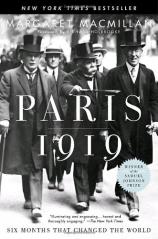
Paris 1919
Six Months That Changed the World
by Margaret MacMillan
List Price: $16.95
Pages: 624
Format: Paperback
ISBN: 0375760520
Publisher: Random House
For six months in 1919, after the end of "the war to end all wars," the Big ThreePresident Woodrow Wilson, British prime minister David Lloyd George, and French premier Georges Clemenceaumet in Paris to shape a lasting peace. In this landmark work of narrative history, Margaret MacMillan gives a dramatic and intimate view of those fateful days, which saw new political entitiesIraq, Yugoslavia, and Palestine, among themborn out of the ruins of bankrupt empires, and the borders of the modern world redrawn.
top of the page

1. In 1919, Europe had just been through a devastating war, which left political, social, and economic turmoil in its wake. The war also had a considerable impact on the Middle East and parts of Asia and Africa. What were the main issues and concerns facing the peacemakers in 1919?
2. Some historiansArno Mayer, for examplehave argued that the peacemakers of 1919 were determined to prevent the spread of revolution westward from Russia. To what extent did fear of Bolshevism shape the decisions made in Paris?
3. It has often been said that there was a gulf between Woodrow Wilson and his new diplomacy, on one side, and the Europeans and their old diplomacy on the other. Discuss what is meant by the new and the old diplomacy. Was there in fact such a gulf?
4. What did Woodrow Wilson mean by "national self-determination"? Why did some of his colleagues, such as Robert Lansing, worry about it? What impact did the notion of self-determination have? Was it easy to put into effect?
5. Each country in Paris had its own concerns and aims. Evaluate the main interests that each of the major powersFrance, Great, Britain, Italy, Japan, and the United Statesbrought to the table.
6. The peace settlements, in particular the resolution with Germany, have often been blamed for the outbreak of World War II. Was the Treaty of Versailles as punitive, unfair, and vindictive as has often been said?
7. Discuss the ways in which decisions made in Paris affected China and Japan. Did the relationship between the two countries grow better or worse as a result?
8. The Paris Peace Conference was the first major international peace conference where the press was present in force. In addition, the leaders of the powers had to pay attention to the views and wishes of their electorates. How important was public opinion in the making of the peace settlements after World War I?
9. A number of countries had designs on the territory of the Ottoman empire after World War I, and the Ottoman empire itself was in no position to fight back. Nevertheless, why did the Treaty of Sèvres remain a dead letter? In what ways was the later Treaty of Lausanne different?
10. During the war, the Alliesthe British and the French in particularmade a number of agreements and promises about the Arab parts of the Ottoman empire. To what extent have those agreements and the decisions made by the peacemakers about the Middle East had an impact on developments there since?
11. Although Woodrow Wilson is often seen as the person responsible for the League of Nations, many people, both in Europe and North America, shared his goals. What was the League supposed to accomplish? Why is it often described as a great experiment?
top of the page

"The history of the 1919 Paris peace talks following World War I is a blueprint of the political and social upheavals bedeviling the planet now. . . . A wealth of colorful detail and a concentration on the strange characters many of these statesmen were keep [MacMillan's] narrative lively."
The New York Times Book Review
"MacMillan's book reminds us of the main lesson learned at such a high cost in Paris in 1919: Peace is not something that can be imposed at the conference table. It can grow only from the hearts of people."
Los Angeles Times
"Beautifully written, full of judgment and wisdom, Paris 1919 is a pleasure to read and vibrates with the passions of the early twentieth century and of ours."
San Francisco Chronicle
"MacMillan is a superb writer who can bring history to life."
The Philadelphia Inquirer
"For anyone interested in knowing how historic mistakes can morph into later historic problems, this brilliant book is a must-read."
Chicago Tribune