Reading Group Guide
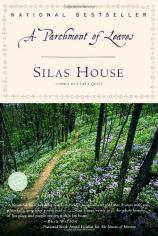
A Parchment of Leaves
by Silas House

List Price: $13.95
Pages: 304
Format: Paperback
ISBN: 0345464974
Publisher: Ballantine Books

Click here to buy this book from Amazon.com.
Click here to buy this book from Amazon.ca.


About This Book


It is the early 1900s in rural Kentucky, and young Saul Sullivan is heading up to Redbud Camp to look for work. He is wary but unafraid of the Cherokee girl there whose beauty is said to cause the death of all men who see her. But the minute Saul lays eyes on Vine, he knows she is meant to be his wife. Vine's mother disapproves of the mixed marriage; Saul's mother, Esme, has always been ill at ease around the Cherokee people. But once Vine walks into God's Creek, Saul's mother and brother Aaron take to her immediately. It quickly becomes clear to Vine, though, that Aaron is obsessed with her. And when Saul leaves God's Creek for a year to work in another county, the wife he leaves behind will never be the same again. The violence that lies ahead for Vine, will not only test her spirit, but also her ability to forgive—both others and herself. . . .

top of the page


rgg_discuss.gif (1294 bytes)


1. On her wedding day, Vine Sullivan says: "Family's the only thing a person's got in this life." Yet, when Vine attempts to tell Saul about Aaron's menacing behavior, she realizes what Saul's "great fault" is: "He would always choose his family over me." How does Vine cope with this realization throughout the course of the novel? Explore how the concept of family is developed in this story.

2. Explain why the title of Part I of the novel, "Confluence," is an appropriate label for this section of the story.

3. By the end of Part I, Vine seems conflicted: lonely, yet at peace; happy, but restless; homesick, but able to make her own home with Saul. Vine also seems to have a more heightened sensory awareness than the other characters, always noting the smells, sights, tastes, sounds, and feelings around her. How do these character traits serve her during the story?

4. Why is Saul Sullivan such a poor communicator in person but such an articulate letter-writer?

5. How does music operate within this story? Are you familiar with the song references and lyrics? Does the banjo have symbolic meaning in the story?

6. Purple colors are often referred to in the story. What does the color purple signify for you?

7. How does nature serve as a main character in this novel? Consider references to landscapes, creeks, mountains, birds, wildflowers, trees, snakes, etc.

8. Discuss Silas House's use of vernacular speech in this story. What words or phrases spoken by the characters are unfamiliar to you? How do the characters' dialects affect your interpretation of the story? What do you learn about the characters and the place where they live through their speaking styles?

9. Are you familiar with the mountain traditions described in the book such as a "house raising" or a "hog killing"? What about the many folklore beliefs and rituals practiced by Esme? What are some of the traditions or rituals you learned from your family or community, and how do they compare or contrast to the practices of Appalachians at the turn of the 20th century?

10. Even though Vine would not know the modern word "feminist," would you label her as a feminist? Why or why not? What are your personal connotations for the word "feminist" and the notion of "feminism?"

11. Vine's friend Serena serves traditional feminine roles in the community such as midwife, caregiver, and mother, yet she is described as being rough as a man; she chain smokes and wears men's clothes. How do these androgynous characteristics affect your perception of Serena?

12. Discuss Vine's awareness of the rigidity of men's and women's roles in her time and community. For example, she notes: "Men and women never sat beside one another at the table;" "A woman had never offered to shake my hand before–it was something that only men did;" and "In a place where men had once made things so busy, now there was only women…. Sometimes it seemed like we would do just fine without any men at all."

13. Describe the relationship Vine has with the women in her community who are not related to her: Serena, Esme, and Aidia. What is the significance of both Vine and Aidia being "outsiders?"

14. Discuss the prejudices that the characters in A Parchment of Leaves either endure or participate in. Consider: Native American vs. European American, masculine roles vs. feminine roles, townspeople vs. "creekers," church goers vs. free thinkers, etc.

15. With which character(s) do you most closely identify? Why?

16. By the end of the novel, Vine Sullivan has a complete, complex, and conflicted cultural identity. Discuss how her heritage, region, and gender impact her self-awareness and shape her various roles as mother, wife, daughter-in-law, farmer, and community member.

top of the page

Critical Praise

"A beautiful, heartbreaking novel, so vividly imagined and told that it stays with you, powerfully, long after you've read it. . . . Silas House writes as if the whole history of his place and people resides within his heart."
—Brad Watson, National Book Award Finalist


"A SEAMLESS WORK OF FICTION, entrancing in the manner of a vivid dream . . . The novel is steeped in details of place—the sounds, smells, and quality of light in House's native Kentucky."
Newsday


"An eloquent and moving novel of the Appalachian South from one of her most promising new writers."
—Sharyn McCrumb, Author of The Songcatcher


"Breathtaking for both its beauty and its pain . . . A superb combination of wonder and suffering."
Kirkus Reviews (starred review)


"One of the truest and most exciting new voices in American fiction."
—Robert Morgan, Author of Gap Creek

 
Back to top.   


Privacy Policy | Contact Us | Advertising | About Us

© Copyright 2001-2009, ReadingGroupGuides.com. All rights reserved.
The Book Report, Inc. • 250 West 57th Street • Suite 1228 • New York, NY • 10107
Ph: 212-246-3100 • Fax: 212-246-4640

Bookreporter.comReadingGroupGuides.comGraphicNovelReporter.comFaithfulReader.com
Teenreads.comKidsreads.comAuthorsOnTheWeb.comAuthorYellowPages.com