Reading Group Guide
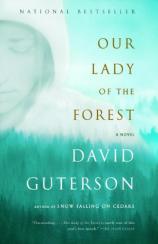
Our Lady of the Forest
by David Guterson

List Price: $13.00
Pages: 336
Format: Paperback
ISBN: 0375726578
Publisher: Vintage

Click here to buy this book from Amazon.com.
Click here to buy this book from Amazon.ca.


About This Book


From the best-selling author of Snow Falling on Cedars—an emotionally charged, provocative new novel about a teenage girl who claims to see the Virgin Mary.

Ann Holmes seems an unlikely candidate for revelation. A sixteen-year-old runaway, she is an itinerant mushroom picker who lives in a tent. But on a November afternoon, in the foggy woods of North Fork, Washington, the Virgin comes to her, clear as day.

Father Collins—a young priest new to North Fork—finds Ann disturbingly alluring. But it is up to him to evaluate—impartially—the veracity of Ann's sightings: Are they delusions, or a true calling to God? As word spreads and thousands, including the press, converge upon the town, Carolyn Greer, a smart-talking fellow mushroomer, becomes Ann's disciple of sorts, as well as her impromptu publicity manager. And Tom Cross, an embittered logger who's been out of work since his son was paralyzed in a terrible accident, finds in Ann's visions a last chance for redemption for both himself and his son.

As Father Collins searches his own soul and Ann's, as Carolyn struggles with her less than admirable intentions, as Tom alternates between despair and hope, Our Lady of the Forest tells a suspenseful, often wryly humorous, and deeply involving story of faith at a contemporary crossroads.

top of the page


rgg_discuss.gif (1294 bytes)


1. The book's opening echoes the tone of official reportage, using "the girl" instead of naming Ann Holmes. Elsewhere in the narrative Ann is called "the visionary." Why? Does this create a sense of distance from her? Does the narrative tone of voice, as well as the narrator's stance, shift throughout the novel? Is the tone of objectivity about the events and characters maintained?

2. What role do sexuality and sexual desire play in this story, particularly for Tom Cross, Father Collins, and Ann? What is attractive about Ann for Father Collins (37)? Are beauty, sexual desire, violence, and victimization interrelated in this novel? If so, how?

3. Does Guterson expect his readers to believe that Ann's encounters with the Virgin Mary are real? Alternatively, does he place readers in the position of Father Collins, who is skeptical and yet open-minded, or of Carolyn, who is entirely analytical and cynical about the visions? Is there a character with whom readers are most likely to identify? Who is it?

4. What kind of person is Carolyn Greer? Is she an opportunist, an intellectual, a cynic, an actor, a thief? If she is talented and intelligent, why is she living in a campground in North Fork? Is she a more interesting person than Ann?

5. Why did Father Collins decide to become a priest? Does the priesthood solve his personal dilemmas? Does he have the necessary qualities of leadership to be a priest? A year after Ann's death, what effect have Ann's visions and their aftermath had on Father Collins? Has he become a better priest, or a wiser person?

6. What does the extended passage in which Tom Cross thinks about his family life, and particularly his son, tell us about him (pp. 94—103)? Is Tom Cross responsible for the accident that paralyzed his son? With his anger, desperation, and self-loathing, how dangerous is he? Is there anything admirable or positive about him? How does he change?

7. How does Guterson evoke the unique locale of the Pacific Northwest, with its local economy that pits loggers against "jogging-shoed, tree-hugging latte lovers" (p. 105)? In what ways does he evoke the feeling of life in a rainy, foggy place? How important is the setting to the story, in terms of the local economy, weather, and landscape?

8. What is the connection, if any, between Ann's visions and the fact that she has been repeatedly raped by a drug addict who was obsessed with religion (see pp.129—30)? Does the novel suggest that her devotion to the Virgin results from a need to cleanse herself of her own past and to make amends for the abortion she had (p. 131)?

9. The narrator shares with readers the information that Ann is a victim of violent sexual abuse; this fact is not made known, however, to Father Collins or to the public and so is not a factor in the inquiry into her case. What are the effects, for the reader, of knowing Ann's history?

10. How relevant to her credibility is the fact that Ann wasn't raised as a Catholic, like Bernadette of Lourdes or the children at Fátima? Do her followers care? Is this a story about Catholicism, or about a larger phenomenon in America today? What is Guterson suggesting about religious faith, or about the need for it?

11. Father Collins and Father Butler know that Ann has used psilocybin mushrooms, and this leads them to suspect that her visions are hallucinogenic "flashbacks" (pp. 131—33, p. 169). The evidence gathered by Carolyn, however, points to side effects of the allergy medication Ann habitually used. How does Father Collins respond to Carolyn's accusation that "Phenathol is behind this massive spectacle? This multimillion-dollar film-set church" (p. 316)? Given their conversation, what is the effect of the novel's final scene (pp. 317—18)?

12. Does Guterson suggest that there is a place where hysteria and faith overlap? What are readers to make of the thousands of believers who come to North Fork to follow Ann to the sight of her visions? What does Guterson suggest about the psychology of large groups and the behavior of crowds (pp. 134—46)?

13. Why does Carolyn come back to visit North Fork for the opening of the church (p. 311)? What effect do Ann's followers, and the eventual building of the church, have upon the area's economy?

14. What is the meaning of the Virgin's dire warnings, and of the urgency of her message to Ann? How should readers interpret this aspect of Ann's vision, as well as Ann's fear of Satan?

15. There are often moments of humor in Our Lady of the Forest; what kinds of incidents or descriptions are funny? What sort of humor do they exemplify?

16. To what extent is Guterson interested in Ann's position as a child who is essentially uncared for and homeless, a victim of her mother's neglect? Is the novel interested in the social issues that brought Ann to North Fork? Does Ann's obsession with the Virgin Mary reflect her need for a caring mother?

17. The novel builds to a climactic scene in which Tom Cross confronts Ann in the church (pp. 296—305). What are the dynamics of the scene? What does Tom Cross want from Ann, and how close to violence is he? Why does Carolyn intervene as she does?

top of the page

Critical Praise

"This is Guterson's best book."
Chicago Sun-Times


"Another virtuoso performance from David Guterson . . . Gripping . . . Marks an expansion of his vision . . . Transporting . . . Balances on the tension between belief and despair without ever losing its sense of mystery."
L.A. Times Book Review


"Spellbinding . . . Mesmerizing . . . Brilliantly conceived . . . A marvelous and affecting spectacle, both timeless and contemporary, that makes for electric reading."
Seattle Times


"Explores a complex and challenging set of questions without a hint of condescension . . . The dimensions of this compelling novel are catholic in the larger sense."
Christian Science Monitor


"An intense and affecting journey of faith, miracle and humanity."
Denver Post

"Blends some of the appeal of Stephen King's uncanny tales . . . and John Updike's fables . . . Thoroughly absorbing . . . Guterson writes virtuoso dialogue."
Seattle Weekly


"Magnificent . . . Reading it, I kept putting [Guterson] in the best possible literary company . . . I was in a state of elation while I was reading . . . A marvelous book, in every sense."
—Jonathan Raban


"An intense, gripping read . . . Finely etched characters, the most intriguing and fully realized cast in any Guterson novel . . . Should resonate with many readers searching for belief in the post-9/11 world."
Seattle Post-Intelligencer


"Surely one of this year's best novels . . . Outstanding . . . [Displays] heart, compassion, and a willingness to tackle the most fundamental, and insolvable questions of faith, belief, and personal responsibility."
Pittsburgh Tribune-Review

 
Back to top.   


Privacy Policy | Contact Us | Advertising | About Us

© Copyright 2001-2008, ReadingGroupGuides.com. All rights reserved.