IndieBound Independent Bookstores

Barnes & Noble

Loading
Reading Group Guide
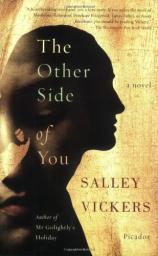
The Other Side of You
by Salley Vickers

List Price: $14.00
Pages: 272
Format: Paperback
ISBN: 9780312426798
Publisher: Picador USA

Click here to buy this book from Amazon.com.
Click here to buy this book from Amazon.ca.


About This Book

Salley Vickers has been widely praised for her perceptive novels, which capture both the vulnerabilities and the bold transformations of richly imagined characters. In The Other Side of You she brings us a powerful meditation on love in all its manifestations, woven with captivating themes of art, psychology, and literary history.

Psychiatrist and psychoanalyst Dr. David McBride has never come to terms with the violent accident that took his brother’s life during their boyhood. When a mysterious new patient named Elizabeth Cruikshank comes into his care, her experiences with loss and hopelessness tap a well of emotion in David, leading him to confront not only his grief over his brother’s death but also the painful dynamics of his marriage and other unsettling aspects of the way he has shaped his life.

Elizabeth’s traumas led to a suicide attempt, followed by deep reticence. It is not until David recalls a painting by the Italian artist Caravaggio that she finally yields her story. As she recounts the chance encounter that took her to Rome, and her tragic tale of passion and betrayal, David begins to find a strange and disturbing reflection of his own loss in the haunted “other side” of this elusive woman. Through one long night’s dialogue, they journey together into the past, opening a new vision of the future for each of them. As they explore the ways love and art can penetrate the complexities of the human heart, David and Elizabeth provide rich inspiration for a reading group’s discussion.

top of the page


rgg_discuss.gif (1294 bytes)


1. How did you picture the narrator as you read the initial paragraphs of The Other Side of You? How did those first impressions compare to the David McBride who emerges as the novel unfolds?

2. What techniques does Salley Vickers use to blend a fast-paced story line with intense psychological explorations? How does she strike a balance between everyday reality and gorgeous wishes?

3. Track down a copy of T. S. Eliot’s poem The Waste Land and read the lines that surround the book’s epigraphs; they can be found in the section Eliot titled “What the Thunder Said.” What is the effect of the way the quotation is used to introduce each part of the novel? How do Eliot’s scenes of desolation and thirst relate to the notion of our “other sides”? Who are the phantom-like “thirds” walking beside the novel’s characters?

4. Discuss the many parallels between David’s story and Elizabeth Cruikshank’s. Did it enhance your reading for David to tell both stories, revealing his past in first person and weaving Elizabeth’s details throughout in his own voice?

5. David tells us much about the evolution of psychiatric care in England. What are his opinions of the changes made in his profession over the years, from increased patient rights to the wane of lobotomies, such as the one Mrs. Beet’s husband experienced? What do these opinions, as well as his interactions with various patients, tell us about his outlook on humanity itself?

6. In what ways is David’s approach in treating Elizabeth unconventional, particularly during her last session? Would she have experienced true healing with a more conventional therapist? What “cure” did she evoke in David?

7. What spurs the turning point that marks the end of part one? How did Elizabeth help David to fully understand the lines that open part two, “Age and disease and death may destroy our physical being but it is other people who get inside us and damage our hearts and minds”?

8. David tells us that his mother was inclined to protect her daughters more than him. How do his perceptions of his mother influence his perceptions of women in general? How does his family history shape his beliefs about a man’s responsibilities? 

9. Why did Elizabeth marry Neil? Would she have experienced the marriage as “awful” even if she had never met Thomas? What is at the root of her hesitation to leave Neil, no matter how much anguish her staying causes?

10. Part two, chapter two, ends with David’s description of an egotist: “armored against disappointments … the undisputed center of the world.” Does Olivia fit his definition of an egotist? What is the nature of his attraction to her?

11. How does the story of Peter (the “wolf man”) shape the novel? How is David affected when his optimistic decision about Peter goes badly? What metaphor can be drawn from Peter’s illness --- the notion that fear causes him to harm other people?

12. At the end of part three, chapter two, David admonishes us to beware of those who care. What does he begin to understand about Jonny’s death at that point? How does it give him the courage to deliver his liberating lines to Olivia in chapter four?

13. Discuss the paintings and corresponding scripture that serve as a catalyst throughout The Other Side of You. What themes were most striking to you in these narratives? In what way were they an appropriate backdrop for the questions raised by the novel?

14. How do the novel’s two settings --- Italy and England --- speak to the characters’ mind-sets? What did both locales mean to David and Elizabeth (and even to Keats)? What makes Caravaggio’s life an ironic footnote to the novel?

15. Discuss the various types of love described in The Other Side of You. Why isn’t Olivia drawn to the idea of parental love? How would you characterize the way David and Gus support each other? What sort of love develops between Elizabeth and David, and why doesn’t it manifest itself in a long-term relationship?

16. How does David’s concept of mortality and fate shift throughout the novel? What lessons does he take from the way Thomas’s story ended?

17. What forms of love have been most prominent in your life? Have you ever experienced a powerful “what if” like the one Elizabeth carried with her for years after her brief encounter with Thomas?

18. Salley Vickers’s previous novels have featured a variety of characters who overcome isolation or grief. How does The Other Side of You give voice to this theme? What inspiring notions of healing exist in her fiction?

top of the page

Critical Praise

“With imagination, sensitivity, and skill, Salley Vickers gives us valuable psychological and spiritual insights about grief, regret and reconciliation.”
— Karen Armstrong, author of The Great Transformation


“Salley Vickers takes the most interesting part of the analytical process --- when something unknown becomes known, moves out of shadow into light, which is tremendously moving to read about… This is a subtle and thoughtful novel, and in the resolution there is anguish as well as calm.”
— Sebastian Faulks, author of Charlotte Gray


“Love and pain, death and life, self knowledge and insensibility --- all these big, vital themes converge in this moving, utterly engrossing novel.”
The Guardian


“The writing is so good and the structure so skilful that Vickers manages to make delicate and difficult notions vivid. Her territory is the faultline along which memories of loss are experienced … it is rare for a novel to present it so directly and with such success.”
— John de Falbe, The Spectator


“There is something rare and special about Vickers as a novelist. In exploring the connections between faith and imagination, art and redemption, religion and science in an intelligent, unusual but very readable way, she manages to touch something buried deep in all of us. It gives her work a compelling quality.”
— Peter Stanford, The Independent


“The lives of the characters in this gently absorbing novel continue to resonate with the failures, possibilities, regrets and redemptions --- consoled and mirrored by art --- that we all endure.”
— Carol Ann Duffy, The Daily Telegraph


“The evocation of place, and the pervading sense of sadness, are skilfully created, and the flawed humanity and depth of feeling of the characters are compelling.”
The Times Literary Supplement

 
Facebook Fan Page  Follow us on Twitter


Add Your Guide to ReadingGroupGuides.com!

Bookreporter.com Bets On...: Books We're Betting You'll Love


Privacy Policy | Contact Us | Advertising | About Us

© Copyright 2001-2012, ReadingGroupGuides.com. All rights reserved.
The Book Report, Inc. • 250 West 57th Street • Suite 1228 • New York, NY • 10107
Ph: 212-246-3100 • Fax: 212-246-4640

Bookreporter.comReadingGroupGuides.comGraphicNovelReporter.comFaithfulReader.com
Teenreads.comKidsreads.comAuthorsOnTheWeb.com