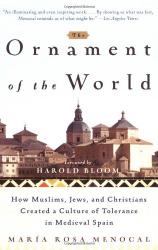
The Ornament of the World: How Muslims, Jews, and Christians Created a Culture of Tolerance in Medieval Spain


About the Book
The Ornament of the World: How Muslims, Jews, and Christians Created a Culture of Tolerance in Medieval Spain




A fascinating history of a brilliant lost civilization with powerful lessons for the modern world.
"Once upon a time in the mid-eighth century, an intrepid young man named Abd al-Rahman abandoned his home in Damascus, the Near Eastern heartland of Islam, and set out across the North African desert in search of a place of refuge. Damascus had become a slaughterhouse for his family, the ruling Umayyads, who had first led the Muslims out of the desert of Arabia.... This sole survivor was undoubtedly too young—he was in his late teens or early twenties—to be terrified at the odds against him, nor was his flight westward, toward what was the farthest frontier of the Islamic territories, as arbitrary or hopeless as it might have seemed....
"This book tells the story of how this remarkable turn of events... powerfully affected the course of European history and civilization. Many aspects of the story are largely unknown and the extent of their continuing effects on the world around us is scarcely understood...."
-From The Ornament of the World
A portrait of the vibrant civilization of medieval Spain, The Ornament of the World is the story of an extraordinary place and time. Both history and literature often depict the Middle Ages as a dark and barbaric period, characterized by intellectual backwardness and religious persecution. Now María Rosa Menocal brings us an altogether different vision of medieval Europe, where tolerance was often the rule and literature, science, and art flourished in a climate of cultural openness.
The story begins as a young prince in exile—the last heir to a glorious Islamic dynasty—flees the massacre of his family and founds a new kingdom on the Iberian peninsula: al-Andalus. Combining the best of what Muslims, Jews, and Christians had to offer, al-Andalus and its successors influenced the rest of Europe in dramatic ways, giving it the first translations of Plato and Aristotle, the tradition of love songs and secular poetry, advances in mathematics, and outstanding feats of architecture and technology.
In a series of captivating vignettes, Menocal travels through time and space to reveal the often paradoxical events that shaped the Andalusian world and continue to affect our own. Along the way, we meet a host of intriguing characters: the brilliant and dedicated Jewish vizier of a powerful Muslim city-state; the Christian abbot who commissions the first translation of the Quran; the converted Jew who, under a Christian name, brings a first taste of Arabic scholarship and storytelling to northern Europe.
This rich and complex culture shared by the three faiths thrived, sometimes in the face of enmity and bigotry, for nearly seven hundred years. Ironically, it was on the eve of the Renaissance that puritanical forces finally triumphed over Spain's long-standing traditions of tolerance, ushering in a period of religious repression. In the centuries since, even the memory of the vital and sophisticated culture in which Muslims, Jews, and Christians once lived and worked side by side has largely been overlooked or obscured.
In this remarkable book, we can at last uncover and explore the lost history whose legacy is still with us in countless ways and whose lessons—both inspirational and cautionary-have a powerful resonance in today's world.


The Ornament of the World: How Muslims, Jews, and Christians Created a Culture of Tolerance in Medieval Spain
- Publication Date: August 27, 2012
- Paperback: 352 pages
- Publisher: Back Bay Books
- ISBN-10: 0316168718
- ISBN-13: 9780316168717