Reading Group Guide
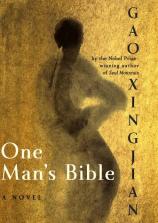
One Man's Bible
by Gao Xingjian

List Price: $26.95
Pages: 464
Format: Hardcover
ISBN: 0066211328
Publisher: HarperCollins

Click here to buy this book from Amazon.com.
Click here to buy this book from Amazon.ca.


About This Book


One Man's Bible is the second novel by Nobel Prize-winning author Gao Xingjian to appear in English. Following on the heels of his highly praised Soul Mountain, this later work is as candid as the first, and written with the same grace and beauty.

In a Hong Kong hotel room in 1996, Gao Xingjian's lover, Marguerite, stirs up his memories of childhood and early adult life under the shadow of Mao Zedong and the Cultural Revolution. Gao has been living in self-imposed exile in France and has traveled to this Western-influenced Chinese city-state, so close to his homeland, for the staging of one of his plays.

What follows is a fictionalized account of Gao Xingjian's life under the Communist regime. Whether in "beehive" offices in Beijing or in isolated rural towns, daily life is riddled with paranoia and fear, as revolutionaries, counterrevolutionaries, reactionaries, counterreactionaries, and government propaganda turn citizens against one another. It is a place where a single sentence spoken ten years earlier can make one an enemy of the state. Gao evokes the spiritual torture of political and intellectual repression in graphic detail, including the heartbreaking betrayals he suffers in his relationships with women and men alike.

One Man's Bible is a profound meditation on the essence of writing, on exile, on the effects of political oppression on the human spirit, and on how the human spirit can triumph.

top of the page


rgg_discuss.gif (1294 bytes)


1. The protagonist of One Man's Bible is alternately called "you" and "he." Why might Gao have chosen to split the character in this way? In view of the fact that Gao is writing about himself, why doesn't he simply use the first person?

2. Discuss the relationship between the author's framing and inner narratives, its "present" and "past." In Chapter 10, for example, Gao makes love with Margarethe, while Chapter 11 begins with his memories of making love with the married Lin. Elsewhere Margarethe's relentless questioning is echoed by an interrogation by Red Guards. Where else do you encounter such mirrorings?

3. How does One Man's Bible treat death? How does Gao relate his mother's drowning or the many suicides and political murders that he witnesses? Does this book seem to view death as a tragedy, as a random and relatively inconsequential event, or even as a form of liberation?

4. Margarethe accuses Gao of exploiting her sexually. Do you agree? Is One Man's Bible a sexist book? Do you find its graphic erotic scenes gratuitous? Does sex have a different significance in communist China than it does in capitalist Hong Kong? Do the novel's European and Chinese women experience sex differently? Does Gao ever appear to judge their sexuality?

5. At one point Margarethe and Gao argue over the difference between Maoism and fascism. Does the author's description of Mao's China remind you of accounts you've read of Hitler's Germany or the U.S.S.R. under Stalin? In what way does it seem different? Note, for instance, the relatively low profile of the army and secret police and the way repression seems to emanate not from above but from below, that is to say from students and even, horribly, from children. How has living in such a society affected the novel's characters? Does One Man's Bible contain any similar critique of the capitalist West?

6. One Man's Bible may be seen as a contest between two views of the past. Gao wants to cut himself off from it completely -- a markedly un-Chinese attitude -- while Margarethe, departing from the stereotype of the pragmatic, present-oriented westerner, insists that the past must be remembered, honored, understood. Which view ultimately seems to prevail?

7. Gao describes himself as being like "a free-flying bird. The inner freedom," he says, "had no attachment, was like the clouds, the wind. God had not conferred this freedom upon him, he had paid dearly for it, and only he knew how precious it was." How is this born out by events in the book? How would you sum up the author's view of freedom?

8. In an imaginary conversation with Mao, the author argues that "although it was possible to kill a person, that person's human dignity could not be killed. A person is human because this bit of self-respect is indestructible." What does that dignity consist of? How does Gao manage to preserve his self-respect in a society that not only imprisons its people, but also degrades them? How are the novel's notions of human dignity and freedom related to those set forth in various philosophical traditions -- especially Chinese Taoism and European Existentialism?

9. How does Gao appear to see his role as a writer? Does he believe that art has a social or political function, or that the artist has a responsibility to his society? Do art and literature have a different significance in totalitarian and democratic societies?

10. Do you see the novel's protagonist as its author's alter ego or as a fictional creation who happens to share his name and basic biography? What kind of character is Gao? Does the author ever present him in a less than favorable light?

11. What is the significance of the book's title? What might Gao have intended in calling it a "bible" instead of a novel, memoir or autobiography?

top of the page

Critical Praise

"Admirable dramatic intensity … valuable for its vivid piecemeal picture of 20th-century China's culture of revisionist egoism, paranoia and repression."
Kirkus Reviews


"Unforgettable … One Man's Bible burns with a powerfully individualistic fire of intelligence and depth of feeling."
New York Times


"A remarkable achievement."
Christian Science Monitor


"One Man's Bible … has come to claim its place as a powerful narrative … of the Cultural Revolution's insidious, corrosive terror."
New York Times Book Review


"Captivating … a beautifully stirring account of life in an era of political oppression …[One Man's Bible] is an important book,"
Fort Worth Star-Telegram


"[Gao] paints a stark, unforgiving picture of the results of Mao's regime and of the Cultural Revolution."
Denver Post


"If the hallmark of a good novel is its ability to transport the reader, willing or not, into unfamiliar or uncomfortable territory, then this novel is a success."
Denver Post

 
Back to top.   


Privacy Policy | Contact Us | Advertising | About Us

© Copyright 2001-2008, ReadingGroupGuides.com. All rights reserved.