IndieBound Independent Bookstores BRC Facebook Fan Page
Reading Group Guide
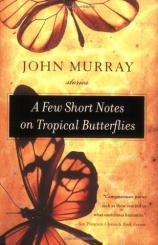
A Few Short Notes on Tropical Butterflies
Stories
by John Murray

List Price: $12.95
Pages: 288
Format: Paperback
ISBN: 0060509295
Publisher: Perennial

Click here to buy this book from Amazon.com.
Click here to buy this book from Amazon.ca.


About This Book


In this remarkably assured and satisfying debut collection, John Murray seamlessly meshes fact with fiction, taking his inspiration from the worlds of science, medicine, and nature. The stories are set in intriguing locations across the globe -- a cholera tent in the slums of Bombay, a United Nations refugee camp in the mountains of Africa, a Key West hideaway -- where his characters, among them doctors, nurses, research scientists, explorers, and collectors, can be found reading The Manual of Clinical Microbiology or Gray's Anatomy or the Complete Textbook of Psychiatry.

And yet, despite the pull of the outer world, these stories are all about the internal world of emotions -- love, loss, obsession, and conflict -- and about families and how they survive. They unfold to tell of moments when people catch glimpses of their real selves, their pasts, and have flashes of understanding about their lives. In "The Hill Station," an American-born scientist is drawn to Bombay, the homeland of her parents, where she breaks free from the confines of her well-ordered life. The title story tells of an aging surgeon who uses his grandfather's collection of butterflies to try and make sense of his past. In "Blue" a young man -- still haunted by the tragic death of his father years earlier -- traverses the Himalayan mountain that would have been his father's last climb. In "Acts of Memory, Wisdom of Man," the son of Indian immigrants relives the summer of 1968, and the events that determined his brother's fate.

Vivid and alive, these stories reveal whole lives -- characters caught between the past and the present, between different cultures, and between their intellects and emotions. Global in scope, classical in form, evocative of place, this rich collection marks an exciting and original debut.

top of the page


rgg_discuss.gif (1294 bytes)


Questions for Discussion Relating to Individual Stories

The Hill Station
1. How do Elizabeth's choices - destroying her diaphragm, traveling to India, helping with the cholera epidemic, marrying the man she met on the bus - indicate how she struggles between chaos and order?

2. How does Elizabeth's work researching disease affect the way she looks at the world?

All the Rivers in the World
1. Why do you think Vitek's father is drawn to Chika?

2. Chika tells Vitek that "nothing really matters . . . except what you do in those few moments when you have to put yourself on the line for others, to overcome your own fear." (67) What does this observation mean in Chika's life? What does it come to mean to Vitek?

A Few Short Notes on Tropical Butterflies
1. What do butterflies - and butterfly collecting - have to do with the themes of this story?

2. How does the story within the story - the narrator's grandfather's experiences tracking tropical butterflies in Africa - illuminate aspects of the narrator's personality and past experiences?

White Flour
1. By revealing piecemeal the facts behind Joseph's father's departure, the truth behind his mother's deception emerges slowly. What is the effect of this method of storytelling?

2. What kind of future do you foresee for Joseph?

Watson and the Shark
1. As the narrator examines a boy critically wounded by machete-wielding soldiers, he "could see that every eye was fixed on me and I felt that sense of power and control that I needed then - this was why I was a trauma surgeon - and I wanted life-or-death, all-or-nothing situations. Life or death. That was why I was there in the jungle, and I honestly had a tremendous feeling of being in the right place and of being filled wit a certain glorious energy." (137) How does the narrator's image of himself change by the end of the story? What causes this change?

2. How does the painting "Watson and the Shark" illustrate the story's major themes?

The Carpenter Who Looked Like a Boxer
1. Here, again, Murray has chosen to save vital information - truths about Danny's wife and father - for the end of the story. As truths are revealed, how do your impressions of Danny and his predicament change?

2. What does the idea of termites invading the house that Danny built - and his neighbors' obsessive concern about the insects - represent in the story? Why is it important that Danny built this house himself, for his wife and his family?

Blue
1. How is Simon's quest to reach the mountain summit driven by the death of his father years before?

2. How does Simon's role in his father's death compare with his role in the deaths of his fellow climbers?

Acts of Memory, Wisdom of Man
1. The title of this story is echoed in the words of the narrator's mother, who cautions him that "Acts of memory are the wisdom of man." At the same time, his father tells him "All meaning depends on a set of arbitrary rules and laws." What does each of these statements mean to you? How do they define the story's central conflict?

2. Who, in the long run, has the most impact on Harry's life - his mother or his father?

General Questions for Discussion
1. In reviewing all the stories, what sorts of experiences do Murray's characters have in saving others and being saved? What happens to those who have an opportunity to save and can't - or won't?

2. Generally speaking, what kinds of relationships do the parents in Murray's stories have with their children? What do these children learn from their parents' actions?

3. How does Murray portray doctors and other people in the medical profession? What sense do his stories give you about science's ability to save lives, or change them for the better? What inherent weaknesses and strengths do medical professionals possess?

4. What parallels can be drawn between the duties of parents to their children and the duties of doctors to their patients?

5. How and why is setting important to these stories?

6. What have you learned about what life is like in India and Africa? Do Murray's depictions of these countries contradict your own notions of them?

top of the page

Critical Praise

"Writing that bristles with emotive power."
Library Journal


"Brilliant.... How lucky for all of us that he chose to write fiction."
—Ann Patchett, author of Bel Canto


"These stories linger with you like a delicious aftertaste."
—Abraham Verghese, author of My Own Country and The Tennis Partner


"Vibrant debut story collection…Murray's prose is strong and agile…the affecting portraits make this collection emotionally resonant and enormously gratifying"
Publishers Weekly (starred review)


"Stunning short story collection…writer to watch."
Booklist (starred)

 
Back to top.   


Privacy Policy | Contact Us | Advertising | About Us

© Copyright 2001-2009, ReadingGroupGuides.com. All rights reserved.
The Book Report, Inc. • 250 West 57th Street • Suite 1228 • New York, NY • 10107
Ph: 212-246-3100 • Fax: 212-246-4640

Bookreporter.comReadingGroupGuides.comGraphicNovelReporter.comFaithfulReader.com
Teenreads.comKidsreads.comAuthorsOnTheWeb.comAuthorYellowPages.com