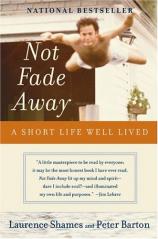
Not Fade Away


Review
Not Fade Away



Peter Barton spent his all-too-brief, brilliant life like a gambling addict let loose in a casino. He didn't taste experience --- he devoured it in great chomps and gulps of adventure, leaps in imagination, success in business ventures, and deep family commitment.
He played away his early years as an anti-war hippie, experiencing to the fullest extent the joys and freedoms of the 1970s. But by the time he reached that life altering, ominous "over thirty" hurdle, he began to think seriously about his future. He took a reality check, buckled down at Harvard Business School, and projected his enormous intellectual and physical energies into the world of ideas. As a visionary on the threshold of the cable television era, Barton co-founded Liberty Media, which pioneered with the Discovery Channel, Fox Sports, The Learning Channel, Black Entertainment Television, and STARZ.
Along the way to his meteoric success, Barton met and married his wife and started a family. Once he knew they were financially secure, having made some profitable stock market investments, he felt free to explore new horizons and stepped down as President of Liberty Media. Barton was about to launch a whole new career in the fledgling Internet sphere when life's ultimate reality check arrived via cell phone in the middle of a meeting with Yahoo executives in Silicon Valley. It was Barton's doctor calling from Denver. He had been ignoring a vague but persistent stomachache and had gone in for some tests. He remembers the call this way:
"'I need you to come to my office to discuss this with me. You have cancer.' Just like that. That terse, that quick; that casual. I don't remember getting up, but suddenly I'm standing. The Yahoo board of directors is staring at me. Maybe they understand that something bad has happened; maybe they're just wondering what could possibly be more important than going head to head with AOL."
Life is suddenly brought into sharp focus for Barton.
NOT FADE AWAY is narrated by Barton in collaboration with mystery writer and novelist Laurence Shames. It is a diary, a memoir and a biography. Shames, who didn't know Barton personally but was introduced to him by a mutual friend, says that Barton's first intent was to leave something of himself for his three children, ages 14, 11 and 9.
But as the relationship between the two men intensified during the last months of Barton's life, the idea behind the book grew to become much more. Shames saw the enormous humor and deep affection Barton felt for not just his family but for life, and he wanted to bring the depth of feeling that Barton was experiencing to the public --- not only his exuberance for life but his growing insights into himself as the inevitable drew near.
NOT FADE AWAY isn't a sad story or one filled with angst and foreboding. It is a story that deals with love, success, friendships, business relationships, war protests, the simple joys of parenting and the simple-minded joys of college pranks.
Barton jams with Sha Na Na, rock climbs at Robert Redford's Sundance Ranch, and deals craps in Vegas. He reminisces about his boyhood and relationship with his father, who also died young, and rejoices over the fact that he lived longer than him. He then writes of the self-discovery that arrives when one's mortality is brought sharply into focus. Almost reluctantly he discusses briefly the pain and encumbrances of illness, but he focuses on separating his mind from his demanding body, trying to prevent the physical wreck, which he likens to a rusted-out old car, from becoming who he really is. Barton fiercely denied to Shames early in their relationship that he was spiritual or religious. This amuses Shames, and as the process moves on, Barton's deep core of strength and belief in "something more" begins to shine through.
NOT FADE AWAY deals with life at its most glorious, and the end of life at its most transcendent. Perhaps readers of this often humorous, deeply honest, adventurous and courageous story will come away feeling as columnist Dave Barry did when he said, "Sooner or later, we'll all make the journey Peter Barton took; now, thanks to him, it doesn't look so scary."
Reviewed by Roz Shea on January 22, 2011


Not Fade Away
- Publication Date: September 14, 2004
- Genres: Nonfiction
- Paperback: 224 pages
- Publisher: Harper Perennial
- ISBN-10: 006073731X
- ISBN-13: 9780060737313