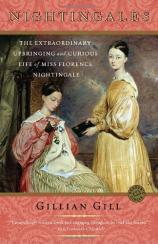
Nightingales
The Extraordinary Upbringing and Curious Life of Miss Florence Nightingale
by Gillian Gill
List Price: $15.95
Pages: 592
Format: Trade Paperback
ISBN: 0345451880
Publisher: Random House
Florence Nightingale was for a time the most famous woman in Britain --- if not the world. We know her today primarily as a saintly character, perhaps as a heroic reformer of Britain's health-care system. The reality is more involved and far more fascinating. In an utterly beguiling narrative that reads like the best Victorian fiction, acclaimed author Gillian Gill tells the story of this richly complex woman and her extraordinary family.
Born to an adoring wealthy, cultivated father and a mother whose conventional facade concealed a surprisingly unfettered intelligence, Florence was connected by kinship or friendship to the cream of Victorian England's intellectual aristocracy. Though moving in a world of ease and privilege, the Nightingales came from solidly middle-class stock with deep traditions of hard work, natural curiosity, and moral clarity. So it should have come as no surprise to William Edward and Fanny Nightingale when their younger daughter, Florence, showed an early passion for helping others combined with a precocious bent for power.
Far more problematic was Florence's inexplicable refusal to marry the well-connected Richard Monckton Milnes. As Gill so brilliantly shows, this matrimonial refusal was at once an act of religious dedication and a cry for her freedom --- as a woman and as a leader. Florence's later insistence on traveling to the Crimea at the height of war to tend to wounded soldiers was all but incendiary --- especially for her older sister, Parthenope, whose frustration at being in the shade of her more charismatic sibling often led to illness.
Florence succeeded beyond her wildest dreams. But at the height of her celebrity, at the age of thirty-seven, she retired to her bedroom and remained there for most of the rest of her life, allowing visitors only by appointment.
Combining biography, politics, social history, and consummate storytelling, Nightingales is a dazzling portrait of an amazing woman, her difficult but loving family, and the high Victorian era they so perfectly epitomized. Beautifully written, witty, and irresistible, Nightingales is truly a tour de force.
top of the page

1. Florence Nightingale grew up in a privileged and progressive milieu at the time the British Empire was reaching the zenith of its power and when Christian evangelicalism was changing the whole character of society. What resemblances do you see between British society in Nightingale's day and American society now?
2. In the course of Florence's youth, as a result of her father's wealth and her mother's social skills, the Nightingale family rose to become one of the legendary "ten thousand" families who ruled England and its far-flung empire. In her long fight to improve the health and quality of life for her fellow citizens, how much do you think Nightingale was impeded and how much was she helped by her family's social prominence?
3. Florence Nightingale was brought up in a deeply religious family and felt very close to God, even as a small child. She wrote in her private notes that on three different occasions she heard the voice of God calling her to His service. Discuss the importance of Nightingale's sense of divine mission and the character of her spirituality.
4. Florence Nightingale had a deep but difficult relationship with her only sibling, Parthenope Nightingale Verney. What did the sisters have in common? Why were they so often at odds?
5. Florence Nightingale never really forgave her parents, especially her mother, Fanny Nightingale, for preventing her from undertaking full-time work in hospitals when she was in her twenties. Do you blame the Nightingale parents?
6. Florence Nightingale's relationships with other women were rarely smooth. Both in letters and in her unpublished work Suggestions for Thought,she frequently said how much she despised women of her own class. Talk about her relationships with her cousins Hilary Bonham Carter and Marianne Nicholson, her aunt Mai Shore Smith, and her friends Mary Clarke Mohl and Selina Bracebridge.
7. What were the key qualities that allowed Florence to succeed when she went out to Scutari in Turkey during the Crimean War?
8. The work of the women nurses during the Crimean War was a turning point in the history of the nursing profession. What was the work of women nurses like before Nightingale's era, and why was it so difficult to launch nursing as a profession for women of all classes?
9. Florence Nightingale was revered and even adored by many who worked with her in the army hospitals, yet she also aroused bitter hostility. Even Nightingale's admirers have agreed that her relationships with other nurses while at Scutari and in the Crimean peninsula were often bitterly contentious. The bitter tirades against Nightingale by other Crimean War nurses, notably Mother Frances Bridgeman, Mary Stanley, Martha Clough, and Elizabeth Davis, have always provided the ammunition for those who attack Nightingale as a power-hungry, self-publicizing harpy. What was it about Florence Nightingale that made her so controversial?
10. Florence Nightingale's work during the Crimean War made her a legend in her lifetime. How did she react to her fame? How did she use it?
11. In 1857, when she was thirty-eight, Florence Nightingale's health collapsed. For decades she was a bedridden invalid, admitting only chosen people to see her, one on one, and she never again had anything approaching a normal social life. Some have diagnosed Nightingale as suffering from an organic disease, most probably chronic brucellosis. Others have diagnosed her as a hysteric and hypochondriac who used physical symptoms to get her way. Recently, a suggestion has been made that she suffered from bipolar disease. What is your diagnosis of Nightingale's illness, and what do you think she gained and lost from her fifty-three years of invalidism?
12. Do you think Florence Nightingale was a heroine? Do you think her life is still meaningful for us today? Do you like her, or just admire her?
top of the page

"A dynamic and absorbing account, written in a lively and captivating manner, of a remarkable family and its even more remarkable scion, Florence Nightingale. Gill has used her sources to maximum effect, engaging the reader in a pacy narrative that brings that far distant 'other country,' the Victorian age, so vividly to life. I highly recommend it!"
Alison Weir, author of Eleanor of Aquitaine
"Nightingales is wonderful. I will certainly never again dare to think of Florence Nightingale as 'a lifelong spinster' with an invalid's need for noble self-sacrifice, but as a powerful woman who changed the course of the British government toward their own wounded forever."
Nancy Milford, author of Savage Beauty and Zelda
"Imaginatively conceived and elegantly written, Nightingales tells the compelling story of a family and an era with great style and flair. Even minor characters are wonderfully drawn and the tone is both intimate and erudite."
Diane Jacobs, author of Her Own Woman: The Life of Mary Wollstonecraft
"A beautifully written and nuanced portrait . . . Gill infuses her subject with rare vitality and untangles the strands of historical, social, and personal forces that determine the course of female life. This multifaceted approach challenges the myths surrounding Nightingale's struggle for fulfillment, giving us a fascinating window into one Victorian woman that becomes a lens through which we can view ourselves."
Susan Hertog, author of Anne Morrow Lindbergh
"Nightingales brilliantly captures the unique intensity both of individuals and an age. Gill vividly evokes the complex and fascinating interrelations of an exceptional family. She engages her reader at every step as we travel with the fiercely intelligent and charismatic Florence Nightingale on her remarkable life journey."
Anna Beer, author of My Just Desire