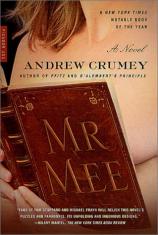
Mr. Mee
by Andrew Crumey
List Price: $15.00
Pages: 352
Format: Paperback
ISBN: 0312282354
Publisher: Picador USA
In this inventive and affecting novel, an octogenarian book collector named Mr. Mee discovers the Internet with life-changing results.
Told in turns from the point of view of the endearing, utterly guileless Mr. Mee, two eighteenth-century French philosophers, and a middle-aged university professor, Andrew Crumey's book concerns the creation and mysterious disappearance of Rosier's Encyclopedia, a potentially explosive text written more than 200 years ago that purportedly disproves the existence of the universe. When Mr. Mee comes across a reference to the Xanthics, an obsolete sect that maintained unorthodox beliefs about fire, his hunt for more information compels him to try locating a copy of the singular encyclopedia. Technologically ignorant, Mr. Mee is at last persuaded by his addled housekeeper to conduct a modern search for the book on the Internet. But instead of finding additional clues about Rosier's Encyclopedia, Mr. Mee stumbles upon an image of a naked woman reading from an intriguing text....
Alternating among the three stories, Andrew Crumey takes us closer to the truth about Rosier's Encyclopedia and the secrets it contains. At times funny, often thought-provoking, and utterly engaging, Mr. Mee is Crumey's most rewarding novel to date.
top of the page

1. Identify the three separate narrative strands that run through Mr. Mee , describing the characters, settings, goals, and conflicts that comprise each strand. How do these three strands relate to one another? Also, in your judgement, has author Andrew Crumey successfully interwoven these strands? Explain why or why not.
2. First and foremost, this is a comic novel. Name and locate the various types of comedy-satire, farce, slapstick, parody, and so on-that appear in these pages. Which did you consider the most effective, and which the least? Defend your answers with references from the book.
3. What did you, as a reader, come to learn-over the course of this novel, in each of the three different narratives-about Jean-Bernard Rosier and his elusive Encyclopedia? Why do you suppose the character of Rosier is never encountered directly? What other such "ghosts" are important to the direction or design of this novel?
4. Of the main characters in this book--Mr. Mee, Ferrand, Minard, and Dr. Petrie-at least two of them are avid readers and one of them, Petrie, is an author. Explain Petrie's unorthodox notions, as culled from Proust and elsewhere, on the complex relation between autobiography and fiction. How do these ideas inform his doctoral thesis (and book) entitled Ferrand and Minard? And how do such ideas inform Mr. Mee more generally? Finally, consider Mr. Mee as a piece of writing that is itself about writing-both art and craft, impulse and creation, expression and communication, lie and truth.
5. In Chapter 11, the jovial and chubby 18th-century Parisian copyist known as Minard encounters another character who is known as Minard. How do you (as a reader) explain this occurrence? Where and why does this meeting happen? And how does this scene fit in with the novel's thematic blurring of literary, historical, and personal identities? Also, why do Ferrand and Minard keep insisting that "these are not [their] real names"? Discuss the difficult nature of selfhood as it is illustrated in Mr. Mee.
6. While trying to seduce his beloved Louisa, in Chapter 12, Dr. Petrie talks to the pretty young co-ed about his personal life (his wife, her job, their lack of children, etc.). In doing so, he is reminded of a similarity to the family life of Jean-Jacques Rousseau. Louisa's reply is brief but telling: "Yes. Back to Rousseau." Why does she mean by making this remark? Does it seem justified to you-or sarcastic, impatient, or the like? Fully explain your view in light of Dr. Petrie's behavior.
7. As a group, explore the novel's manifold philosophical aspects. The syllogisms of Aristotle, the paradoxes of Zeno, probability theory, and quantum physics are but a few of the actual philosophical concepts at least touched on in these pages. Explain these ideas, citing outside research as necessary, and point out where and why they surface in the novel. Can you identify other such "real" constructs? What about the make-believe theories and philosophies running throughout Mr. Mee ? What are these, and where do they show up?
8. One of the major themes in this book is the human mind's ongoing struggle between information and wisdom. Identify those phenomena in Mr. Mee (fictional, historical, technological, or otherwise) which might symbolize information, and those which might stand for wisdom. How is this struggle framed and presented within the novel? And how, if at all, is it resolved?
9. Several of the chapters in Mr. Mee are rendered as letters. As readers we can identify the authors of these letters, but rarely do we know who exactly is reading them. Where else is this awkward, lopsided, and mysterious relationship discernible in the novel? Also, discuss this book's properties as a literary labyrinth or textual jigsaw puzzle. Compare it with any other works you have encountered in this genre (such as those by Eco, Kundera, Stoppard, Borges, and so on).
10. Describe the Epilogue of Mr. Mee . Who is narrating this passage, and when and where does it take place? How is each of the novel's three narratives changed and/or concluded by this ending? And how does the "Theatrophone" device described in the Epilogue relate to the novel's imformation-versus-wisdom theme (especially as discussed earlier, in question #5)?
top of the page

"Clever, puckish, and artfully
complicated . . . [Crumey's book] raises seductive questions about the nature of
experience . . . Fans of Tom Stoppard and Michael Frayn will relish this novel's puzzles
and paradoxes, its unfolding and ingenious designs . . . Jaunty and sometimes enjoyably
silly . . . Crumey is a confident narrator, and his book has a heart as well as a brain.
It is not only an intellectual treat but a moving meditation on aspiration and
desire." Hilary Mantel, The New York Times Book Review
"Crumey tells [his] tale with
elegance and humor, and in rich detail. His immense talent reveals itself most potently in
his ability to find remarkable connections in otherwise disparate intellectual concepts
conceived over the course of several centuries, and then to turn those connections into a
coherent and lively story . . . The many surprises and twists [in this book] provide a
rare and spectacular reading experience . . . Mr. Mee is a challenging book, but
it's one to savor." Andrew C. Ervin, The Washington Post Book World
"An intellectual romp . . .
Crumey has spun a delightful brain-tickler of a novel that undermines its own pretensions,
a subversion that is in fact at the heart of the book's very real debate over the power of
literature to redeem or corrupt-or do anything at all." Maureen Shelly, Time Out
New York
"Crumey has written another
novel of ideas in the grand tradition of Calvino, Borges, and Kundera . . .
Delightful." Publishers Weekly (starred review)
"Enriching, enlightening, and
highly entertaining." The Boston Globe
"A good-humored, intelligent,
very up-to-date novel whose narrators, like physicists, shape reality by observing
it." The New York Times
"Like a trompe l'oeil painting,
or a puzzle that invites us to draw at least two contradictory, yet equally plausible
conclusions, Mr. Mee disturbs as it diverts, charms as it challenges." Washington
Times