IndieBound Independent Bookstores

Barnes & Noble

Loading
Reading Group Guide
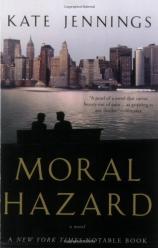
Moral Hazard
A Novel
by Kate Jennings

List Price: $11.95
Pages: 192
Format: Paperback
ISBN: 0007154623
Publisher: Fourth Estate

Click here to buy this book from Amazon.com.
Click here to buy this book from Amazon.ca.


About This Book


In the world of high finance, reflects Cath, women are about as welcome as fleas in a sleeping bag. She's in a unique position to note this fact. A confirmed liberal who can scarcely contain her own sarcastic wit, she is a spy in the house of Mammon: a speechwriter for self-important plutocrats, disguising their greed with lulling words. Cath has found herself on Wall Street because she needs serious money. After ten good years, her beloved husband, Bailey, is suffering from a tragically early case of Alzheimer's.

So begins Cath's journey into two nightmare worlds. Caught between them, she must grasp at whatever will keep her from falling apart -- even if that means risking moral hazard.

Kate Jennings' prose is lean yet rich in telling detail. Tense and compulsively readable, Moral Hazard reveals the soap-bubble fragility of this closed world and the steely strength of the people who inhabit it.

top of the page


rgg_discuss.gif (1294 bytes)


Being liberal:

1. Cath refers to herself as a bedrock feminist, a garden-variety fatalist, as someone who despises sentimentality. Do you think these assessments are fair? How would you describe her personality?

2. Hanny assures Cath that Wall Street will make her a conservative. Do you think there's any truth to what Hanny has said? In what ways, do you think Cath's personality changes throughout the novel?

Judgment:

3. In the first summer of Bailey's disease, Cath says that she left the apartment for work every day and felt, against all reason, that "life had possibilities". Do you have any idea why she might feel that way? Do you think there's anything she likes about working on Wall Street? How would you describe Cath's attitude toward the majority of her coworkers?

4. Mike refers to Horace as a complex character. What do you think of Horace? Why do you think it's so important for Cath to be liked by Horace?

5. What do you think about the fact that Cath "sells Mike out" to Horace?

Jargon:

6. When discussing the math of derivatives, Mike says that "you have to understand the subtleties." Later in the novel the Niedecker CEO uses the same phrase when talking about Russia defaulting on its loans. Do you think that either of these characters "understands the subtleties"? How would you describe Cath's attitude towards the use of this phrase? In what ways do you think this novel may be about "understanding the subtleties"?

7. Cath talks about hating words like strategize, going forward, proactive, paradigm, incentivize, added value, comfort level, outside of the box. Do you think there's any use for these kinds of words in the business world?

7. What do you think the phrase "moral hazard" means? In what ways, do you think it's an appropriate title for this book?

Being of Sound Mind:

9. At the very beginning of the novel, Cath mentions that Bailey's mother was an outspoken member of the Hemlock Society, who took her own life rather than enter a nursing home. She also says that Bailey often talked about his mother's courage as well as his own commitment to 'dignity in death'. With this in mind, what do you think about Cath's decision to put Bailey in a nursing home "against the wishes he expressed when of whole mind"? Do you feel that Bailey's life ends in accordance with his wishes?

Marriage:

10. Little is said about Cath's marriage to Bailey before he started showing signs of Alzheimers, except that they had ten good years but also had their problems. Based on what you do know about Cath and Bailey, would you expect them to have a good marriage? What kinds of problems do you think they may have had?

11. Cath says she agrees with George Eliot's claim that "marriage is awful in nearness", that husband and wife are "yoked together, bound in a three legged race with no finish line". How do you feel about this take on marriage?

Take-aways:

12. Cath insists that she hasn't learned anything from the experience of working on Wall Street, except that daily life is what gets you through the most unbearable situations. What do you think about this statement? What do you think about the novel's ending?

top of the page

Critical Praise

"One of those rare, subtle books that has more power because of it's understatement."
Brookline Booksmith


"An elegantly slim volume...with objectivity, humor and refreshing irony."
Times Literary Supplement (London)


"Powerful...darkly, disconcertingly comic...Jennings' disturbing and memorable novel builds quietly to its thought-provoking climax."
London Sunday Times


"American readers will feel themselves fortunate to make the acquaintance of a writer like Kate Jennings.
—Carol Shields, New York Times Book Review


"A powerful fable of personal tragedy and valiant survival: Kate Jennings's wit and intelligence ring true on every page.
—Maureen Howard


"An ideal subway read for smart working men and women."
Publishers Weekly (starred review)


"A unique book by an extraordinary writer: the great city illuminated from within."
—Shirley Hazzard


"I trust every word that comes from this supremely clear–eyed author."
—Les Murray


"A timely, exquisitely written novel."
Booklist


"A most impressive achievement."
—Peter Singer

 
Facebook Fan Page  Follow us on Twitter


Add Your Guide to ReadingGroupGuides.com!

Bookreporter.com Bets On...: Books We're Betting You'll Love


Privacy Policy | Contact Us | Advertising | About Us

© Copyright 2001-2012, ReadingGroupGuides.com. All rights reserved.
The Book Report, Inc. • 250 West 57th Street • Suite 1228 • New York, NY • 10107
Ph: 212-246-3100 • Fax: 212-246-4640

Bookreporter.comReadingGroupGuides.comGraphicNovelReporter.comFaithfulReader.com
Teenreads.comKidsreads.comAuthorsOnTheWeb.com