|
|
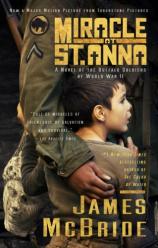
Miracle at St. Anna
by James McBride
List Price: $14.00
Pages: 304
Format: Paperback
ISBN: 1573229717
Publisher: Riverhead Books
With his bestselling memoir The Color of Water, James McBride created a fascinating story of growing up in the projects of Red Hook, Brooklyn and a vivid portrait of his indomitable mother. Now, in his first novel, he broadens his scope from personal history to the larger history of WWII and the little known role that black soldiers played in it.
The story begins in 1983 with the abrupt and unexplained shooting by Hector Negron, a New York City postal employee, of a man who wanted only to purchase a stamp. Why Hector has killed this man and how he came to possess the head of the statue of the Primavera, which had adorned the Santa Trinita bridge in Florence since the sixteenth century, is the mystery that Miracle at St. Anna sets out, in a most circuitous fashion, to solve.
Stepping back forty years, the novel plunges us into the world of the all-Negro 92nd Division, into the fierce fighting of WWII in the mountains of Italy, and into the hearts and minds of four unforgettable soldiers. It is a war in which the unquestioned racial attitudes of 1940s America take on life-and-death consequences on the battlefield, as white commanders willfully jeopardize their black troops. It is, as private Bishop says, "a white man's war.... Niggers ain't got nothing to do with it." But when Sam Train, an illiterate giant of a soldier from North Carolina, saves a white Italian boy from the invading Germans, a journey begins that will take Sam, Bishop, Hector Negron, and Lieutenant Stamps far from their Division commanders to the remote mountain village of St. Anna di Stazzema. Here they will encounter the village witch, a beautiful young woman, partisan fighters led by the legendary "Black Butterfly," and an Italian family that treats them with an equality they have never before experienced. More importantly, it is here, in the aftermath of a brutal Nazi massacre, that they will witness miracles and make the powerful discovery that "everybody got something to do with everything."
With a view of the war that is both panoramic in its sweep and deeply personal in its exploration of the human spirit, Miracle at St. Anna brings to life a largely overlooked historical moment and extends the reach of James McBride's considerable storytelling powers.
top of the page

1. Why do you think McBride chose to frame his WWII story with the post office episode that takes place in 1983? How does this narrative frame clarify or comment on the picture of the war it contains?
2. What knowledge of the African American experience in WWII did you bring to Miracle at St. Anna? How did reading the novel deepen your understanding of this aspect of the war?
3. In a fiery argument with Stamps, Bishop says, "So now the great white father sends you out here to shoot Germans so he can hang you back home for looking at his woman wrong.... The Negro don't have doodleysquat to do with this...this devilment, this war-to-free-the-world shit" [p. 147-9]. In what ways does the war reveal the racism and hypocrisy entrenched in American society? How are the black soldiers treated by their white commanders? How are they treated by the Italians? Is Bishop's cynicism justified?
4. Why does Train become so attached to the young Italian boy he rescues? What does the boy offer him that he's never had before? What does Train learn from him? Is the boy, as Train claims, "an angel"?
5. The novel is titled Miracle at St. Anna but several miracles occur in the book. Which of these is the miracle referred to in the title? What effects do these events have on those who experience them? Do you think McBride wants us to read them as divine manifestations of God's power or simply as remarkable occurrences?
6. Why does Rudolfo betray the Italian partisan hero Peppi, the "Black Butterfly"? What are the consequences of that betrayal? How is Rudolfo's treachery revealed?
7. Why does McBride tell the history of the statue's head that Train carries with him throughout the war? What does this history add to the story? Is it possible to read the entire novel as a complex elaboration of that statue's journey from a sixteenth-century marble mountain in Carrara, Italy, to late twentieth-century New York City?
8. In the Acknowledgments, McBride says that the book began when he was boy listening to his stepfather and step-uncles tell stories about the war. What struck him most forcefully was not the stories themselves but his Uncle Henry's pride in his service. In what ways does the novelóand its stories of the Buffalo Soldiers of the 92nd Divisionóreflect that pride?
9. Train, Stamps, Bishop, and Hector are four distinctive and vividly drawn characters. How are they different from one another? What varying attitudes do they have about the war? What larger themes does McBride address through the conflict between Bishop and Stamps?
10. In a moment of mistrust of the Italians, Hector thinks: "He was glad he didn't love anybody. It was easier, safer, not to love somebody, not to have children and raise kids in this crummy world where a Puerto Rican wants to kill an innocent woman for doing nothing more than trying to help him" [p. 138]. Why would Hector feel this way? In what sense is the entire novel about love and the risk of loving?
top of the page

"McBride creates an intricate mosaic of narratives that ultimately becomes about betrayal and the complex moral landscape of war."
The New York Times Book Review
"Full of miracles of friendship, of salvation and survival."
Los Angeles Times
"Searingly, soaringly beautiful
The book's central theme, its essence, is a celebration of the human capacity for love"
The Baltimore Sun
"McBride is adept at describing the wartime state of mind: land and people lying ravaged in the wake of a wild brutality
The author is also skilled at capturing those almost epiphanic moments that seem to happen so often during wars, when ships pass briefly in the night. At these moments, his narrative,
which is based on a true story, plunges straight to the heart."
San Francisco Chronicle
"McBride makes an impressive foray into fiction with a multi-shaded WWII tale
a haunting meditation on faith that is also a crack military thriller...strikingly cinematic
with nods to Ralph Ellison and Gabriel
Garcia Marquez, McBride creates a mesmerizing concoction
a miracle in itself."
Entertainment Weekly
"James McBride
brings formidable storytelling skills and lyrical imagination to his novel
[He] deftly broadens the landscape of his drama by entering the minds of a range of supporting characters: Italian
freedom fighters, white army officers, starving villagers, a clairvoyant, and even a 16th-century
sculptor."
Minneapolis Star Tribune
"An outstanding novel about World War II inspired by the famous Buffalo Soldiers...so descriptive that I feel as though I'm an eyewitness to everything that happens emotionally on the frontline. The work provides us
with a lesson not only about history but also about humanity and heroism."
The Dallas Morning News
"A miracle in its own right
McBride's prose is stunning. His ability to bring to life an actual historical event (the massacre at St. Anna and the famed Buffalo Soldiers of the 92nd Division) is a gift
McBride is able to make it work, with the understanding that true miracles happen within ourselves."
Denver Rocky Mountain News
"McBride's descriptions of the almost unavoidable, myth-infested Apuan Alpsterrain as beautiful as it is unbearableare seething poetry. His reconstruction of historyfrom Florentine politics and tribalism
to marble quarrying and sculptureare masterful. McBride's empathy for his fellow human is as affecting as the poetry of his prose. He makes his reader...feel the pain, terror, anguish, self-doubt of his characters. The book's central theme, its essence, is a celebration of the human capacity for love. Even in the course of virtually
unbearable warfare and deprivation...people are able to touch each other, to care. That, McBride insists, is the enduring, immortal miracle of the human race for all its imperfections."
The Baltimore Sun
"Great-hearted, hopeful, and deeply imaginative."
Elle
"McBride has taken a bold leap into fiction. [He] goes deep into each character and takes you with him. His rich description of the landscape...transports you into this world. It's a great piece of storytelling. I cried. I laughed. I hated finishing this book."
Albuquerque Tribune
"McBride has the enviable capacity to enlarge and complicate his readers' understanding of what it means to be human. McBride, who delivered a beautifully nuanced portrait of racial relations in his memoir, The Color of Water, brings the same humanity and understanding to his exploration of the complicated relationships between black soldiers and their white commanders in this novel."
BookPage
"A sweetly compelling novel. McBride combines elements of history, mythology and magical realism to make this a story about the little things like life and forgiveness and shared experience."
Atlanta Journal Constitution
"Miracle at St. Anna powerfully examines the horrors of history and finds an unexpected wealth of goodness and compassion in the human soul."
Newark Star-Ledger
"The miracles of survival, of love born in extremity, and of inexplicable 'luck' are the subjects of this first novel. [Miracle at St. Anna] is true to the stark realities of racial politics yet has an eye to justice and hope."
Library Journal (starred review)
"Riveting."
Newsday
"Roars ahead kicking and screaming to the finish, lightening-lit with rage and tenderness."
The San Francisco Chronicle
"A powerful and emotional novel of black American soldiers fighting the German army in the mountains of Italy. This is a refreshingly ambitious story of men facing the enemy in front and racial prejudice behind
Through his sharply drawn characters, McBride exposes racism, guilt, courage, revenge and forgiveness, with the soldiers confronting their own fear and rage in surprisingly personal ways at the decisive moment in their lives."
Publishers Weekly
"A tale of hardship and horror as well as nobility andyesmiracles, during the Italian campaign in World War II."
Philadelphia Daily News
"World War II provides a dazzling backdrop for James McBride's first novel."
Savoy
"A brutal and moving first novel
McBride's heart is on his sleeve, but these days it looks just right."
Kirkus Reviews
|
|