Reading Group Guide
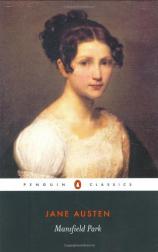
Mansfield Park
by Jane Austen

List Price: $7.00
Pages: 560
Format: Paperback
ISBN: 0141439807
Publisher: Penguin Classics

Click here to buy this book from Amazon.com.
Click here to buy this book from Amazon.ca.


About This Book


(Excerpted from The Jane Austen Book Club)

Mansfield Park was written between 1811 and 1813, and published in 1814. It marks Austen's return to novel writing after an interruption of more than a decade.

Ten-year-old Fanny Price is taken from her impoverished home to the estate of her wealthy aunt and uncle Bertram. There she is tormented by her aunt Norris, disliked by her cousins Tom, Maria, and Julia, and befriended only by her cousin Edmund. Her position is less than a daughter, more like a servant. Years pass. Fanny grows up shrinking and sickly (though very pretty).

While Uncle Bertram is away on business, Henry and Mary Crawford come to stay at the nearby parsonage. The Crawfords, brother and sister, are lively and charming. Both Maria and Julia are taken with Henry. Edmund is equally smitten with Mary.

Amateur theatricals are planned, then cancelled by Uncle Bertram's return. But the rehearsals have already encouraged several damaging flirtations. Maria, humiliated by Henry's lack of real interest, marries Mr. Rushworth, a wealthy buffoon.

Henry then falls in love with shy Fanny. She refuses the advantageous match and, as punishment, is sent back to her parents. Henry pursues her for a time, then has an affair with Maria that results in her disgrace. Edmund's eyes are opened by Mary's casual response to this.

Tom, the eldest Bertram cousin, nearly dies of vice and dissipation; Fanny is fetched back to Mansfield Park to help nurse him. At the end of the book, Edmund and Fanny marry. They seem well suited to each other, though not, as Kingsley Amis has pointed out, the sort of people you would like to have over for dinner.

top of the page


rgg_discuss.gif (1294 bytes)


1. Mansfield Park was written after a silence of more than a decade. During this period, Austen moved several times, saw the deaths of her father and a potential suitor, and became the dependent old maid we find so often among her more pitiable characters. The Napoleonic Wars continued; England embarked on imperialistic adventures. Austen followed both with interest. Do you see evidence of these things in the novel?

2. At the heart of its plot, Mansfield Park has three sisters. What kind of family life do you imagine would account for Mrs. Bertram and Mrs. Norris and Mrs. Price? Find something good to say about Mrs. Norris.

3. Fanny is an Austen heroine who, throughout the course of the book, has nothing to learn. In this she stands in sharp contrast to Emma Woodhouse. Do you like Fanny as well as you like Emma? Less? More?

4. In one of the book's most famous scenes, Fanny sits wilted in the heat at the Rushworth's estate, while the other characters come and go around her. Discuss the ways this epitomizes the entire plot of the book.

5. The various roles played in The Lover's Vows often result in Austen characters who are, under the cover of the play, allowed to act in ways more congruent with their real natures than polite society permits. They perform themselves.

Meanwhile, William H. Galperin suggests that, when Fanny Price insists she cannot act, she is actually demonstrating her "inability to know one is always acting." Galperin speaks of "a fundamental duplicity in which one literally performs one's inability to act."

Think about this until your head explodes.

6. Plato has suggested that one cannot be both a good actor and a good citizen. What do you imagine he meant? Discuss the relevance of this to Mansfield Park.

7. In most books, the villains are identifiable through their mistreatment of the hero/heroine. In Mansfield Park, the Crawfords are among the tiny handful of people who see the value of Fanny Price. Are they ever unkind to her?

Why is Fanny so little moved by their interest and esteem?

In your opinion, is any of this esteem genuine?

8. The Crawfords are superficially the most attractive characters in the book. Where do their virtues become vices? Answer the same question with regard to Fanny and Edmund.

9. Kingsley Amis said, "Edmund and Fanny are both morally detestable and the endorsement of their feelings and behavior by the author . . . makes Mansfield Park an immoral book." Do you agree? Is there any difference in your mind between Austen herself and the book's narrator?

10. Earlier Austen novels suggest a society in positive transformation; earlier heroines struggle towards the possibility of improvement. In contrast, Mansfield Park is about a society threatened with transformation. Fanny Price makes no positive movement. She protects Mansfield Park by her resistance, by her refusal to change. In the end, the society represented by the estate of Mansfield Park will not and cannot be saved? What in that society seemed valuable to you? Is there anything to regret about its loss?

top of the page

 
Back to top.   


Privacy Policy | Contact Us | Advertising | About Us

© Copyright 2001-2009, ReadingGroupGuides.com. All rights reserved.
The Book Report, Inc. • 250 West 57th Street • Suite 1228 • New York, NY • 10107
Ph: 212-246-3100 • Fax: 212-246-4640

Bookreporter.comReadingGroupGuides.comGraphicNovelReporter.comFaithfulReader.com
Teenreads.comKidsreads.comAuthorsOnTheWeb.comAuthorYellowPages.com