IndieBound Independent Bookstores BRC Facebook Fan Page
Coming Soon
Reading Group Guide
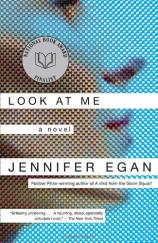
Look at Me
A Novel
by Jennifer Egan

List Price: $14.00
Pages: 432
Format: Paperback
ISBN: 0385721358
Publisher: Anchor Books

Click here to buy this book from Amazon.com.
Click here to buy this book from Amazon.ca.


About This Book


Questions of identity in an age marked by a preoccupation with appearances permeate Look at Me, which takes place in a time in which the most frightful aspects of the virtual revolution have entirely derailed age-old notions of self and identity. Egan's horrifying look at a world in which commercial viability far outweighs humanitarian concerns is punctuated by fleeting, almost wistful glimpses of people who are far enough removed from the epicenter of the information age that they have escaped, at least for now, its ravages. There is young Charlotte, daughter of Charlotte Swenson's girlhood friend, who traverses the rural landscape of her Midwestern town with a steamy sexuality untouched by time. There is Moose, the erstwhile football hero whose glory days have slipped away, leaving him obsessed with a mysterious vision of the historical, industrial age, an age of purity and hope that somehow gave rise to today's technological excess. And there is the enigmatic Michael West, who repeatedly exchanges one way of life for another in an endless quest for what he believes is revenge, but in fact is something else.

Have you ever wondered what might become of your essential self if the surface were torn away? Have you pondered the difference between the face you present to the world and the reality you carry inside? Jennifer Egan's multifaceted portrait of a fashion model who finds herself suddenly confronting such questions invites us to evaluate our most deeply held notions of identity and challenges us to examine the price we pay for the furious pace of modern life.

top of the page


rgg_discuss.gif (1294 bytes)


1. "I was not Rockford—I was its opposite, whatever that might be," Charlotte declares. In Charlotte's mind, what does Rockford represent? How is her chosen path a reaction to her place of birth? Is her return to Rockford at the end of the book merely circumstantial, or does it represent a symbolic shift in her perception of her hometown?

2. Charlotte describes her notion of the shadow self as, "that caricature that clings to each of us, revealing itself in odd moments when we laugh or fall still, staring brazenly from certain bad photographs." Why does this concept interest Charlotte, and what does that reveal about her character? What do you imagine Charlotte's shadow self looks like? Does it change after her accident?

3. Many of the characters in Look at Me undergo major transformations—whether during the course of the novel or before it begins. In what specific ways do the characters change, and how do these changes affect their lives? Which transformations do you find most surprising? How is the idea of transformation linked to the novel's larger thematic concerns about identity and self?

4. Discuss Z/Michael West. For what is he searching, and what does he find? How does his personal journey mirror Charlotte Swenson's?

5. While recuperating from her accident and subsequent surgery, Charlotte allows none of her friends or acquaintances to see her. Once people see you in a weakened state, she claims, they'll never forget, "and long after you've regained your vitality, after you yourself have forgotten these exhibits of your weakness, they'll look at you and still see them." How does this statement reflect Charlotte's worldview at the beginning of the book? Is she right? Is her perspective borne out over the course of the novel, or does it evolve?

6. Misperceptions and misunderstandings play a crucial role in the plot of Look at Me; characters often reach for something they believe they see in one another, only to find that they were mistaken, or even purposely deceived. Identify some of these misunderstandings and talk about their significance to the novel as a whole.

7. Charlotte says, "information was not a thing—it was colorless, odorless, shapeless, and therefore indestructible. There was no way to retrieve or void it, no way to halt its proliferation." Compare this statement to Moose's idea that "now the world's blindness came from too much sight, appearances disjoined from anything real, afloat upon nothing, in the service of nothing, cut off from every source of blood and life." What is the connection between these two statements? Do they present differing views of the world or simply different interpretations of the same problem? In the end, does Look at Me seem to sanction them or call them into question?

8. Despite his apparent instability, there is a peculiar beauty in Moose's striving for vision and in his efforts to communicate that vision to the young Charlotte. For what is he looking? Define, if you can, his odd emotional and spiritual response to industrial and historical events. When Moose experiences his vision once again at the end of the novel, what exactly do you think he sees?

9. Discuss Charlotte's relationship with Irene Maitlock. What is it about Irene that draws Charlotte to her? Do you see any connection between this relationship and Charlotte's friendship with Ellen Metcalf? How does Charlotte and Irene's relationship change over the course of the book?

10. All of the characters in Egan's novel deal differently with the concept of memory: Michael West allows himself just one memory a day, Charlotte shuns her memories, and Moose exists in a world saturated by memories of his own life, along with imagined recollections of an earlier historical time. What connection does the novel suggest between personal memory and cultural memory? How do you suppose the young Charlotte might feel about her memories twenty years down the road?

11. Look at Me begins by recounting Charlotte Swenson and Ellen Metcalf's girlhood sexual misadventures. At the end of the novel, Charlotte and Ellen meet again, in very different circumstances. Talk about both women's experiences in the interim, and about the significance of their last meeting. Did it satisfy you?

12. At the end of the novel, Charlotte demurs, "As for myself, I'd rather not say very much." Indeed, the novel seems intentionally to leave us without a clear sense of what the future holds for its characters. Why do you think Egan has chosen to end her book so ambiguously? What sorts of lives will the Charlottes, Ellen Metcalf/Hauser, Z, Moose, Ricky, and Irene Maitlock go on to live?

13. Do you feel that Look at Me, with its depiction of how behind-the-scenes events contribute in the making of public images, will have any impact on the way you perceive celebrities?

14. Do you consider Look at Me—in particular, its brutal portrayal of the modeling world—a futuristic novel? Or can it be read it as a fairly accurate look at our present, evolving world? Might there be some way of escaping some of the disturbing scenes Egan describes?

top of the page

Critical Praise

"Brilliantly unnerving… A haunting, sharp, splendidly articulate novel."
The New York Times


"Comic, richly imagined, and stunningly written… An energetic, unorthodox, quintessentially American vision of America."
The New Yorker


"Look at Me is so engrossing, energetic, sharp, and funny, it reminded me of Ralph Ellison's masterpiece, Invisible Man."
—Maureen Corrigan, Fresh Air (NPR)


"Arresting… Look at Me is the real thing–brave, honest, unflinching. [It] is itself a mirror in which we can clearly see the true face of the times in which we live."
—Francine Prose, The New York Observer


"Egan limns the mysteries of human identity and the stranglehold our image-obsessed culture has on us all in this complicated and wildly ambitious novel."
Newsweek


"Intriguing… . An unlikely blend of tabloid luridness and brainy cultural commentary… . The novel's uncanny prescience gives Look at Me a rare urgency."
Time


"Egan has created some compelling characters and written provocative meditations on our times… . [She] has captured our culture in its edge-city awfulness."
The Washington Post Book World


"Look at Me is a complicated novel … but the questions it raises are worth following a lifetime of labyrinths toward the answers."
Los Angeles Times


"Ambitious, swiftly paced… . Egan writes with such shimmering élan that it's easy to follow her cast on its journey."
The Wall Street Journal


"Prescient and provocative… . The characters … jump from the pages and dare you to care about them… . The prose is crisp and precise… . The pieces fit together at the end with a satisfying click."
Philadelphia Inquirer


"Impressive… . Few recent books have so eloquently demonstrated how often fiction, in its visionary form, speaks of truth."
Salon.com


"Look at Me makes us think about our trust in the images that bombard us, and what we give away in the process."
Chicago Tribune


"Egan's rich new novel … is about bigger things: double lives; secret selves; the difficulty of really seeing anything in a world so flooded with images."
The Nation


"Stunning… . This is more than a story, it's a thought-world, a novel of ideas brilliantly cloaked in the skin of characters."
The Sunday Oregonian


"Egan's take … is surreal and profoundly ironic and exaggerated, but it still rings true… . Beneath it all, she finds characters worth saving."
Hartford Courant


"Breathtaking… . Combines the tautness of a good mystery with the measured, exquisitely articulated detail and emotional landscape of the most literary of narratives… . Sure to leave readers thinking about these very real characters for some time to come."
BookPage


"An imaginative, well-paced read with serious questions about the elusiveness of meaning inside the gilded cage. Egan has intelligence to burn but plenty of feeling too."
People


"Part mystery, part cultural critique, [Look at Me] … build[s] to a conclusion that is unexpected and disturbing, and mak[es] an incisive statement about our society's obsession with fame and glamour."
San Francisco Chronicle


"Riveting… . As the book gains momentum, Egan's writing is both fluid and driven, with wonderful slashes of satire… . A remarkable study of our culture … and of our palpable need to be known."
O: The Oprah Magazine


"Egan has created a compelling world… . With [her] graceful prose and vivid characterizations, she navigates her plot lines' churning waters with admirable skill."
Seattle Weekly


"[A] scintillating inquiry into the complex and profound dynamics of perception… . Egan … animates a superb cast of intriguing and unpredictable characters, and tells an elegantly structured, emotionally arresting and slyly suspenseful story."
Newsday


"Dark, hugely ambitious… . As riveting as a roadside wreck –and noxiously, scathingly funny."
Elle


"Intelligent and refreshingly dark, Egan's eerie tale has the same mesmerizing pull as the culture it skewers."
Us Weekly


"This masterfully plotted work bears the stamp of a perceptive–if not clairvoyant–writer whose disturbing vision … rings all too true."
SF Weekly


"Egan's ability to move with ease between sincerity and satire sets Look at Me apart… . Her authentic-feeling details give a sense of unusual immediacy."
Vogue


Privacy Policy | Contact Us | Advertising | About Us

© Copyright 2001-2010, ReadingGroupGuides.com. All rights reserved.
The Book Report, Inc. • 250 West 57th Street • Suite 1228 • New York, NY • 10107
Ph: 212-246-3100 • Fax: 212-246-4640

Bookreporter.comReadingGroupGuides.comGraphicNovelReporter.comFaithfulReader.com
Teenreads.comKidsreads.comAuthorsOnTheWeb.comAuthorYellowPages.com