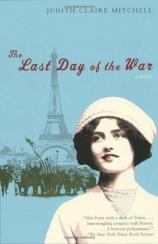
The Last Day of the War
A Novel
by Judith Claire Mitchell
List Price: $14.00
Pages: 384
Format: Paperback
ISBN: 038572201X
Publisher: Anchor
This exciting debut novel is the love story of a Jewish girl and an Armenian-American soldier who together enter a maze of underground politics at the conclusion of the First World War.
Yael Weiss, an eighteen-year-old from St. Louis, reinvents herself as the twenty-five-year-old Methodist Yale White when she travels to Paris with the YMCA to work in a soldiers' canteen. Dub Hagopian --- the doughboy she has a carried a torch for all the way across the Atlantic --- is at once the patriotic child of immigrants from Rhode Island and, covertly, a member of Erinyes, an organization dedicated to avenging the Armenian massacres of 1915.
In her jaunty, engaging style, Mitchell captures the atmosphere of political carnival surrounding the Paris Peace Conference, where Yale, Dub, and their crowd gather, bursting with both the passionate ideals and the devil-may-care energy of youth. When they decamp to a château outside Paris, where Erinyes is hatching a radical plan and Armenian war orphans are billeted, Yale and Dub will face the largest decisions of their young lives.
A beautiful love story, The Last Day of the War is also a tragicomic farce about the workings of history and a testament to the moral fortitude of men and women swept up in the tide of their extraordinary times.
top of the page

1. Describe the structure of The Last Day of the War . Why has Mitchell divided her book into nine parts, three set in the US and six in Paris? How does she incorporate flashbacks into the chronological narrative to give the history of the characters? Discuss the various names of the chapters; what part do they play in the structure? What is the effect of the structure --- the way the story is told --- on you as a reader?
2. How has her Jewish and Midwestern background influenced Yale and her decisions? Is she at odds with her Jewish identity? Why does Yale feel compelled to lie about her age, religion, and name? How is she able to convince others of her masquerade?
3. The Last Day of the War is in many ways a coming-of-age story. How does Yale change over the course of one year from the day she steals a suit on her 18th birthday to the Paris Peace Conference, ending WWI? What has she learned and how has she matured in this year?
4. What meaning does Paris have for both Yale and Dub? How are they liberated and/or confined in Paris? What does each of them do in Paris that they would not have been able to do in the States?
5. At the end of the novel, Shusan declares: "He [Dub] could be any American boy." Do you agree? In what way are Yale and Dub outsiders? And how are they both essentially and ultimately American?
6. What attracts Yale and Dub to each other? Is it their otherness? Why does Yale romanticize Dub, and travel to Paris in the hope of finding him again? What does Dub feel for Yale? What does he feel for his girlfriend back home? Why does he feel indebted to Ramela? What does he owe Yale, if anything? Describe Yale and Dub's relationship, and discuss what draws them to each other.
7. How has Dub's Armenian immigrant experience in Providence influenced him? Can he ever separate himself from this identity of the Armenian-American immigrant and from the Armenian collective memory? How is it both liberating and a burden for Dub?
8. Describe Yale's friendship with Mary Brennan White. What do they share with and learn from each other? Does the presence of Dub and his Armenian friends strengthen or weaken their friendship? How have they both discovered themselves through the friendship?
9. What is the friendship between Dub and Raffi based on? How does it mirror or contrast with the friendship between Yale and Brennan?
10. Discuss the purpose and role of Aram Kazarian and his wife in the novel. What do they represent to Dub and his friends? What about their chateau? Describe it, and its importance in the novel not only as a safe haven from the chaotic world, but as an emotional hold on the characters. How does the outside world eventually sneak in?
11. Why does Amo Winston, the 40-year-old YMCA matron, pick on Yale and Brennan? What do they represent for her? How do they feel about her? How and why does their relationship change over the course of the novel?
12. Discuss the theme of revenge in the novel. Who wants revenge and why? Can anyone be innocent in war? What does Kerim Bay represent for Dub and Raffi? Discuss the plan to assassinate him, and what its outcome reveals about Dub and Raffi, and their relationship.
13. What role do lying and deception play in this novel?
14. Discuss the importance of names in the novel --- Yael Weiss/Yale White; Dub Hagopian; Mary Brennan White; Shushan; and others. What do their names reveal about the various characters?
15. The Last Day of the War is a historical novel. What did you learn about WWI and the early 20th century by reading this novel? How much did you know about the Armenian massacres before reading the book?
16. What is the significance of the title, The Last Day of the War?
top of the page

"When people say they love sinking into a great novel, The Last Day of the War is exactly the kind of book they crave. Judith Claire Mitchell's debut novel is an eloquent, sweeping, generous tale of war, love, history, deceit, and friendship, and it reads like the work of a seasoned novelist. Delicious, enveloping, and deeply affecting, The Last Day of the War is the kind of book that will be passed among readers for years to come."
--- Thisbe Nissen, author of The Good People of New York
"An engaging tale of humor and pathos and young love amid the rich tapestry of post-war France."
--- Seattle Post-Intelligencer
"Smart and entertaining...Like her heroine, Mitchell's debut novel is willfully charming, alternatively impudent and intense . . . "
--- Publishers Weekly
"Exceptional . . . This eloquent first novel encompasses the full spectrum of joy and torment that is the human condition."
--- Booklist
"A bravura performance . . . Intelligent . . . blistering . . . ntermingling romance with history, [it’s] Alan Furst with a dash of Tintin."
The New York Times Book Review
"Mitchell captures Europe after World War I with a seasoned writer's appreciation for the timeless appeal of a lost world. . . . An engaging tale of humor and pathos and young love amid the rich tapestry of post-war France."
Seattle Post-Intelligencer
"A sprawling, exciting love story. . . . This combination of love and war, history and revenge, makes for a thrilling read, one that lingers long after you finish it."
The Providence Journal
"Engaging. . . . Page-turning. . . . The work of a very good novelist."
Chicago Tribune