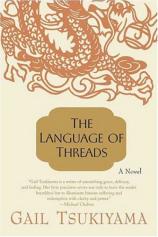
The Language of Threads


Review
The Language of Threads




With the Japanese invading China and threatening the lives of all its citizens, Pei, the young silk worker from Gail Tsukiyama's WOMEN OF THE SILK takes her young charge, Ji Shen, and makes for Hong Kong. Once there, however, her life changes irrevocably, forming the story of the author's just-published sequel, THE LANGUAGE OF THREADS.
Tsukiyama has a gentle, quiet, simple style of telling a story and does not digress from it with this novel. However, Pei's life at the silk factory was far more adventurous and exciting than her life will prove to be in Hong Kong. Staying with a former silk worker who vows to help all who have been part of the "sisterhood," Pei and her friend find a good mentor in Song Lee, who helps Pei get work in a well-respected Hong Kong household while the much younger Ji Shen is enrolled at a local school. When a jealous employee seeks and then accomplishes Pei's firing, the two young women from the silk factory are forced to find alternate means of making a living.
Pei and Ji Shen find refuge at the home of Mrs. Finch, an expatriate with whom they share the horrible and frightening experiences that come with the end of World War II. Bomb scares, blasts and power outages, and finally the nuclear attacks on Nagasaki and Hiroshima bring an end to the battles, but leave Hong Kong in the midst of a crazy time of reorganization and regrowth. Unfortunately, their dire circumstances throw Pei and, most especially, Ji Shen into the black market world of their friend Quan, the kindly rickshaw driver who has been their guide to the ways of the city since their arrival. However, with this deeper involvement in his activities, death and danger once again make their presence felt in Pei's life.
Tsukiyama handles the wartime aspects of the story with a steady hand, but ultimately the story lacks the warmth of WOMEN OF THE SILK. Pei's travels in this book are more adult and more difficult to manage --- often it feels as if her situations are too dire. However, later in the novel, when Pei finds out that her sister Li is still alive and searching for her, some of the warmth from the first book returns and love and hope reenter the picture. All in all, THE LANGUAGE OF THREADS is a solid read, slow in parts, but ultimately satisfying, as Pei finds her way in the postwar world of Hong Kong.
Reviewed by Jana Siciliano on January 22, 2011


The Language of Threads
- Publication Date: September 21, 2000
- Genres: Fiction, Literary Fiction
- Paperback: 288 pages
- Publisher: St. Martin's Griffin
- ISBN-10: 0312267568
- ISBN-13: 9780312267568