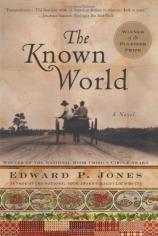
The Known World
A Novel
by Edward P. Jones
List Price: $24.95
Pages: 400
Format: Hardcover
ISBN: 0060557540
Publisher: Amistad
Henry Townsend, a black farmer, bootmaker, and former slave, has a fondness for Paradise Lost and an unusual mentor -- William Robbins, perhaps the most powerful man in antebellum Virginia's Manchester County. Under Robbins's tutelage, Henry becomes proprietor of his own plantation -- as well as of his own slaves. When he dies, his widow, Caldonia, succumbs to profound grief, and things begin to fall apart at their plantation: slaves take to escaping under the cover of night, and families who had once found love beneath the weight of slavery begin to betray one another. Beyond the Townsend estate, the known world also unravels: low-paid white patrollers stand watch as slave "speculators" sell free black people into slavery, and rumors of slave rebellions set white families against slaves who have served them for years.
An ambitious, luminously written novel that ranges seamlessly between the past and future and back again to the present, The Known World weaves together the lives of freed and enslaved blacks, whites, and Indians -- and allows all of us a deeper understanding of the enduring multidimensional world created by the institution of slavery.
top of the page

1. Why is the character of Moses significant to the novel? How would you characterize his relationship with Henry and Caldonia Townsend? What about with his wife and child?
2. What is the significance of the title, The Known World? What "known world" is charted in John Skiffington's map in the jail? What world is charted in The Creation described by Calvin in his letter to his sister Caldonia? What role does the land and its borders play in this book?
3. Who is William Robbins and how does he impact the lives of blacks on neighboring plantations? Did you find his relationships with Henry, Augustus, and Mildred Townsend, and Philomena, Dora, and Louis compelling?
4. What is the significance of the Augustus Townsend character? In what ways is Augustus a victim of attitudes about slavery in the South? In what ways is he a victor? How did you respond to his captivity and its outcome?
5. How would you characterize Jebediah Dickinson? What explains his sudden appearance at the Elston farm? When Fern says of Jebediah: "With him there ... I feel as if I belong to him, that I am his property," what does she mean?
6. Were relationships between parents and children notably different during the era of slavery than in the present day? Consider Caldonia, Calvin, and Maude; William Robbins, Patience, and Dora; and Augustus, Mildred, and Henry in your evaluations.
top of the page

"Stunning....His first novel is...likely to win acclaim."
The New York Times
"Heartbreaking....fascinating."
Newsweek
"A profoundly beautiful and insightful look at American slavery and human nature."
Booklist
"Beautifully written . . .[it] ought to enjoy the massive readership that Charles Frazier’s runaway hit, Cold Mountain did."
USA Today