IndieBound Independent Bookstores

Barnes & Noble


Loading
Reading Group Guide
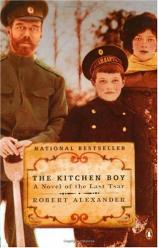
The Kitchen Boy
A Novel of the Last Tsar
by Robert Alexander

List Price: $14.00
Pages: 240
Format: Paperback
ISBN: 0142003816
Publisher: Penguin USA

Click here to buy this book from Amazon.com.
Click here to buy this book from Amazon.ca.


About This Book


The time: July 1918. The place: The town of Yekaterinburg, just on the Siberian side of the Ural Mountains. In the Ipatiev House, the former Tsar of Russia and his family live imprisoned by Bolshevik soldiers. As a loyalist army presses toward the town and the Romanovs pray for a rescue that will never come, their captors receive a stark authorization from Moscow: Nikolai, his wife, and their five children are all to be shot to death. This is the story, recounted in all its vivid and terrible drama, of Robert Alexander's novel The Kitchen Boy.

Although the general facts surrounding the captivity and murder of the Russian royal family have long been known, some key gaps in our knowledge have continued to raise curiosity and fuel speculation. When, in 1991, the secret mass grave of the Romanovs and four of their attendants was discovered, two bodies-those of the Tsarevich Alexei and his sister Grand Duchess Maria —were not found. Remaining unrecovered is a family suitcase packed with thirty-six pounds of priceless jewels. There was yet one other remarkable disappearance. Mere hours before the Romanovs and their servants were led to their deaths, the family's kitchen boy, fourteen-year-old Leonka Sednyov, was ordered away from the Ipatiev House. He was never heard from again.

Combining these mysteries with a meticulously researched body of facts, Robert Alexander has crafted a tale of intrigue, tragedy, and betrayal in which all appearances are utterly believable yet nothing is quite what it seems. The story is recounted by Misha Semyonov, a recent widower now in his nineties who fled to America during the tumult of the Russian Civil War. With death approaching, Misha wants to set the record straight for his granddaughter and for the world at large: he is none other than Leonka, the vanished kitchen boy. Eighty summers ago, he carried a series of secret messages between the ex-Tsar and a band of potential rescuers, and, on the night of July 16-17, 1918, he bore witness to the royal massacre. But Misha must face his own issues of guilt, truth, and deception. Although he has resolved to convey "a thousand truths" to his granddaughter, will he dare to disclose the ultimate, shattering facts of his own existence?

Seen through the youthful, astonished eyes of Leonka but told by the cynical, misanthropic voice of Misha, the novel allows the reader to know a family that discovered greater nobility in its squalid exile than it had ever known in the gilded palaces of St. Petersburg. But The Kitchen Boy is about more than history —it is also a deep and moving meditation on the nature of evil and the power of forgiveness.

top of the page


rgg_discuss.gif (1294 bytes)


1. How did you respond to Misha as a character? How did your feelings toward him change as you read the novel? Do you feel sympathy for him? Why or why not?

2. Misha's tape-recorded recollections are complicated by the passage of time. He observed events through the naïve eyes of a teenager, but he retells them from the perspective of a jaded elderly man. How does the distance between seeing and speaking affect his narration?

3. Misha is a man of harsh judgments —of his country, of Communism, and ultimately of himself. Do you agree with his judgments?

4. Early in the novel, Misha says that truth is one of the three values that enable America to save itself. Recognizing the saving power of truth as he does, why is Misha incapable of telling a true story? Would telling the truth make his salvation possible?

5. The Kitchen Boy describes both Nikolai and Aleksandra as being "blinded by religion," and it tells of one of the key episodes in the rise of an officially atheistic state. Nevertheless, can it be argued that The Kitchen Boy is, at heart, a religious novel?

6. In The Kitchen Boy, the Romanovs bear their sufferings with almost saintly forbearance. Does their acceptance of suffering make them nobler in your eyes, or does it merely deepen their status as pathetic victims of history? People sometimes talk about the redemptive power of suffering. Does suffering redeem anyone in this novel?

7. The Kitchen Boy offers a great deal of commentary on what Misha calls "the Russian soul." Did this novel help you toward a different understanding of what it means to be Russian? Nations are made up of millions of individuals, and yet those individuals do share an invisible connection. Is it possible to speak coherently about a national soul?

8. In Misha's view, "a great curse was unleashed" on the night of July 16-17, 1918, "inundating every corner of [his] vast homeland." In what sense can the subsequent path of Russian history be understood as being the product of a "curse"? Do other nations, America included, suffer beneath their own national curses?

9. Imagine The Kitchen Boy as the basis for a screenplay. Choose a scene and discuss how you, as the director, would want to film it.

10. Late in the novel, Misha reflects that forgiveness is "the last thing" he desires; he does not want it at all. Why is he unable to accept mercy?

11. What is your response to the ending of the novel? The "true" story of May and Misha may strike some readers as beautiful. Others may find it wildly improbable or even grotesque. Does their love strike you as a miracle, as an impossibility, or as something else?

12. The Kitchen Boy retells one of the most frequently told stories in twentieth-century history. Nevertheless, the novel succeeds in maintaining suspense. How does Robert Alexander accomplish this feat of storytelling?

top of the page

Critical Praise

"Ingenious...Keeps readers guessing through the final pages."
USA Today


"A gripping and entirely believable description of the last days of the Romanovs...Thoroughly enjoyable, educational, and just a good old-fashioned page-turner."
—Margaret George, author of Mary, Called Magdalene


"This is a dream of a book... [Robert Alexander's] tough, stylish prose is the perfect medium for this fast-becoming myth of evil and innocence, of frailty and courage, of betrayal and redemption."
—Judith Guest


"Through the power of the author's imagination, we see not only the tragedy of the Emperor, but that of a human being, man, and father."
—Ivan Artsyshevsky, The Romanov Family Association

 
Facebook Fan Page  Follow us on Twitter


Add Your Guide to ReadingGroupGuides.com!

Bookreporter.com Bets On...: Books We're Betting You'll Love


Privacy Policy | Contact Us | Advertising | About Us

© Copyright 2001-2013, ReadingGroupGuides.com. All rights reserved.
The Book Report, Inc. • 250 West 57th Street • Suite 1228 • New York, NY • 10107
Ph: 212-246-3100 • Fax: 212-246-4640

Bookreporter.comReadingGroupGuides.comGraphicNovelReporter.comFaithfulReader.com
Teenreads.comKidsreads.comAuthorsOnTheWeb.com